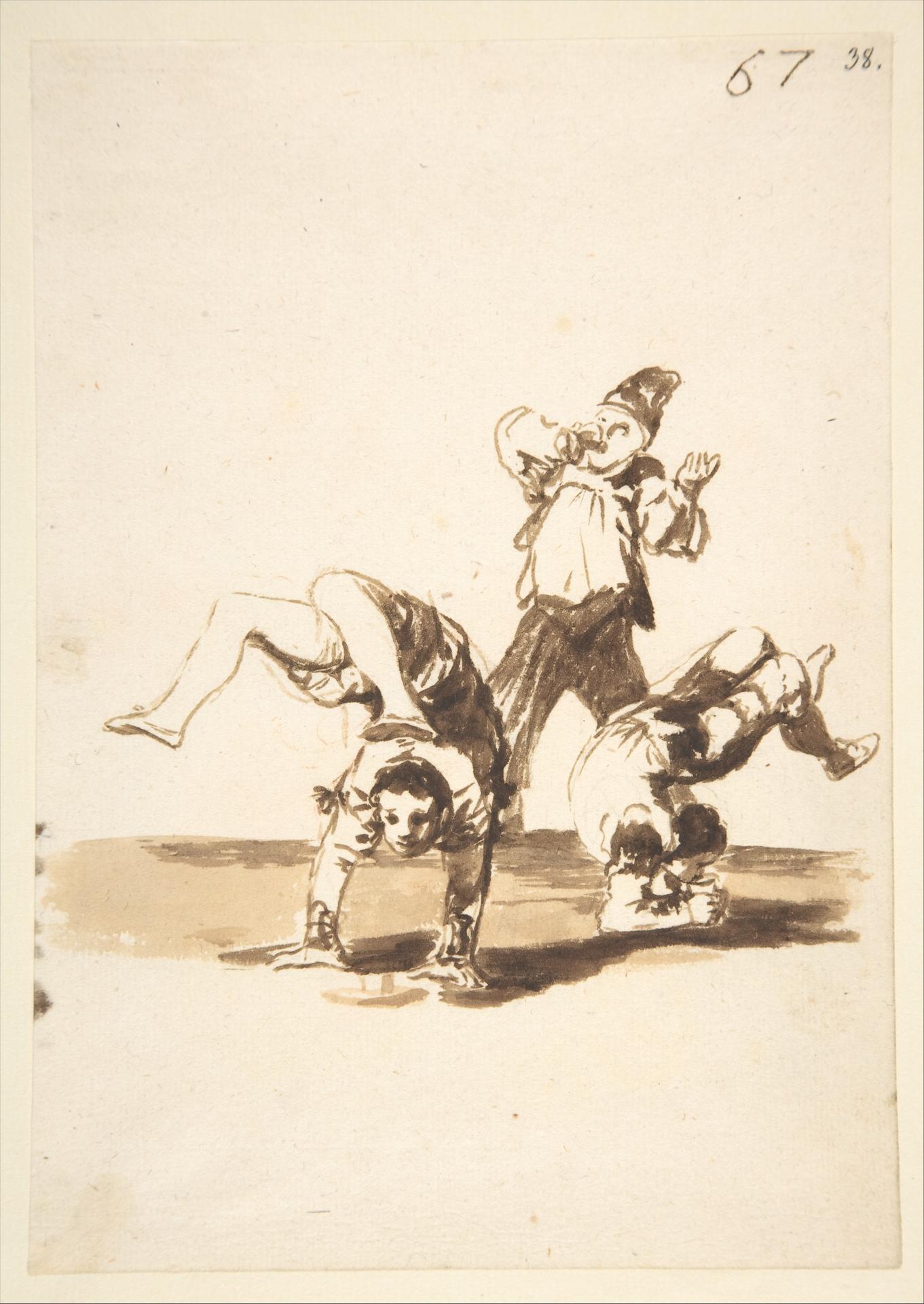
Three acrobats; page 67 from the "Images of Spain" Album (F)
Original title: Three acrobats; page 67 from the "Images of Spain" Album (F)
kurzbeschreibung
Three acrobats appear in a lively scene on this sheet by Francisco de Goya y Lucientes. The drawing dates from around 1812–20 and was made with brush and point of brush in brown ink washes, with traces of red and black chalk.
Description
Three acrobats shape the whole arrangement: one stands upright, another rests on hands and knees while holding a third who lies on the ground. Every figure wears plain dark clothing and a hat. The background stays empty, and the colour range is limited to brown and black tones, interspersed with red and black chalk marks. In the upper right are the numbers '67' and '38'.
Context
The sheet belongs to Goya's album 'Images of Spain' (F), a series of drawings made between 1812 and 1820. He used these albums as a personal sketchbook, recording scenes of Spanish daily life and observations of society. Acrobats appear several times in his late work.
Impact
The fluid brushstrokes make the movement spring out at once, lending the scene vividness despite the few colours. Because the clothing is plain and the background empty, the eye goes straight to the postures and the interplay between the figures.
Technique
The work was carried out with brush and point of brush in brown ink washes, supplemented by traces of red and black chalk. The shifting strokes create a lively texture and bring out the acrobats' sequences of movement.
AI-generated description text
Source: Metropolitan Museum of Art · Public Domain (CC0 1.0)