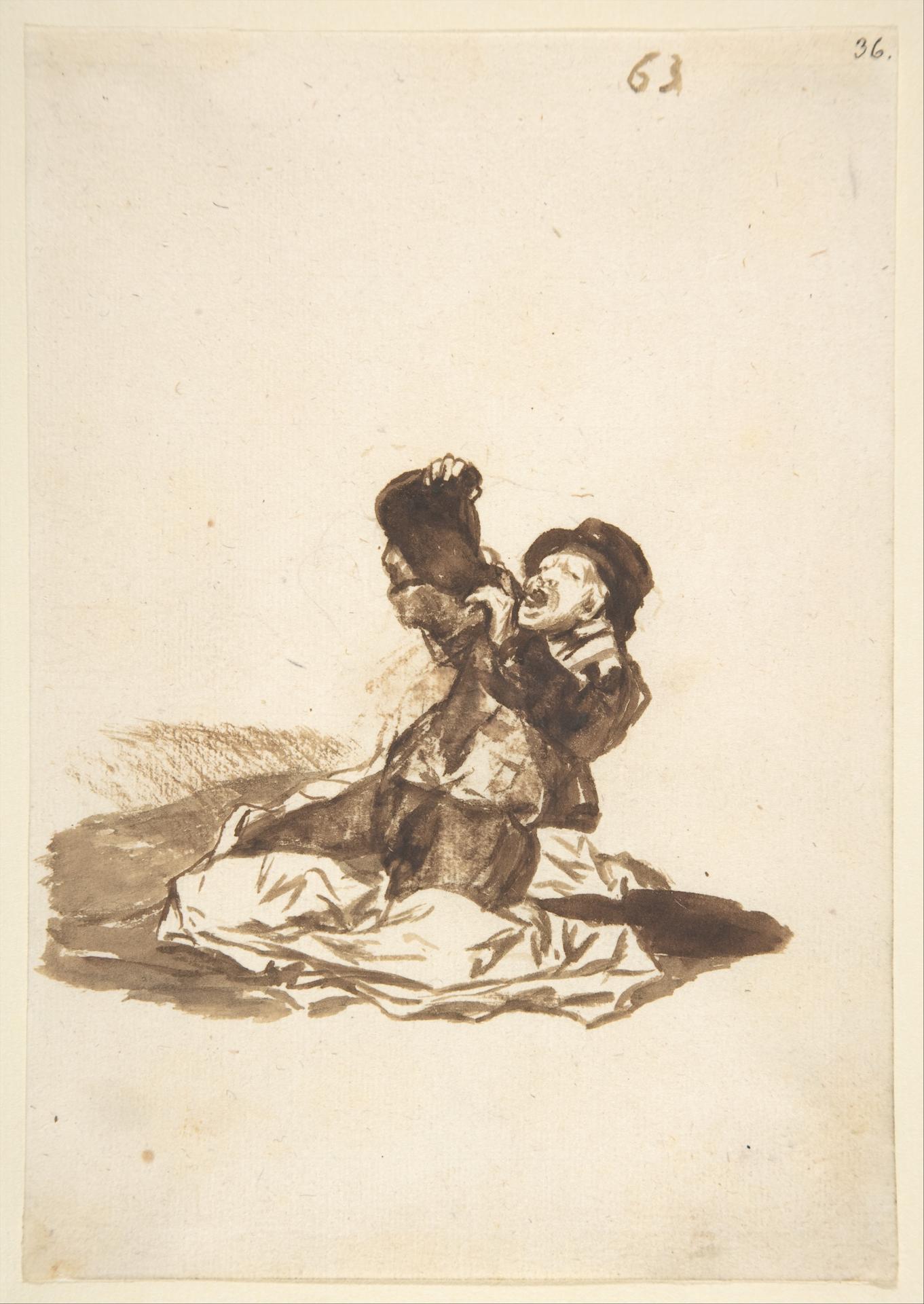
A man on the ground drinking from a wine skin; folio 63 from the 'Images of Spain' Album (F)
Original title: A man on the ground drinking from a wine skin; folio 63 from the "Images of Spain" Album (F)
kurzbeschreibung
A man squatting on the ground drinks from a wineskin, with a child seated beside him. This sheet is by Francisco de Goya and was probably made between 1812 and 1820. It is executed with brush and brown wash over traces of black chalk.
Description
On a white cloth spread on the ground, two figures have settled: a man in a dark cap and dark garment, who grips the wineskin with both hands, and a child in a striped top, to whom the man appears to be handing something. Behind them, the flat, indistinct edge of a landscape is suggested. Brown and gray tones dominate the image, underlaid by a hint of black chalk. The line remains fluid and nearly monochrome; the number 63 appears at the upper right.
Context
The sheet belongs to Goya's album 'Bilder von Spanien,' also known as Album F, made between 1812 and 1820. In this late phase, Goya created such albums and looked with increasing criticism at Spanish society. What is seen here is part of everyday life among ordinary people, a theme that recurs often in his late series. Exact dates are missing because Goya did not date the sheets and the sequence of the albums remains unclear to this day.
Impact
The restrained color and calm arrangement give the sheet something immediate and familiar. Because almost everything stays in one tone, the event takes on a serious, thoughtful quality that draws attention to the everyday life of the two figures. Simple in form yet expressive, the drawing brings the people close to the viewer while leaving room for personal interpretation.
Technique
Brush and brown wash over traces of black chalk allowed Goya to work quickly and spontaneously. The wash creates soft transitions and finely graded light; the chalk provided the contours as an underdrawing. This approach was characteristic of his album sheets, which often served as sketches or preparatory studies for larger works.
AI-generated description text
Source: Metropolitan Museum of Art · Public Domain (CC0 1.0)