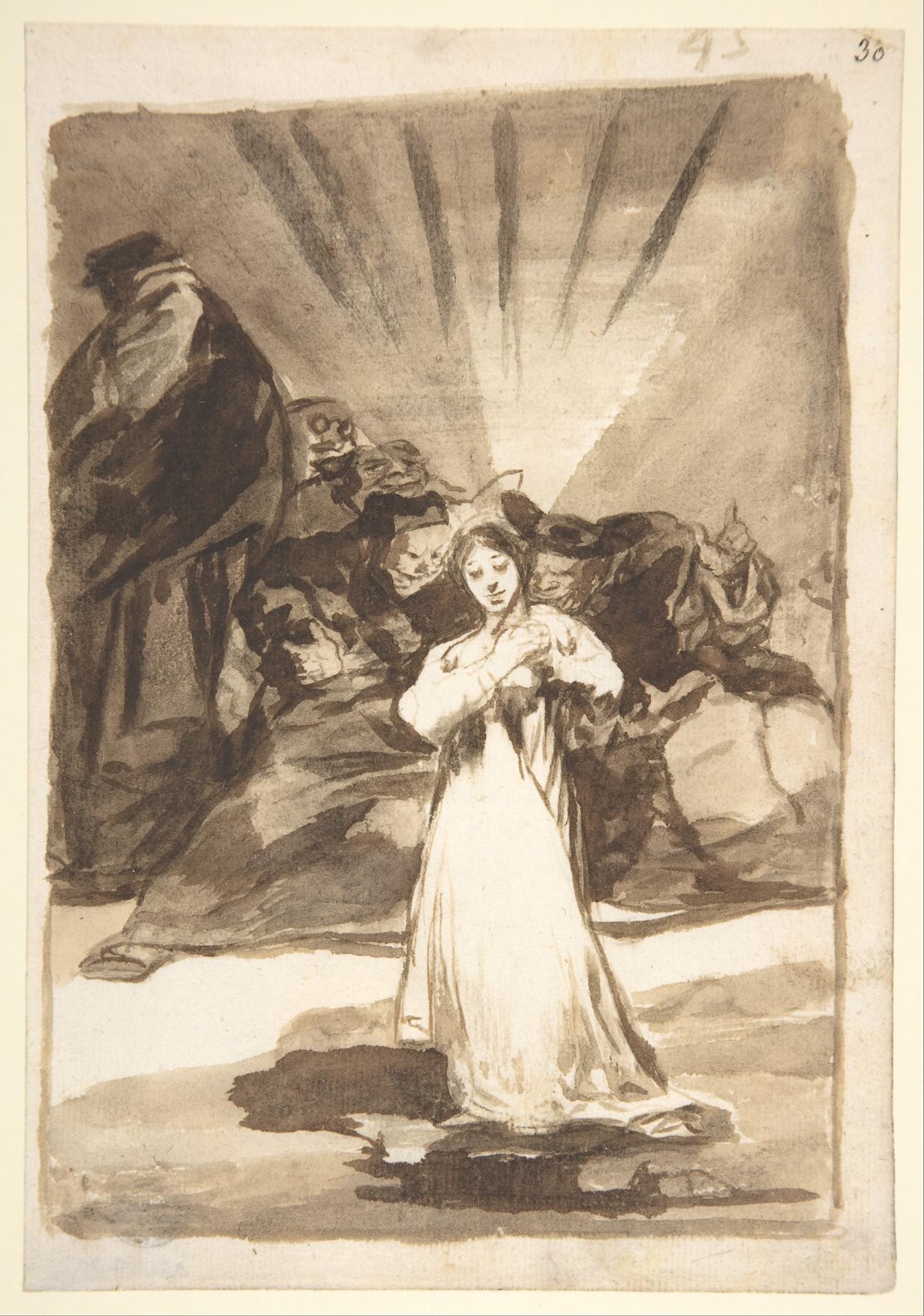
A radiant female figure beset by dark spirits; page 45 from the "Images of Spain" Album (F)
Original title: A radiant female figure beset by dark spirits; page 45 from the "Images of Spain" Album (F)
kurzbeschreibung
A brightly lit female figure stands surrounded by dark, shadowy beings. This sheet is by Francisco de Goya y Lucientes and dates from about 1812 to 1820. It is executed with brush and point of brush, with brown and gray washes over traces of chalk.
Description
In the foreground, the female figure wears a light garment that sets her sharply against the dark spirits. These appear in a wide range of postures and with changing expressions—some laugh, others scream, still others seem to whisper. A gloomy, dark ground further enhances the luminous figure's emergence. Light falls on her from above, giving her an almost sacred, divine quality. The layout is asymmetrical: the figure stands centrally, while the dark shapes crowd on the left side.
Context
This sheet belongs to Goya's album 'Pictures of Spain,' created around 1812 to 1820. During this period Goya lived largely in seclusion and devoted himself to strongly dark, fantastic subjects. The bright figure amid threatening beings can be linked to his engagement with fear and menace, as it recurs in the 'Black Paintings.' Album F is part of a series of sketchbooks Goya kept for himself, which only later came to public attention.
Impact
The contrast between the bright, central figure and the dark, grotesque spirits creates a tension that is both unsettling and captivating. The lighting and asymmetry draw the eye to the figure and heighten her presence. The sheet feels immediate and expressive without slipping into sentimentality.
Technique
Goya worked with brush and point of brush, with brown and gray washes over chalk traces. The washing produces flowing transitions and a lively, dynamic effect. Finer brushstrokes meet broader washes, resulting in a finely graded scale of light and dark.
AI-generated description text
Source: Metropolitan Museum of Art · Public Domain (CC0 1.0)