He Wakes Up Kicking
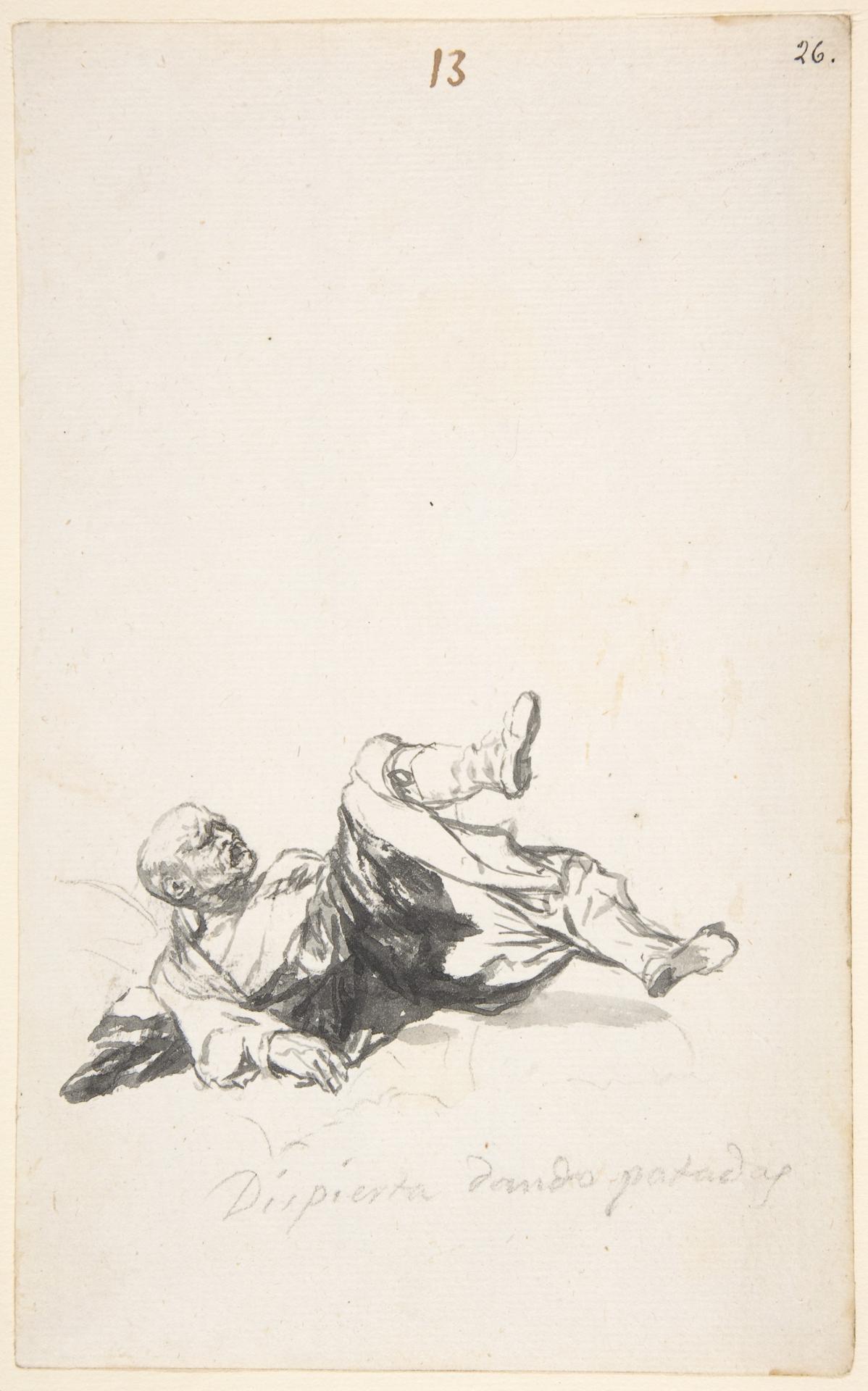
Original title: He Wakes Up Kicking; a man on the floor kicking his legs after waking from a nightmare; page 13 from the "Witches and Old Women" Album (D)
kurzbeschreibung
In the drawing 'He Wakes Up and Kicks Out' by Francisco de Goya (ca. 1819–23), a man lies on the ground, kicking his legs after a nightmare. The sheet belongs to the album 'Witches and Old Women' (page 13) and was executed with brush, carbon black and gray ink and wash, supplemented by black chalk and scraper.
Description
A man sprawls on the ground, legs thrust out, kicking as if just startled from a nightmare. Barefoot, in trousers and shirt, his posture is tense and restless. The style remains simple yet rich in detail: mostly brushstrokes in black and gray, interspersed with white accents that suggest light and shadow. The paper has a fine, rough texture that contributes to the overall effect. At the bottom, handwritten, is 'Dispierta dando patadas'; at the top, the numbers '13' and '26'.
Context
Created between 1819 and 1823, the sheet falls into a period when Goya increasingly turned to dark and fantastic subjects. It belongs to the album 'Witches and Old Women,' which deals with witches and old women and is part of Goya's late work. These sheets were not intended for the public but served Goya as a personal means of expression. The dating is based on stylistic features and the album's affiliation.
Impact
The motif conveys an immediate physical restlessness and gains intensity through the restrained color and dynamic brushwork. An oppressive mood arises that makes the terror of awakening palpable. Coarse paper texture and expressive strokes give the sheet a raw, direct presence.
Technique
Goya worked with a brush, using carbon black and gray ink, which he washed, along with black chalk and a scraper. The wash creates soft transitions, while the scraper reveals individual highlights. The drawing is executed on paper whose rough surface brings out the texture of the strokes.
AI-generated description text
Source: Metropolitan Museum of Art · Public Domain (CC0 1.0)