Nothing is Known of This
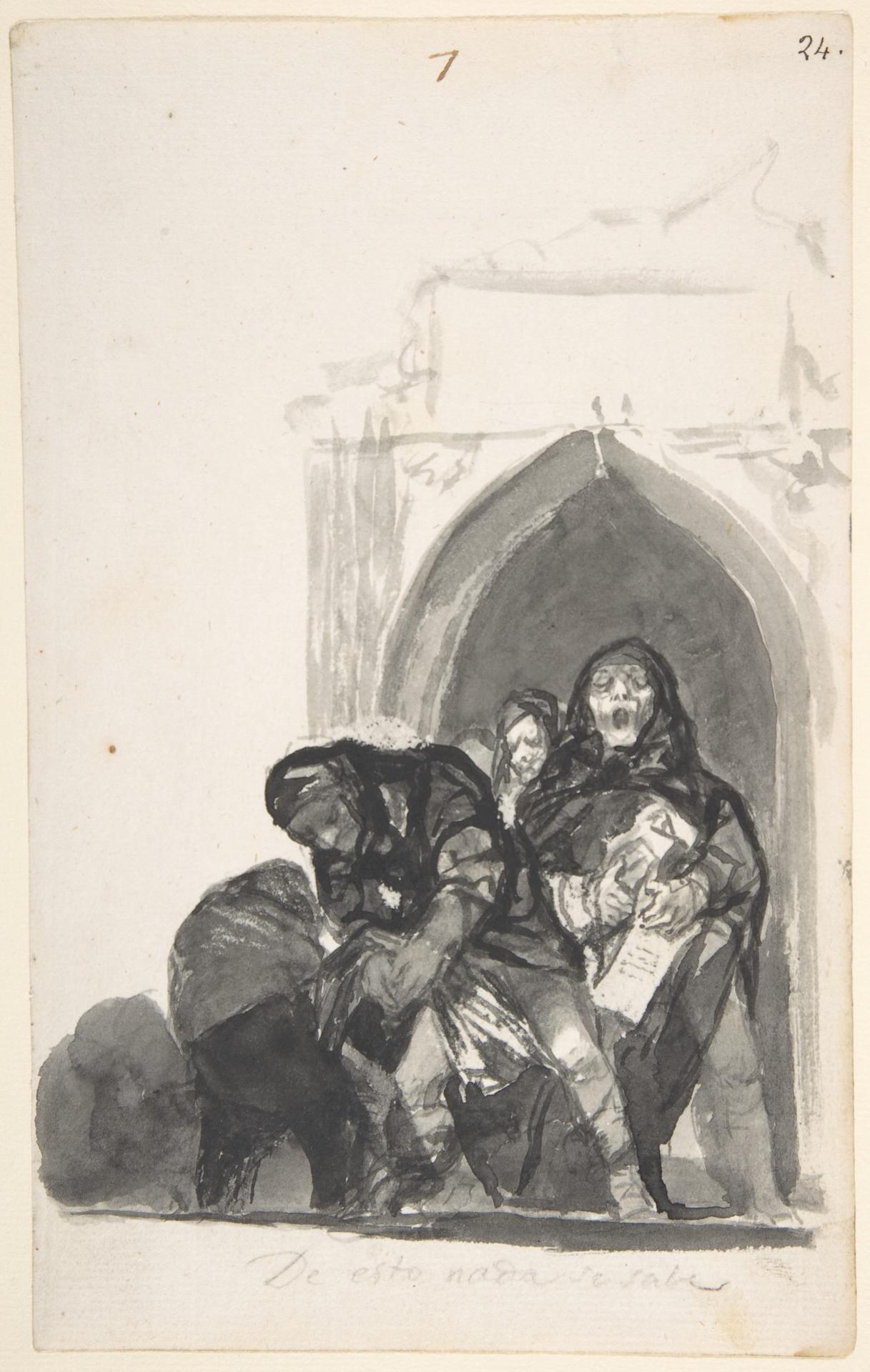
Original title: Nothing is Known of This; two figures picking up a body in front of a church, a monk singing next to them and another in the background; page 7 from the "Witches and Old Women" Album (D)
kurzbeschreibung
Francisco de Goya, known simply as Goya, made the sheet titled "Nothing is Known of This" (original Spanish title "Nichts ist darüber bekannt") in connection with his album "Witches and Old Women" (D), which dates from around 1819–23. Two figures are shown lifting a lifeless body in front of a church portal; beside them, a singing monk accompanies the action, and another figure is hinted at in the background. The motif is executed with brush, charcoal, and gray and black ink, washed and worked with a scraper, on paper.
Description
The layout feels deliberately unbalanced. In the middle, two people struggle to raise a motionless body, while on the left a monk sings or shouts with his mouth wide open. Behind them, Goya only vaguely suggests another figure. Gray and black tones dominate the entire view, applied with ink and watercolor. Subtle gradations and the wash create a diffuse, barely directed light. The handling remains expressive and dramatic, as is typical of Goya's late years.
Context
This sheet belongs to the albums Goya assembled between 1819 and 1823, after he had withdrawn to his villa, the Quinta del Sordo. Under the title "Witches and Old Women" (D), these pages gather scenes dealing with superstition, violence, and the abysses of social life. They were made during a period of political repression following the restoration of the Spanish monarchy. These works were not intended for an audience; they served Goya as a private expression of a dark view of the world.
Impact
An oppressive, uncanny mood hangs over the sheet, intensified by the sparse color and the expressive figures. That a body is lifted so casually in a consecrated place disturbs and leaves the viewer uneasy. What is happening here remains unexplained and confronts anyone who looks with a puzzle.
Technique
Goya worked with brush, charcoal, gray and black ink, and wash on paper. He also used a scraper to bring out highlights and textures. This allowed for fine transitions between light and dark that carry the dramatic mood.
AI-generated description text
Source: Metropolitan Museum of Art · Public Domain (CC0 1.0)