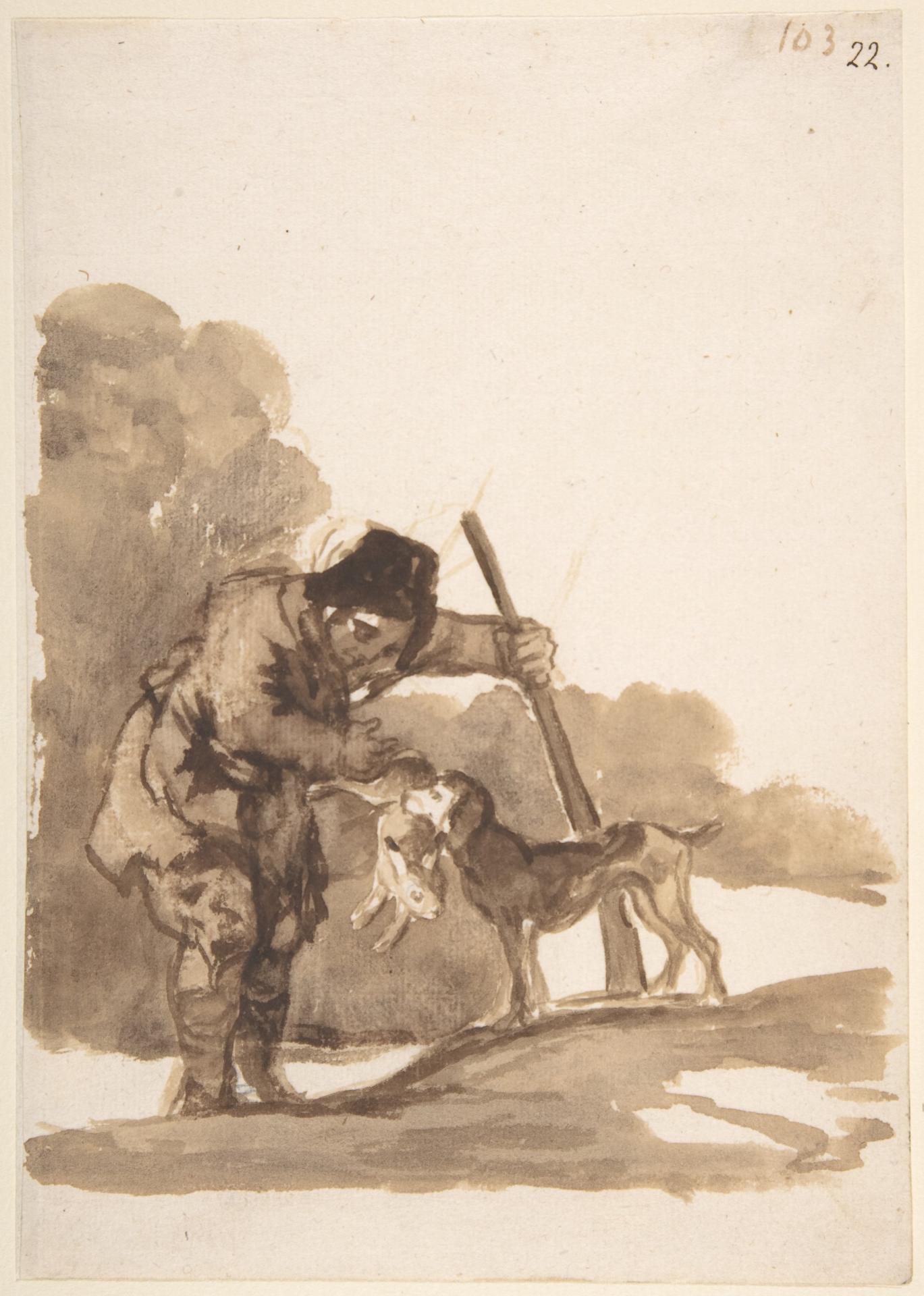
Rabbit hunter with a Retriever; folio 103 from the "Images of Spain" Album (F)
Original title: Rabbit hunter with a Retriever; folio 103 from the "Images of Spain" Album (F)
kurzbeschreibung
Francisco de Goya y Lucientes made 'Hasenjäger mit einem Retriever' sometime between about 1812 and 1820. It belongs to the album 'Bilder von Spanien' (F) and is drawn in brush and brown wash on paper. A hunter in traditional hunting dress bends down toward an animal on the ground — most likely a hare — while a retriever stands beside him.
Description
Your eye is drawn first to the hunter's stooped figure, a weapon in his right hand, as he turns toward the small animal on the ground. His retriever stands close by, also looking down at it. Everything in the arrangement serves this meeting of man and dog; no other figures or objects appear. Near the top, loose brushstrokes suggest trees, and a dark, almost black patch at the right edge hints at a rock face or a stand of woods.
Context
The sheet comes from Goya's albums, a series of drawings made between 1796 and 1828 that often record everyday scenes of Spanish life. The album 'Bilder von Spanien' (F) dates to around 1812–20, a period when Spain was still suffering the aftermath of the War of Independence. In these works Goya frequently turned to social types and rural occupations without giving them dramatic or allegorical meaning.
Impact
A calm, ordinary mood rises from the plain arrangement, strengthened by the monochrome brown tonality. The focused exchange between man and animal gives the sheet an intimate, almost documentary note. You feel placed inside a quiet moment of the hunt, with no pathos or dramatic climax.
Technique
The work was carried out in brush and brown wash, a method that allows broad areas of tone and delicate transitions. Brown nuances dominate the image and create atmospheric depth, while the outlines stay loose and sketchy.
AI-generated description text
Source: Metropolitan Museum of Art · Public Domain (CC0 1.0)