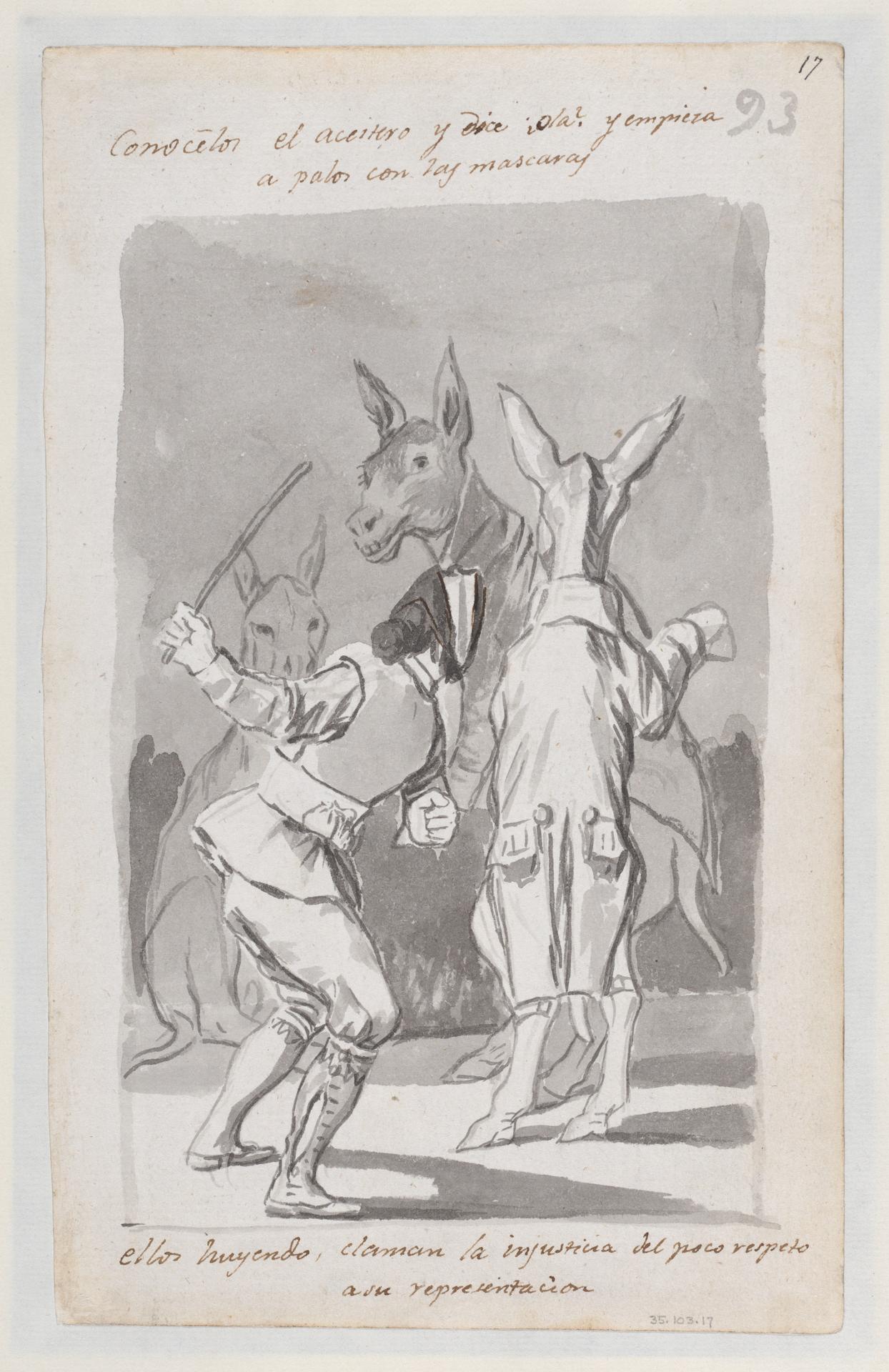
Masquerading asses being whipped; folio 93 (recto) from the Madrid Album "B"
Original title: Masquerading asses being whipped; folio 93 (recto) from the Madrid Album "B"
kurzbeschreibung
Brush, brush tip, and pen, washed with carbon black and accented in brown ink — that is how Francisco de Goya y Lucientes made this drawing between 1796 and 1798. It shows three donkeys being whipped by a human figure with a donkey's head and donkey's clothing. The sheet measures 23.5 x 14.6 cm.
Description
On the left, a figure with a donkey's head swings a whip through the air. Three donkeys stand in the middle ground and on the right, turning away from the blows. The background remains bare and dark, making the bodies stand out. Black and white tones dominate the image, interspersed with charcoal shading and a few brown traces. The poses and the sweep of the whip inject tension into the arrangement.
Context
This sheet comes from Madrid Album B, one of Goya's private sketchbooks from 1796 to 1798. That album gathers satirical and allegorical scenes that expose human folly. The whipped donkeys under the lash of a donkey-like tormentor read as social criticism aimed at ignorance and oppression. Goya was court painter at the time but spent periods in Andalusia, where he began the album.
Impact
The sparse color and dark surface evoke a gloomy, serious mood. The whip's motion and the averted donkey bodies create palpable tension and threat. The satirical conceit invites reflection on power relations.
Technique
Goya worked with brush and brush tip, applied carbon black washes, and used pen and brown ink for details. The washed manner allows fine transitions between light and dark, while the pen sharpens contours. The small paper format points to an intimate, rapid working method in the sketchbook.
AI-generated description text
Source: Metropolitan Museum of Art · Public Domain (CC0 1.0)