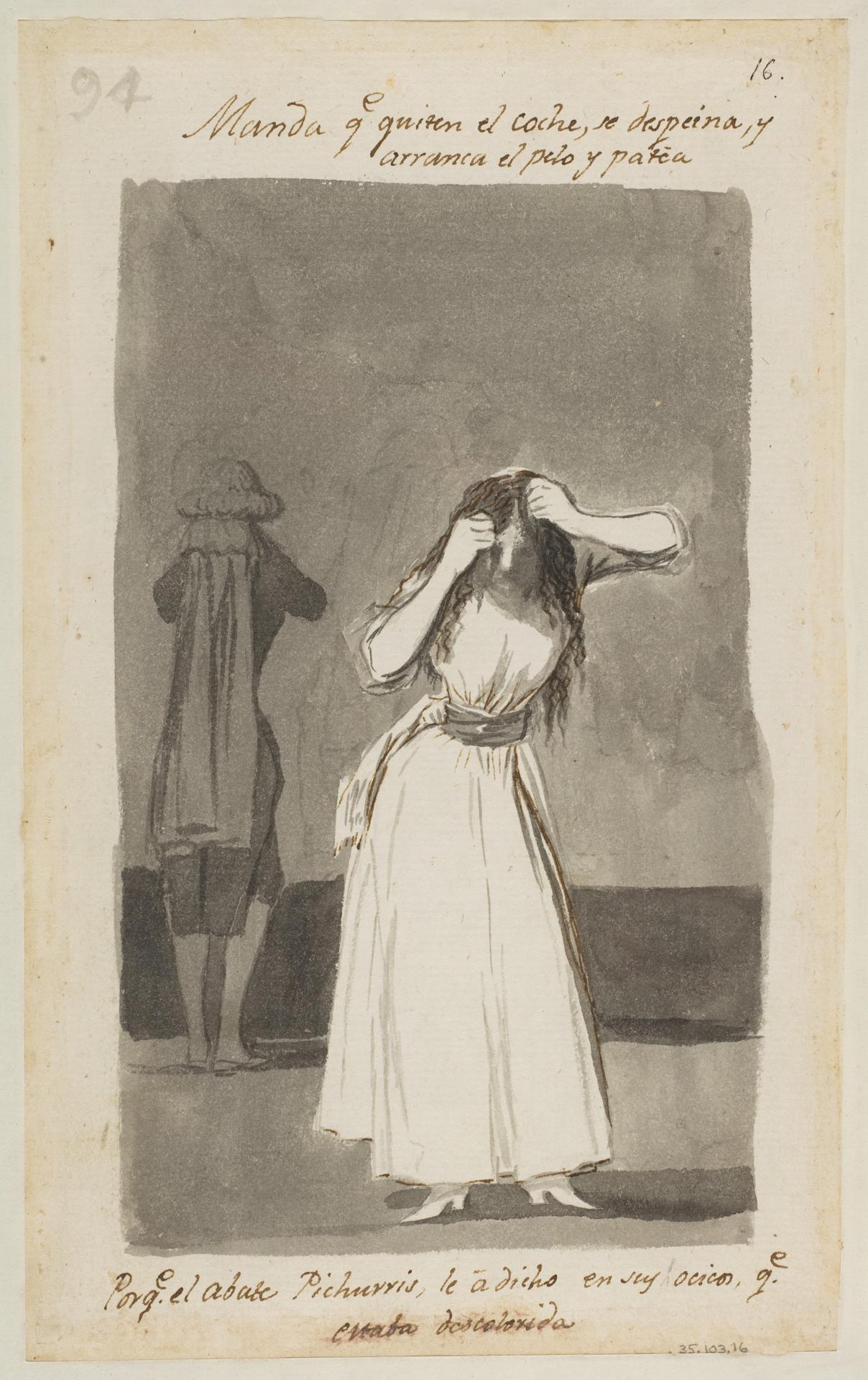
Woman throwing a tantrum and pulling her hair; folio 94 (verso) from the Madrid Album "B"
Original title: Woman throwing a tantrum and pulling her hair; folio 94 (verso) from the Madrid Album "B"
kurzbeschreibung
Francisco de Goya y Lucientes made this sheet from Madrid Album B in 1796–98. A woman in a pale dress clutches her hair with both hands—a violent, desperate gesture. The sketch is executed with brush and carbon black washes, plus pen and brown ink. The subject belongs to a series of studies in which Goya recorded scenes of everyday life in Madrid and the emotional world of its people.
Description
In front, the woman stands in a light white garment. Her head is tilted so far back that her face remains hidden. Both hands dig into her hair, creating a fierce, almost theatrical movement. Behind her stands a dark-clad figure who turns toward the woman and watches the event. The style remains sketchy and spare; carbon black and brown tones produce even, low-contrast lighting. The layout pushes the woman forward, while the background is merely suggested.
Context
During 1796–98 in Madrid, Goya worked on several albums in which he took up urban life and interpersonal dramas. Madrid Album B is one of these sketchbooks, which Goya kept for himself, without a patron, and which often show scenes from popular life. The woman in an extreme emotional situation points to his interest in psychological states, which also emerges in later works such as the Caprichos. The technique with carbon black and ink was typical of his spontaneous studies, often made on the spot or from memory.
Impact
The reduced, sketchy execution directs attention to the woman's expressive posture, which conveys anger and despair. The muted colors and hidden face create distance, yet also lend the expression something universal. The arrangement feels immediate and fleeting, as if the moment of emotion had been captured directly.
Technique
Brush and carbon black in the form of washes were used, along with pen and brown ink. Soft, flowing layers and precise pen lines give the figure both volume and dynamism. The paper measures 23.5 x 14.61 cm—a small format that suggests an intimate, spontaneous working method.
AI-generated description text
Source: Metropolitan Museum of Art · Public Domain (CC0 1.0)