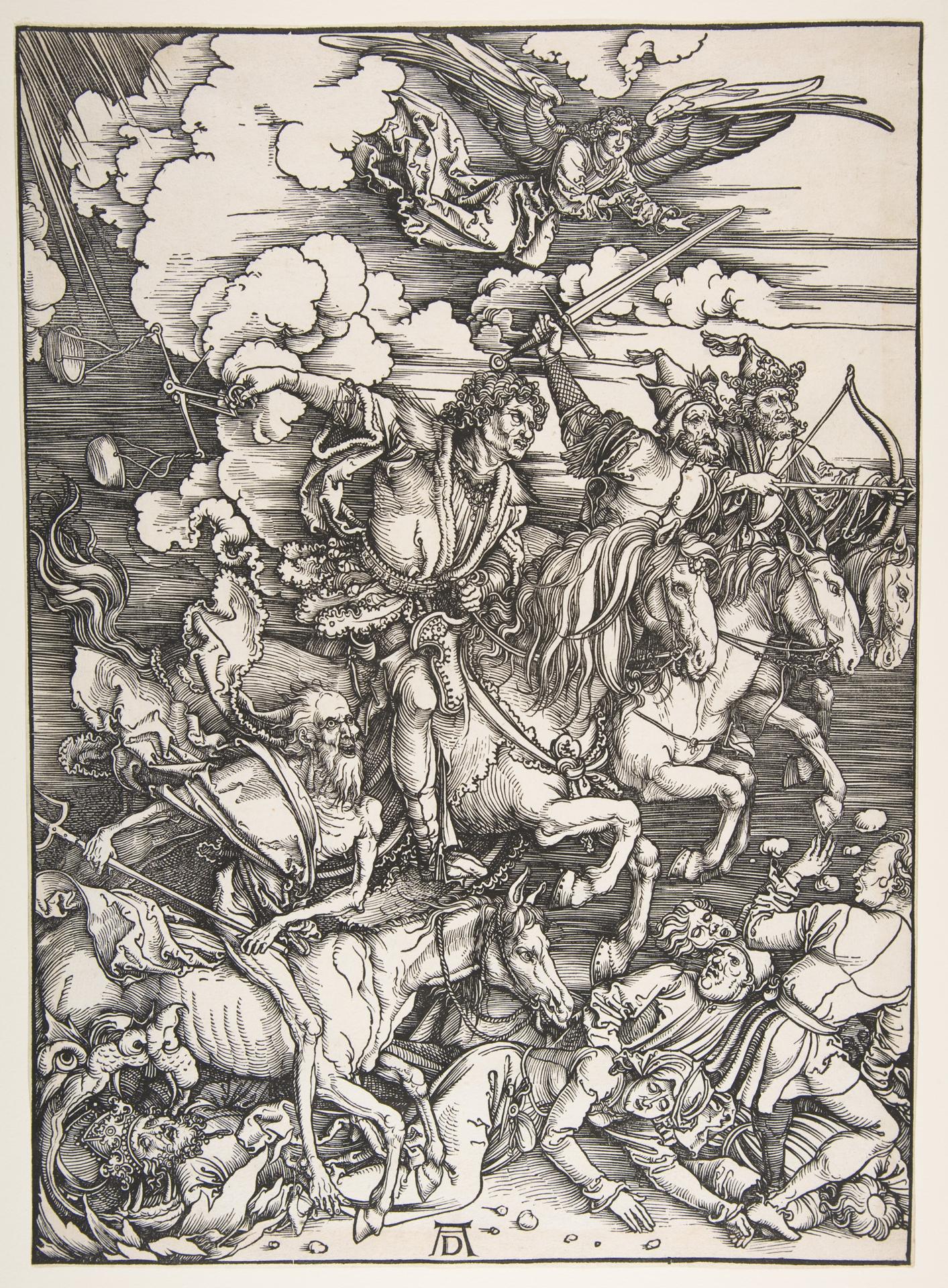
The Four Horsemen, from "The Apocalypse"
Original title: The Four Horsemen, from "The Apocalypse"
kurzbeschreibung
Albrecht Dürer's woodcut "The Four Horsemen" (1498) depicts the apocalyptic riders from the Book of Revelation. The scene shows four horsemen charging across a chaotic landscape, with an angel above holding a sword. This work is part of Dürer's famous "Apocalypse" series.
Description
In the upper part of the composition, a winged angel hovers among clouds, holding a sword. Below, four horsemen ride in a dynamic diagonal line, their horses rearing and trampling figures on the ground. The riders are dressed in varied attire, with one drawing a bow, another wielding a sword, and others carrying scales and a pitchfork. The background features a dark, stormy sky with rays of light, and the ground is strewn with bodies of the fallen.
Context
Dürer created this woodcut in Nuremberg in 1498, during a period of intense religious and political anxiety in Europe. The Apocalypse series was one of the first books to be published and illustrated by an artist himself, marking a shift in the art market. Dürer's work was heavily influenced by the biblical text and contemporary fears of the end of the world.
Impact
The composition is dramatic and dynamic, with the diagonal thrust of the horses conveying a sense of unstoppable force. The contrast between the dark background and the detailed figures creates a powerful, apocalyptic mood. The viewer is drawn into the chaos, feeling the urgency and terror of the scene.
Technique
This work is a woodcut, a relief printing technique where the image is carved into a wooden block, inked, and pressed onto paper. Dürer's mastery of the medium is evident in the intricate cross-hatching and fine lines, which achieve a high level of detail and tonal variation. The print was executed with exceptional precision, allowing for both dramatic shading and delicate textures.
AI-generated description text
Source: Metropolitan Museum of Art · Public domain (CC0)