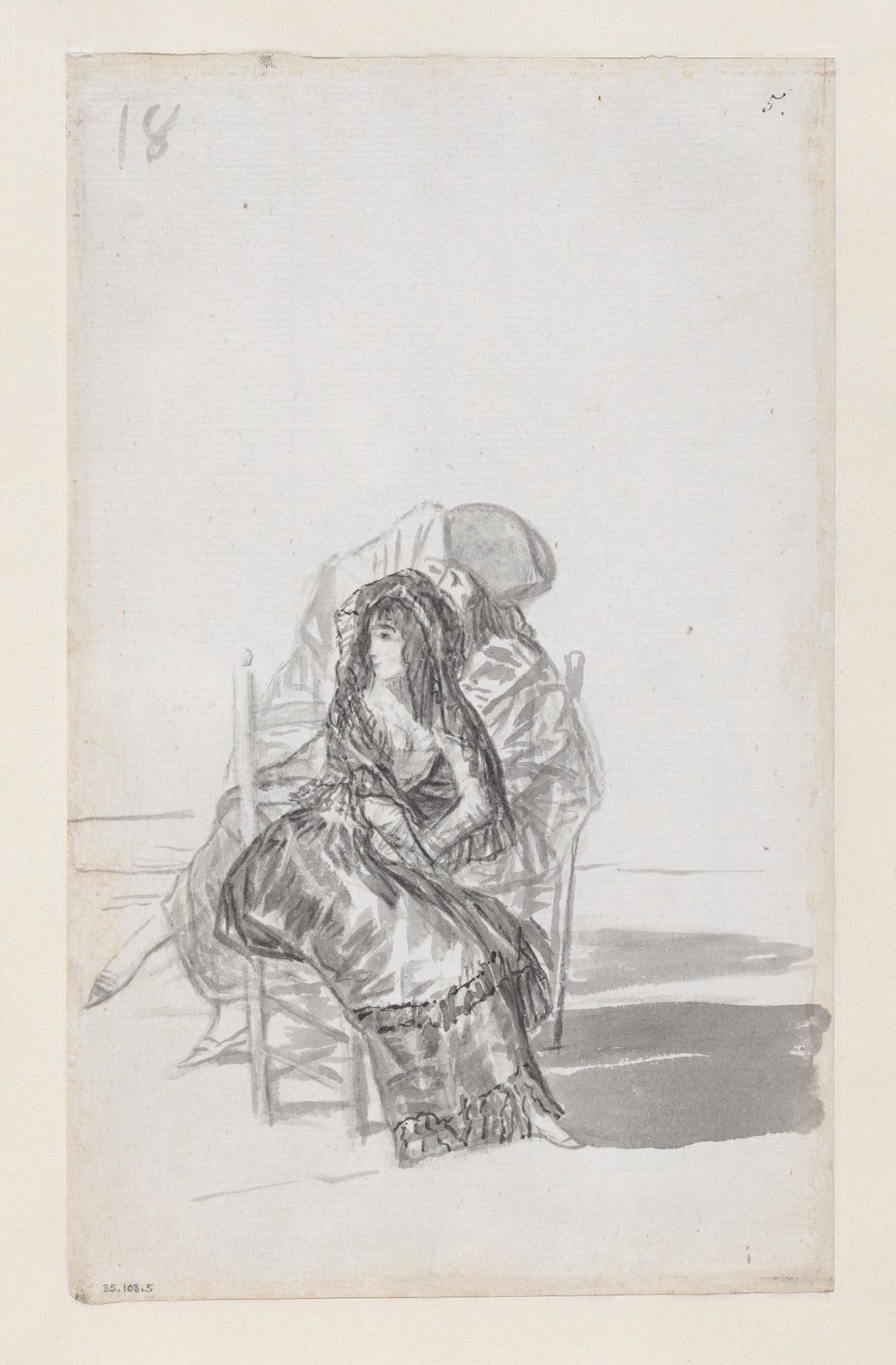
Maja seated on a chair and two companions behind; folio 18 (verso) from the Madrid Album "B"
Original title: Maja seated on a chair and two companions behind; folio 18 (verso) from the Madrid Album "B"
kurzbeschreibung
A seated woman with a cloth draped over her head, two other seated figures behind her: this drawing by Francisco de Goya y Lucientes, made between 1795 and 1797, captures a quiet gathering. Executed with brush and carbon black washes on paper, the sheet belongs to Madrid Album B.
Description
A woman sits on a chair, her long skirt and the apron thrown over her head defining her form. To her right and left, two more people have taken chairs and are part of the scene. The handling remains sketchy and linear; charcoal strokes and brush marks produce monochrome grey values. Light falls from the left, casting shadows on the right side of the figures and on the ground. The layout is plain and focuses entirely on the figures and their arrangement.
Context
Created in 1795–97, when Goya turned increasingly to free sketching after a severe illness, this sheet is part of Madrid Album B. That sketchbook gathers scenes from everyday life and society in Madrid. It belongs to a series of sketchbooks Goya kept between 1796 and 1797, which served as preparatory studies for larger works. Women of the people—majas—appear again and again in Goya's output during these years.
Impact
The spare, almost fleeting line gives the figures an immediate presence. The clear distribution of light and shadow creates a calm, intimate mood that draws the viewer into the event. Monochrome tones and the simple arrangement bring the everyday situation to the fore without idealizing it.
Technique
For this work Goya used brush and charcoal with black, carbon-based washes on paper. The washed drawing allowed him both fine lines and broad tonal areas. The grey tones result from varying the dilution of the ink, which gives the sketch a lively play of light.
AI-generated description text
Source: Metropolitan Museum of Art · Public Domain (CC0 1.0)