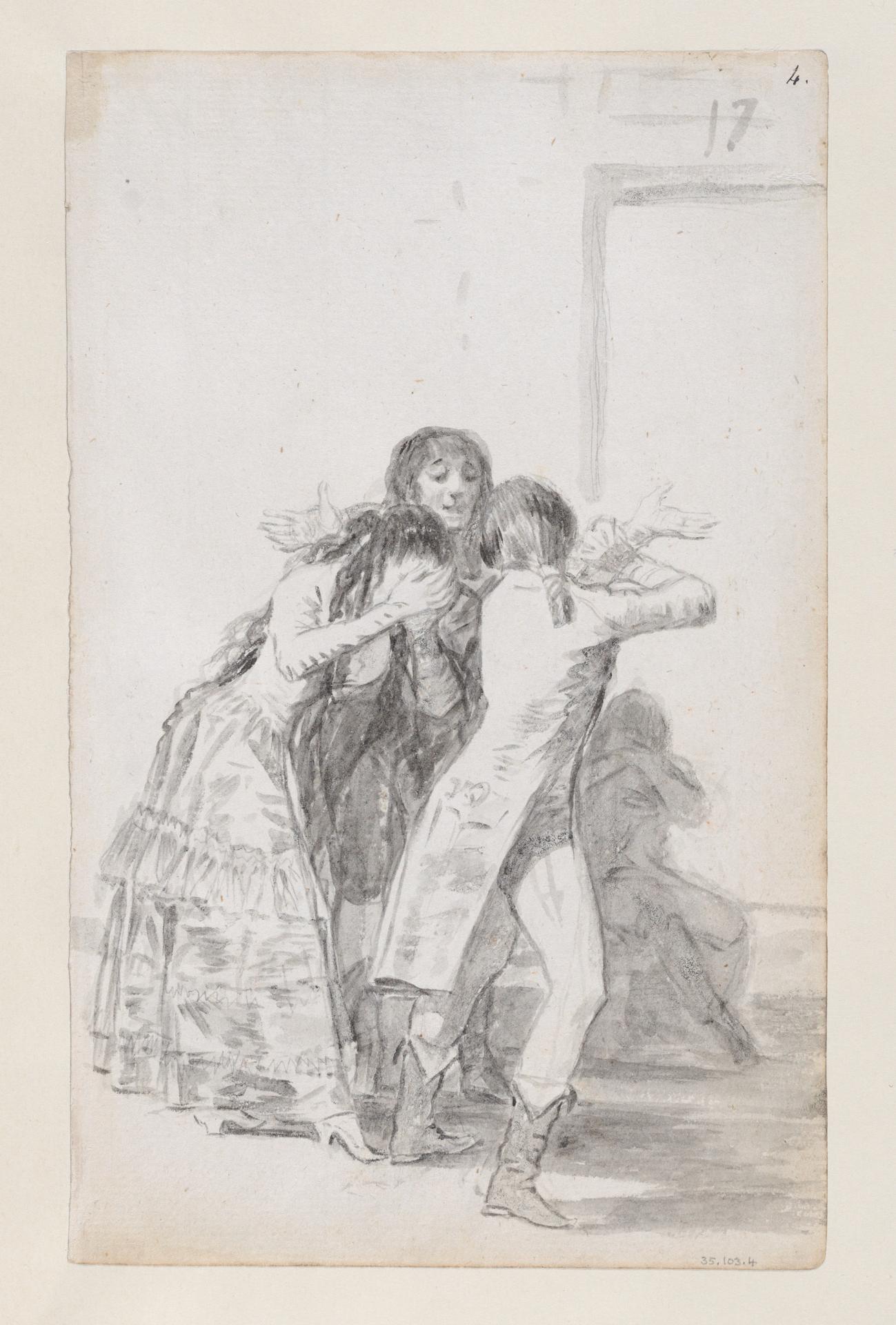
Young woman weeping and covering her face with her hands, accompanied by men; folio 17 (recto) from the Madrid Album "B"
Original title: Young woman weeping and covering her face with her hands, accompanied by men; folio 17 (recto) from the Madrid Album "B"
kurzbeschreibung
A young woman hides her face in her hands and weeps, the focal point of this sheet by Francisco de Goya from 1795–97. Two men embrace and comfort her. The drawing belongs to the Madrid Album B and is executed in a mixed technique of brush, brush point, black chalk and carbon black washes. A doorframe in the background suggests an interior.
Description
The weeping woman occupies the center, both hands before her face. Two men flank her, their arms wrapped around her in consolation. She wears a long skirt and jacket; the men are in contemporary dress with white trousers, collared jackets and belts. The figures' wide-flung arms create dynamism and emotional charge. Gradations of gray and the shading of brushstrokes model light and shadow. A door in the background hints at the interior.
Context
The Madrid Album B was made between 1795 and 1797. In these years, after his serious illness of 1792/93, Goya turned increasingly to intimate and emotional scenes of everyday life. The sheet belongs to a series of sketchbooks Goya kept for his own use, recording his observations of Spanish society. Grief and consolation recur in Goya's work of this period, also in later paintings and prints.
Impact
The drawing's immediate emotional impact comes from its reduced color and expressive gestures. The dynamic arrangement of the figures and nuanced shading give the scene a dramatic intensity that draws the viewer into the event.
Technique
With brush and brush point, black chalk and carbon black washes on paper, Goya achieved fine gradations of light and shadow. The combination of drawing and painterly means allows a lively rendering of the figures and their movements. This technique is characteristic of Goya's sketchbooks, in which he recorded spontaneous observations with great precision.
AI-generated description text
Source: Metropolitan Museum of Art · Public Domain (CC0 1.0)