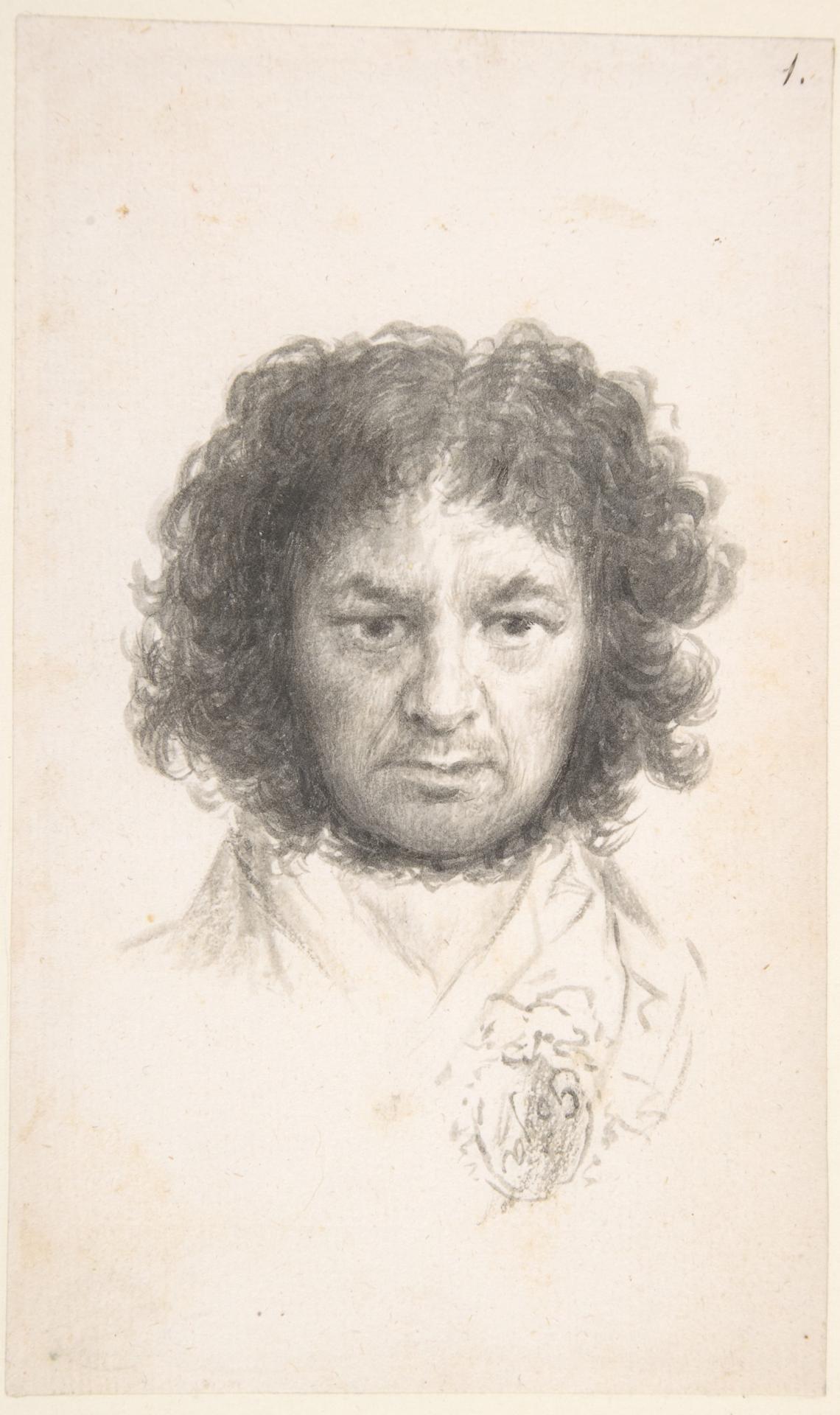
Self-Portrait (ca. 1796)
Original title: Self-Portrait
kurzbeschreibung
Francisco de Goya y Lucientes captured his own likeness here around 1796. This small drawing on paper is executed with brush and point of brush in carbon black ink. We see the artist with curly hair and an ornate collar, facing directly forward.
Description
A face framed by curly hair that falls to the shoulders looks out at us. A shirt with a striking, decorative collar is visible. Shades of gray dominate the monochrome image, produced by carbon black ink. The light appears even, without sharp shadows or harsh contrasts—as if coming from the front. The head fills the center and commands the foreground.
Context
By around 1796, Goya had already made a name for himself as an artist, but he also suffered from illness and deafness. During this time, he turned increasingly away from court painting and created intimate, personal works. This self-portrait belongs to a group of such self-images that he executed in various techniques.
Impact
The direct gaze and the restriction to gray tones create an immediate, almost familiar effect. The fine brushwork gives the portrait a liveliness that extends beyond the small format.
Technique
For this sheet, Goya used brush and point of brush with carbon black ink—a method he valued for quick studies. The varying amount of ink produces the monochrome gray palette applied with the brush.
AI-generated description text
Source: Metropolitan Museum of Art · Public Domain (CC0 1.0)