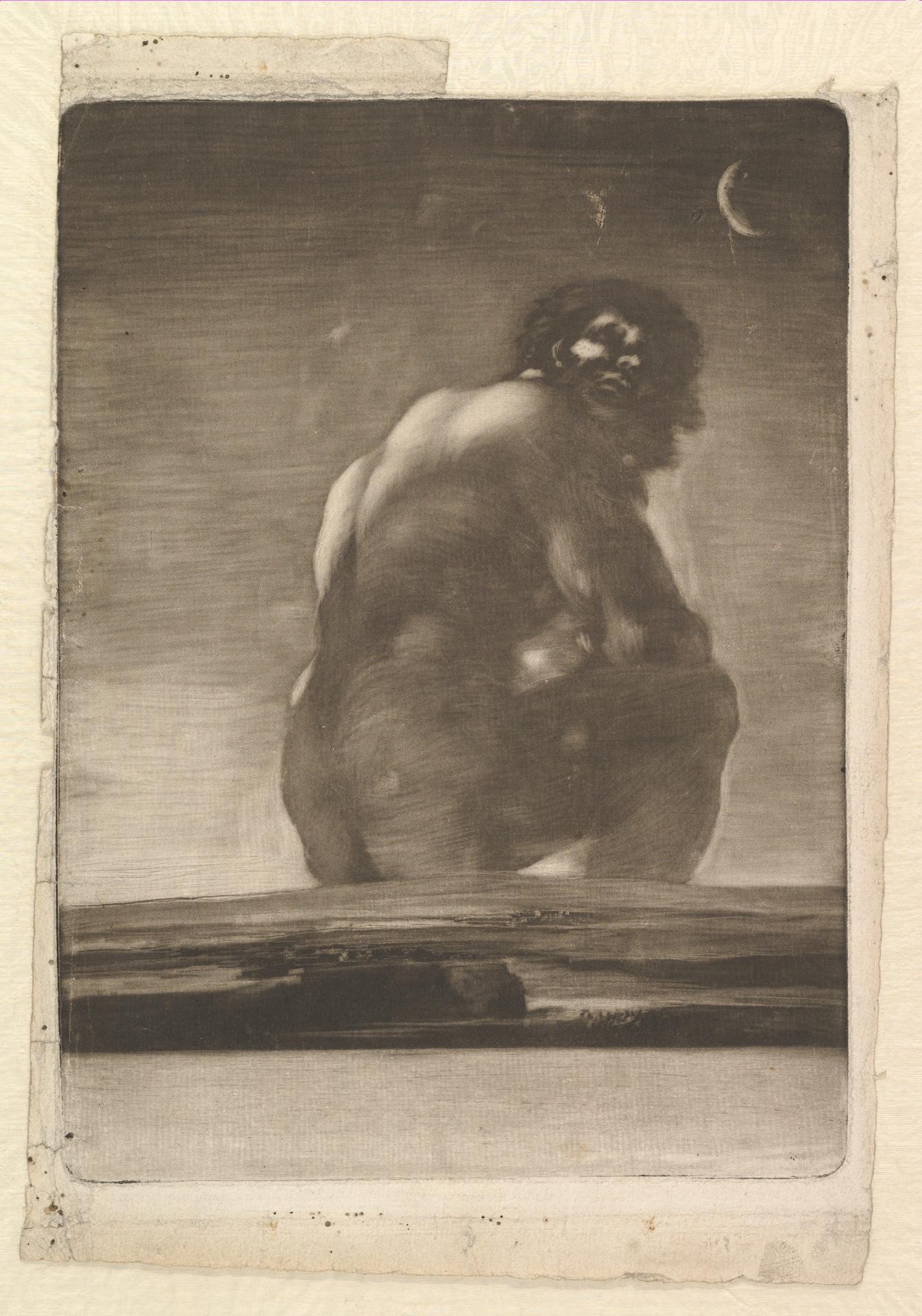
Seated Giant
Original title: Seated Giant
kurzbeschreibung
Unlike many contemporary figure studies, Francisco de Goya's 'Sitzender Riese' (Seated Giant), made around 1814–18, presents a muscular figure from behind. Above it arches a night sky with a moon. The print is executed as an aquatint etching, supplemented by drypoint, roulette, and lavis.
Description
A seated figure is seen from the back. Its round head has short, dark hair; the body appears powerful. It rests on a low platform that occupies the lower half of the image. A moon stands in the upper right. The entire view remains in grayscale with subdued color and even lighting.
Context
This print was probably created between 1814 and 1818, that is, after the Spanish War of Independence. It belongs to a series of prints that deal with violence, power, and human existence. The function and original context of the work have not been fully transmitted.
Impact
The rear view of the massive figure creates an enigmatic and at the same time threatening mood. Because the image is reduced to gray tones and the composition remains calm, the gaze is directed to the physical presence. The contrast between the bright figure and the dark background heightens the monumental effect.
Technique
Executed as an aquatint etching with drypoint, roulette, and lavis, the process allows fine tonal gradations and a soft, painterly effect. The even lighting and muted gray tones recur in Goya's late prints.
AI-generated description text
Source: Metropolitan Museum of Art · Public Domain (CC0 1.0)