Feminine Folly
Original title: 'Feminine Folly' from the 'Disparates' (Follies / Irrationalities)
kurzbeschreibung
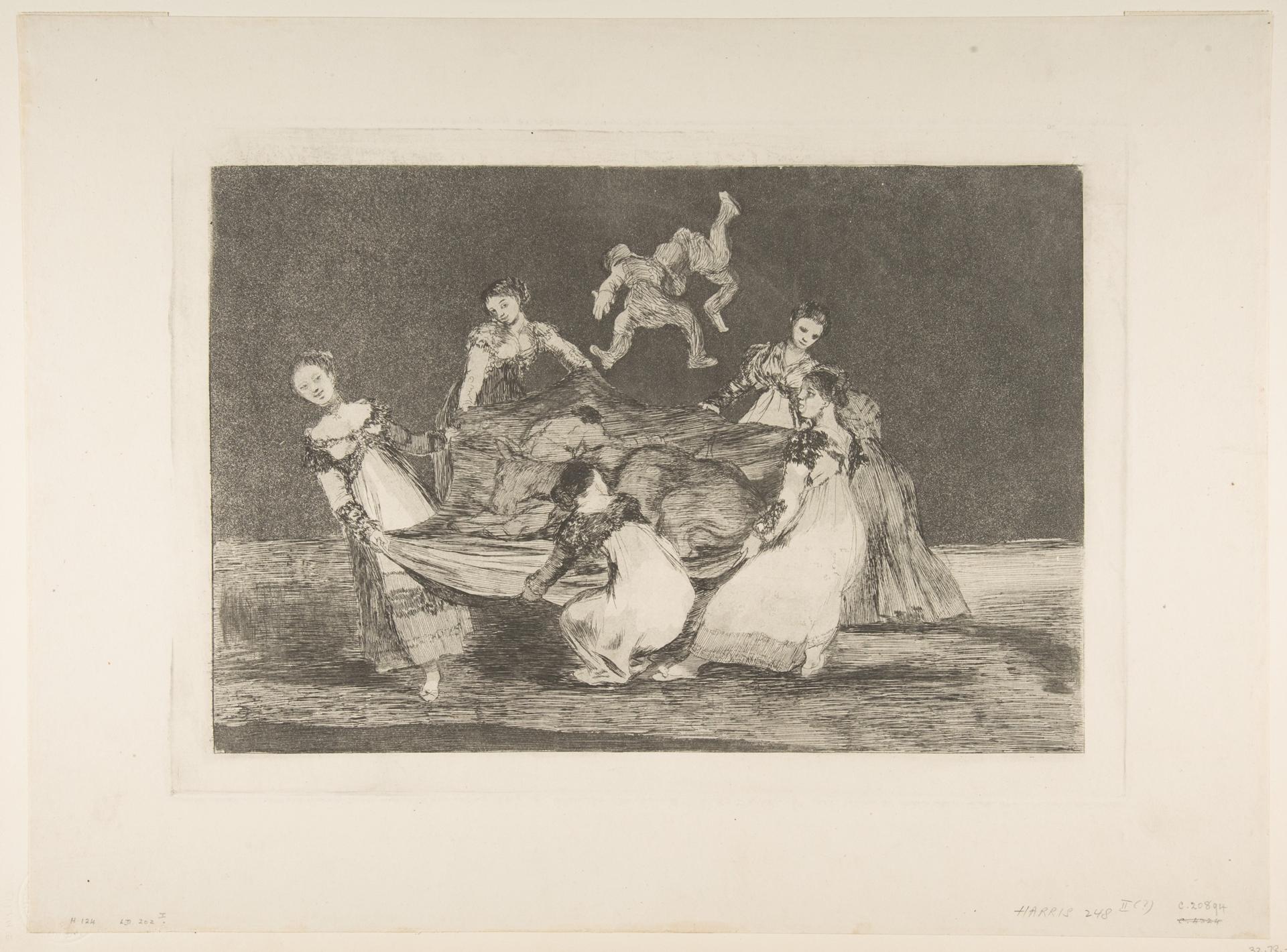
Francisco de Goya made the etching "Feminine Folly" (Weibliche Torheit) around 1815–19 as part of his series "Disparates" (Follies / Irrationalities); it was not printed until about 1848–54. A group of women in historical dress clusters around a torn canvas, while a man leaps through the air.
Description
A man in simple clothing springs into the air, surrounded by women in magnificent, historical gowns. The women look curious and surprised. The layout is asymmetrical, with figures distributed dynamically around the leaping man. Diffuse light creates a dramatic, almost unreal mood. The etching remains monochrome in shades of gray, emphasizing contrasts of light and dark.
Context
Goya's late period, when he increasingly turned away from court art and critically examined human follies, produced the "Disparates" series. The plates were only published after his death, which underscores their subversive and hard-to-interpret imagery. Goya often addressed social and psychological abysses; the role of women and their social portrayal recur as a motif.
Impact
The man's unusual leap and the women's emotional reactions make the image seem surreal and enigmatic. Diffuse light and finely worked details create an oppressive, dreamlike atmosphere. Viewers are prompted to ponder the symbolic meaning without any single reading forcing itself.
Technique
Etching with aquatint and drypoint allows fine tonal gradations and a soft, painterly effect. Aquatint produces the gray areas and shadows, while drypoint ensures precise lines and details. This combination gives the print a particular depth and texture typical of Goya's late graphic work.
AI-generated description text
Source: Metropolitan Museum of Art · Public Domain (CC0 1.0)