Portrait of the court dwarf El Primo, after Velázquez
Original title: Portrait of the court dwarf El Primo, after Velázquez
kurzbeschreibung
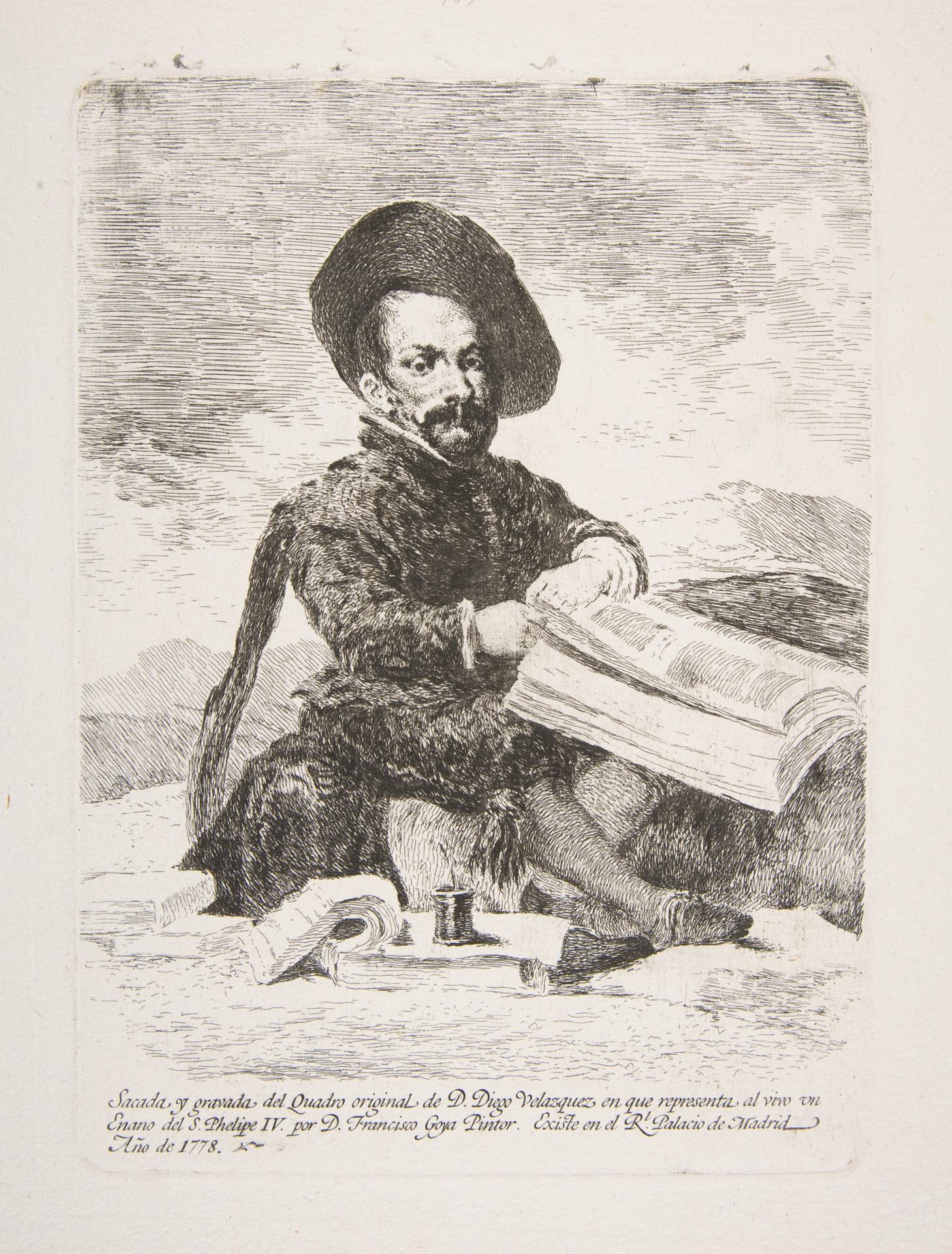
In 1778 Francisco de Goya etched this portrait of the court dwarf El Primo after a painting by Diego Velázquez. The plate measures 21.5 x 15.4 cm and shows a seated man holding a book and a spool of thread.
Description
Seated on a plinth, the man holds a book and gazes into the distance. A wide, flat cap and a fur jacket define his relaxed posture. In front lie a spool of thread and a book or paper; the background dissolves into a blurred mountain landscape. Tones of gray and white, built up with dense, fine hatching, dominate the image.
Context
This etching belongs to a series after Velázquez that Goya made between 1778 and 1785. Encouraged by the Count of Floridablanca, who supported Goya's talent as a reproductive printmaker, the sheet was created before Goya's rise to court painter. Velázquez's original painting of El Primo, made around 1644, shows the court dwarf at the Spanish court.
Impact
Fine hatching and the calm arrangement make the print appear remarkably alive. The sitter's relaxed gaze gives it an intimate, almost dignified mood. Despite the reduced palette, a sculptural depth emerges that draws the viewer into the image.
Technique
As an intaglio process, the drawing was etched into a metal plate. Goya used dense and fine hatching to model light and shadow. The impressions were made with dark printing ink on paper, which produces the gray and white tones.
AI-generated description text
Source: Metropolitan Museum of Art · Public Domain (CC0 1.0)