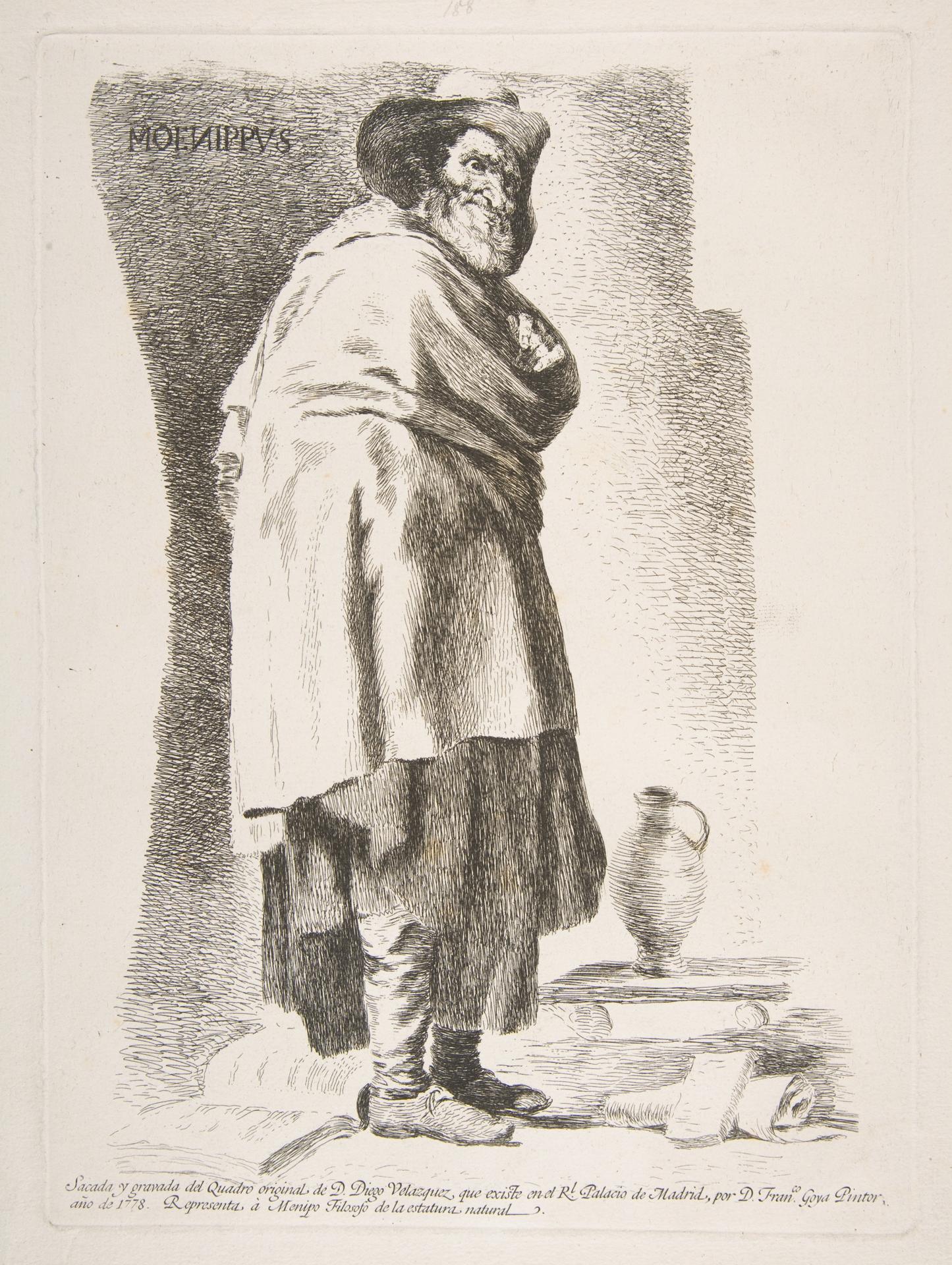
Menippus, after Velázquez
Original title: Menippus, after Velázquez
kurzbeschreibung
In 1778 Francisco de Goya etched the philosopher Menippus after a painting by Diego Velázquez. The print belongs to a series of reproductions Goya made from works by the Spanish master. The etching plate measures 30.6 × 22 cm.
Description
Menippus is shown in half-profile, arms crossed, with a pensive gaze. He wears a robe and a cap; heavy stubble and a bold expression define his face. A simple vessel, resembling a jug or amphora, stands on a table beside him. A dark, shadowy area behind pushes the figure forward. The layout is clear and centered; strong hatching emphasizes texture and form.
Context
Goya etched this print in 1778, when he was deeply engaged with the works of Diego Velázquez, which he copied for the royal court in Madrid. The series of reproductions after Velázquez was commissioned by the Count of Floridablanca and was intended to bring the Spanish master's work to a wider audience. Goya used etching to translate Velázquez's painting style into the medium of printmaking.
Impact
The dense, expressive linework gives the philosopher a lively presence. The dark background and fine hatching create an intimate, thoughtful atmosphere that speaks directly to the viewer. Despite being in black and white, the motif appears remarkably three-dimensional and detailed.
Technique
The etching is an intaglio process: the drawing is scratched into a wax layer on a metal plate and then bitten with acid. Goya used fine lines and cross-hatching to model shadows and textures. The printing plate measures 30.6 × 22 cm; the sheet format is 40.7 × 28.9 cm.
AI-generated description text
Source: Metropolitan Museum of Art · Public Domain (CC0 1.0)