Aesop, after Velázquez
Original title: Aesop, after Velázquez
kurzbeschreibung
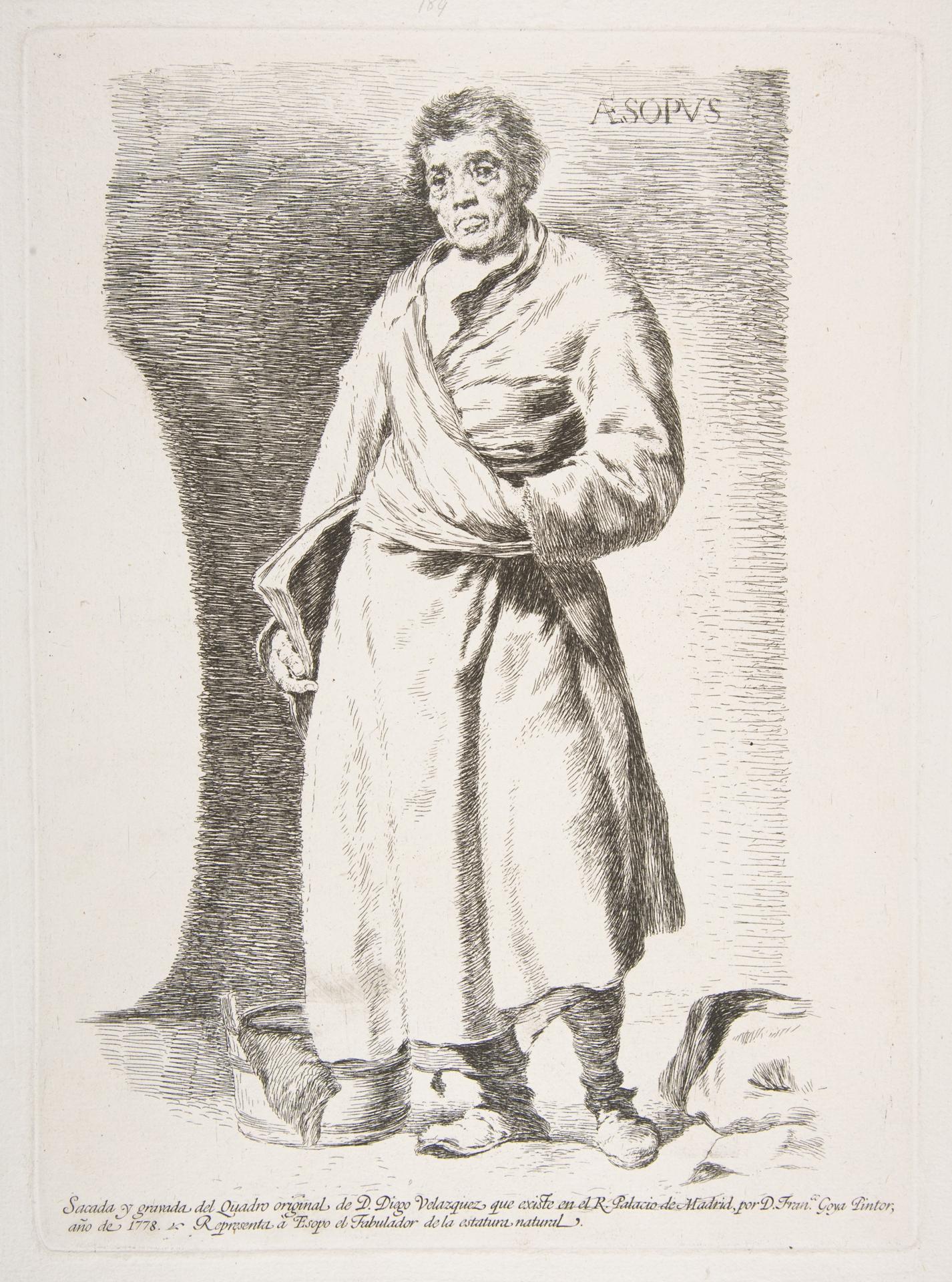
In 1778, Francisco de Goya etched the Greek philosopher Aesop after a painting by Diego Velázquez. The etching measures 29.5 × 21.5 cm (plate).
Description
A man in plain clothing, a robe and an apron, stands upright and gazes into the distance. Behind him, a dark, abstract area emphasizes the figure. The layout is clear and centered; the monochrome execution and subdued light underscore the serious character. Along the bottom edge runs a Latin inscription referring to the original painting and the etching.
Context
In 1778, Goya created this etching as part of a series of reproductions after paintings by Velázquez. The series was commissioned by the royal court to disseminate the works of the famous predecessor. Goya used the etching to study Velázquez's composition and style and to acquire his technique. The model was Velázquez's painting "Aesop," made around 1630, now in the Museo del Prado in Madrid.
Impact
The etching works through its clear arrangement and the calm, dignified posture of the figure. Monochrome rendering and subdued light give the print a serious, contemplative mood. The inscription at the bottom emphasizes the reproductive nature of the work without diminishing its aesthetic quality.
Technique
This is an etching, an intaglio process in which the drawing is scratched into a metal plate etched with acid. Goya used a copper plate covered with an acid-resistant ground. The lines were laid bare with a needle and then etched to create the printing form.
AI-generated description text
Source: Metropolitan Museum of Art · Public Domain (CC0 1.0)