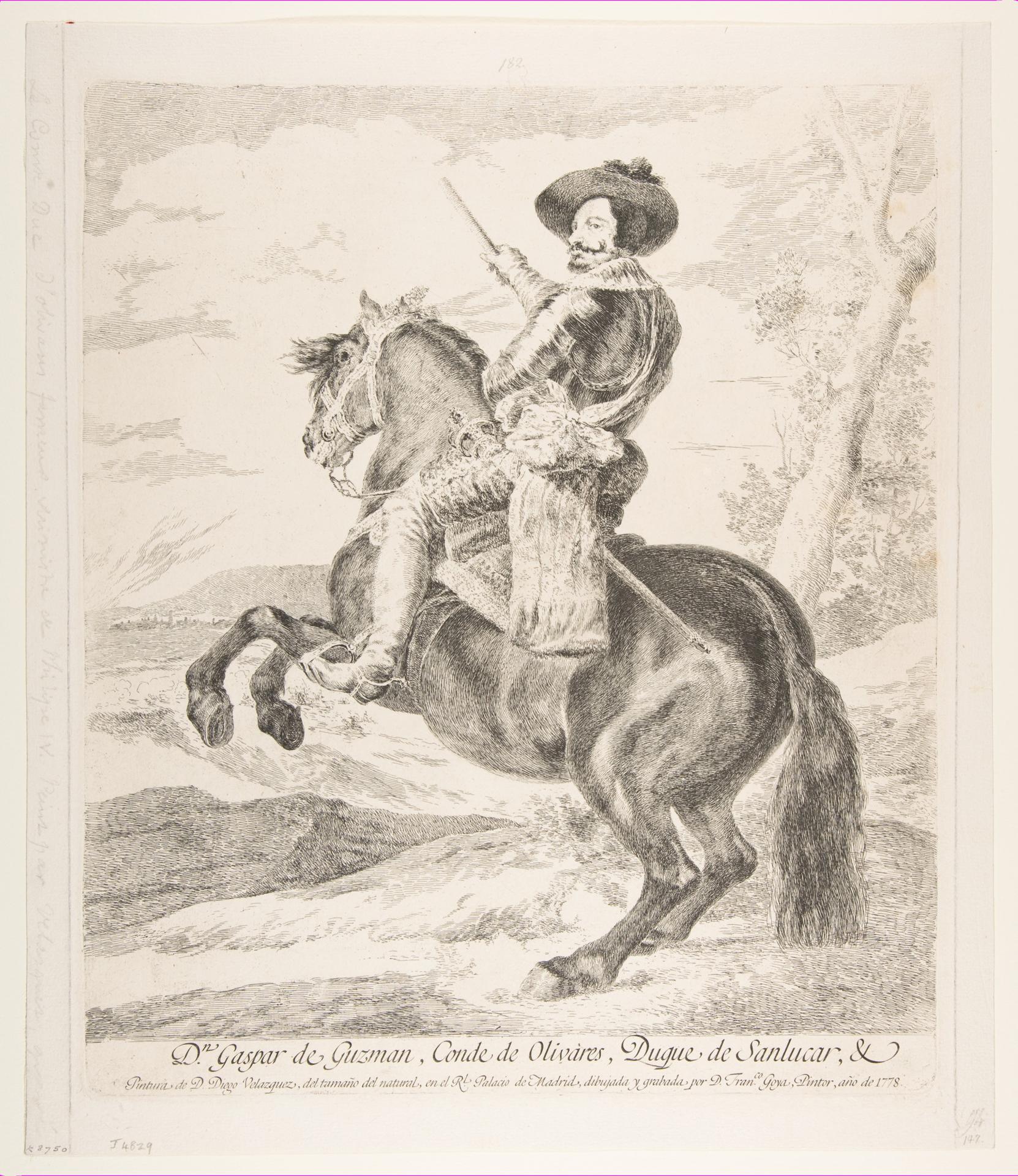
Gaspar de Guzmán, Count Duke of Olivares on horseback, after Velázquez
Original title: Gaspar de Guzmán, Count Duke of Olivares on horseback, after Velázquez
kurzbeschreibung
Unlike the other sheets in the series, which reproduce Velázquez's paintings in painterly breadth, Goya's 1778 etching focuses entirely on the equestrian figure of Gaspar de Guzmán, Count-Duke of Olivares. It belongs to a group of reproductions after works by the Spanish court painter and is executed as an etched plate.
Description
The Count-Duke sits on a rearing horse, dressed in Spanish armor, a broad hat on his head, a fur-lined coat over his shoulders; an arrow rests in his hand. The animal suggests violent motion with its raised hind legs. Trees and an open landscape stagger the space without distracting from the main subject. The layout remains taut, light and shadow are placed with care, so that texture and outline stand out clearly.
Context
This etching was made in 1778 as part of a series that reproduced paintings by Velázquez. The royal collection commissioned the series to make the court painter's works accessible to a wider circle. Olivares was one of the most powerful statesmen under Philip IV and was portrayed several times by Velázquez. In Goya's print, his engagement with Baroque models appears as both appropriation and reinterpretation.
Impact
The horse's rearing posture and the confident linework give the sitter a strong presence. Because the etching does without color and the arrangement remains clear, the sheet has a timeless elegance.
Technique
For this etching, the drawing was transferred to a metal plate and bitten with acid. Goya worked with fine lines and hatching to achieve detail and depth of shadow. The printing plate measures 37.2 × 31.4 cm, the sheet format 41.4 × 35.8 cm.
AI-generated description text
Source: Metropolitan Museum of Art · Public Domain (CC0 1.0)