Knight on Horseback and Landsknecht
Original title: Knight on Horseback and Landsknecht
kurzbeschreibung
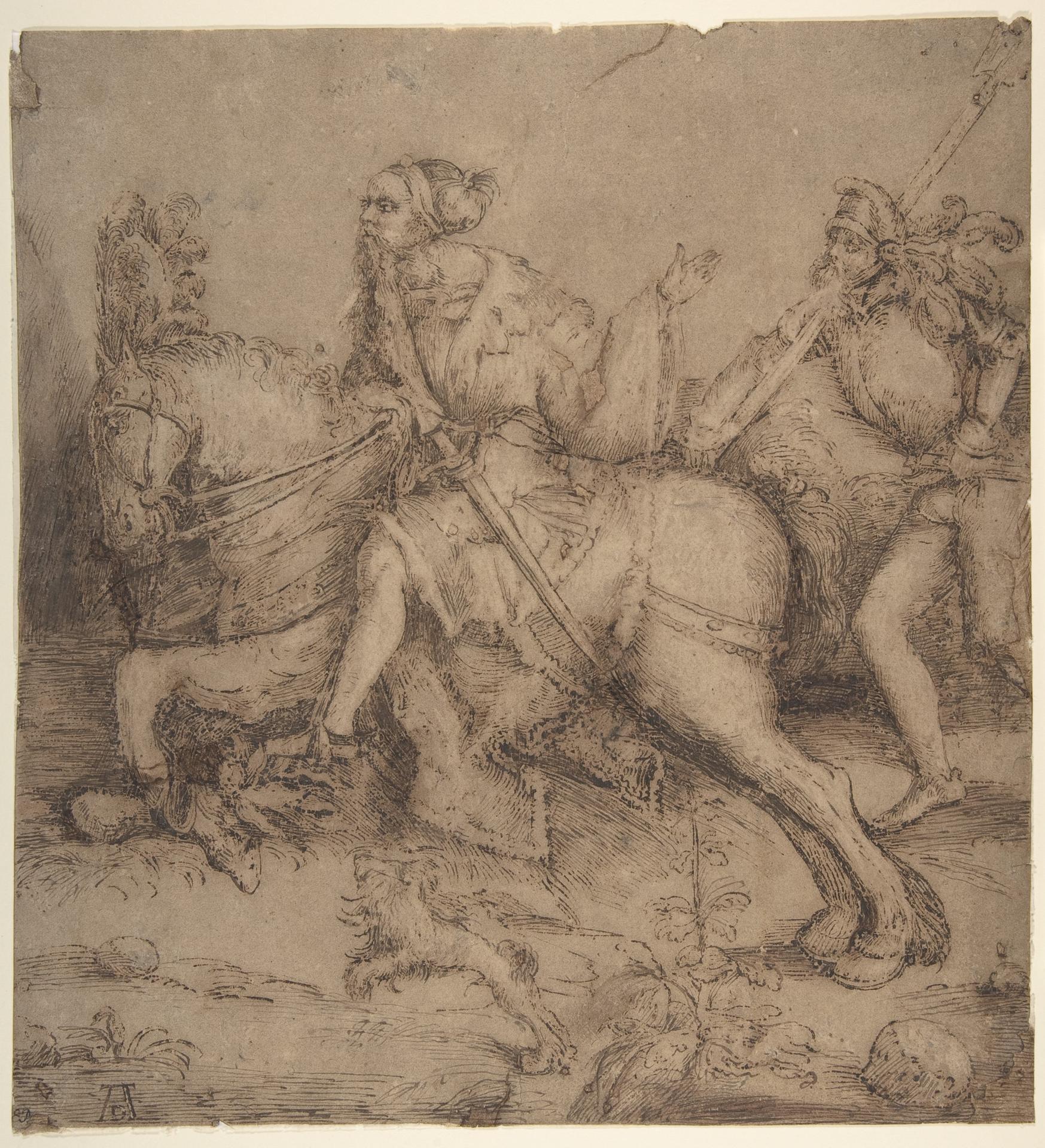
This pen-and-ink drawing by Albrecht Dürer, dated between 1485 and 1528, depicts a mounted knight and a foot soldier (Landsknecht). The work showcases Dürer's mastery of line and his interest in military figures of his time.
Description
The composition is dominated by a knight on horseback in the left foreground, his long beard and headgear suggesting a seasoned warrior. He gestures with his right hand toward the right, while the horse, shown in profile with raised hind legs, appears to be in motion. Behind the horse, a Landsknecht stands holding a long lance or spear over his shoulder, also bearded and wearing a cap. The lower edge of the drawing features vegetation, grass tufts, and stones, while the background remains empty, focusing attention on the figures.
Context
Dürer created this drawing during a period when the Landsknechts were prominent mercenary soldiers in the Holy Roman Empire, often depicted in art for their distinctive dress and martial bearing. The work reflects Dürer's interest in capturing the details of contemporary military life. The exact purpose of the drawing is unknown, but it may have served as a study or a finished work for a patron. Dürer's travels to Italy and his engagement with both German and Italian artistic traditions influenced his approach to such subjects.
Impact
The drawing conveys a sense of dynamic movement and quiet tension between the two figures and the horse. The empty background gives the scene a timeless, almost monumental quality, emphasizing the dignity of the subjects. Dürer's precise line work lends the image a sense of immediacy and realism.
Technique
The work is executed in pen and brown ink, with touches of brush and brown wash, on paper that has been fully laid down on a backing. The use of hatching and cross-hatching creates volume and shadow, while the wash adds tonal depth. This combination of techniques was typical of Dürer's detailed studies and finished drawings.
AI-generated description text
Source: Metropolitan Museum of Art · Public domain (CC0)