A False Bacchus Crowning Drunkards
Original title: A False Bacchus Crowning Drunkards
kurzbeschreibung
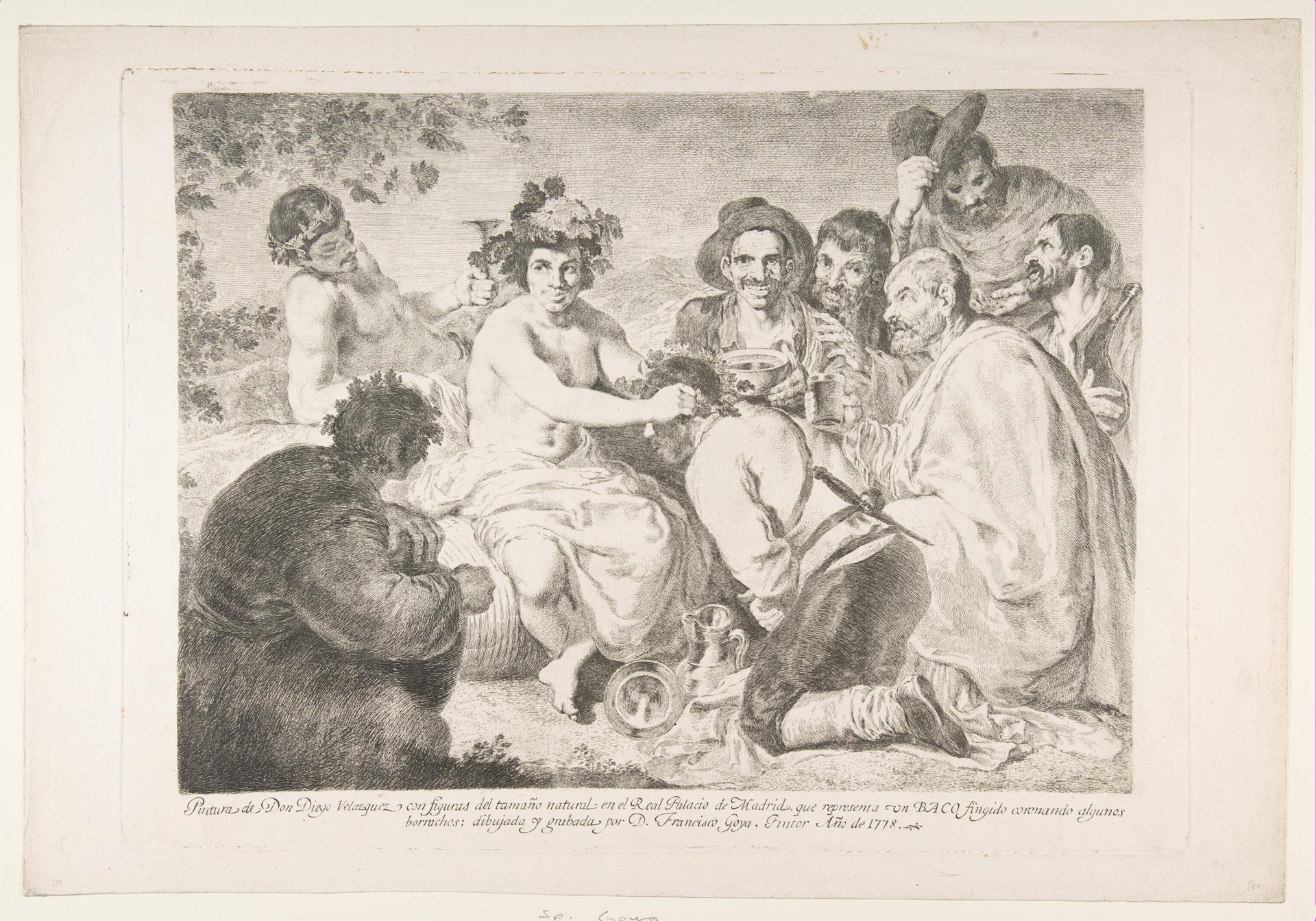
Francisco de Goya produced the etching 'A False Bacchus Crowns Drunkards' in 1778. It presents a boisterous drinking party in a rural setting. A man wearing a wreath of leaves, costumed as a false Bacchus, pours wine. The print combines close observation with comic props.
Description
A man in robes and a leaf crown rises at the center; he raises a glass of wine while seeming to intoxicate those around him. Nearby, several figures sit or stand, drinking and making music; some wear traditional clothing, a few are barefoot. Trees and plants in the background suggest a rural environment. Bodies are captured in lively poses that point in various directions. Gray tones spread evenly across the sheet, without strong shadows or highlights; the faces are exaggerated, giving the scene a comic touch.
Context
This etching dates from 1778, a period when Goya was deeply engaged with printmaking and working from old masters. It belongs to his early interest in Spanish society and its festive culture. The sheet is part of a series of etchings from the 1770s that Goya made before the later famous Caprichos. The false Bacchus alludes to contemporary criticism of excess and hypocrisy.
Impact
The print feels lively and humorous thanks to its dynamic arrangement and exaggerated faces. An ironic distance arises between the ceremonial staging and the banal drunkenness, inviting a smile. The even distribution of light and the delicate lines give the etching a calm yet animated atmosphere.
Technique
As an etching, an intaglio process, the drawing was scratched into an acid-resistant layer on a copper plate and then bitten with acid. Goya used thin lines and hatching to bring out details of the figures and the landscape. The gray values result from varying densities of strokes, without harsh contrasts of light and dark.
AI-generated description text
Source: Metropolitan Museum of Art · Public Domain (CC0 1.0)