The Vision of Saint Eustace
Original title: The Vision of Saint Eustace
kurzbeschreibung
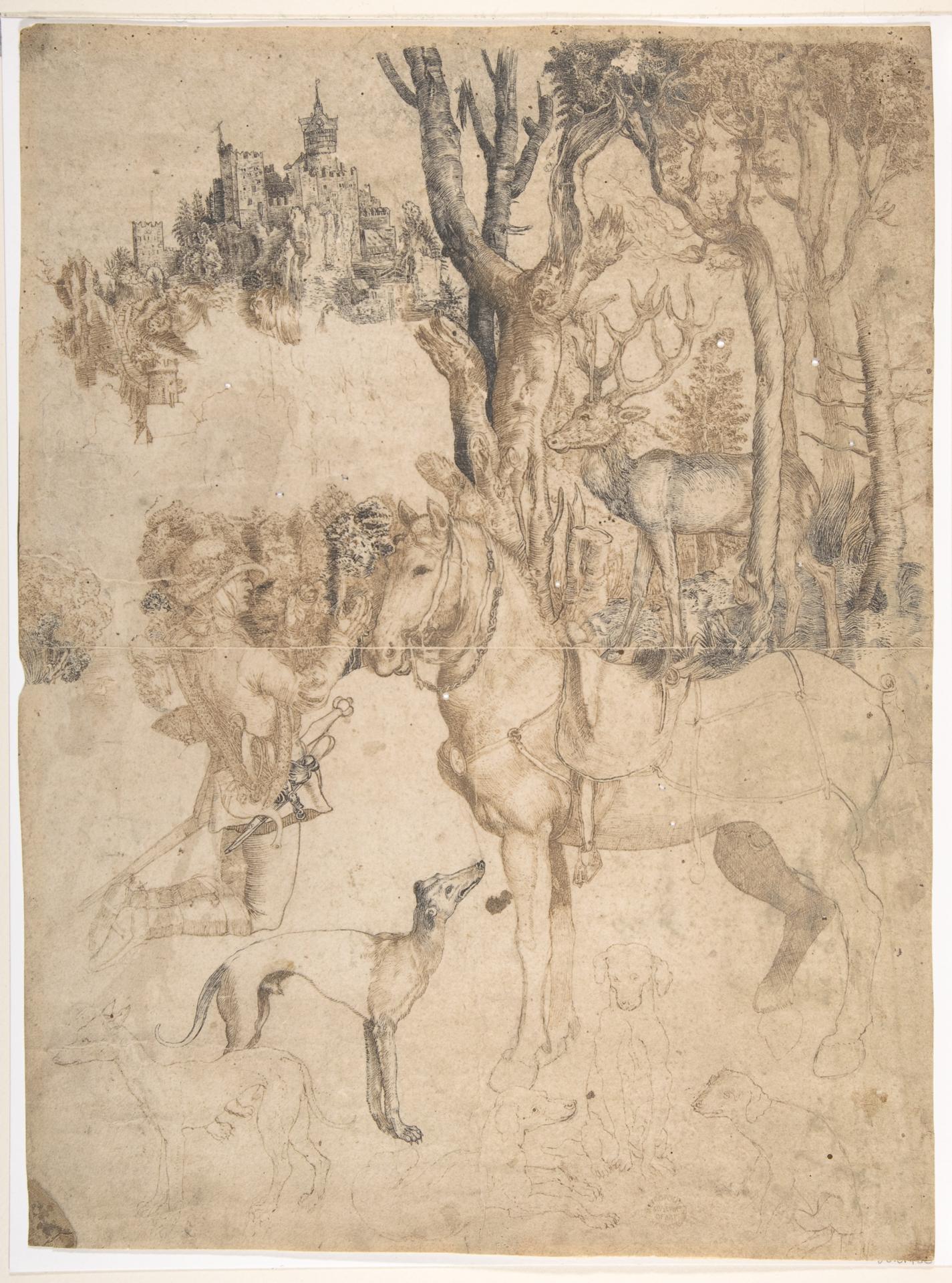
Dating from the 16th century, this anonymous German drawing depicts the vision of Saint Eustace. Executed in pen with brown and black ink over traces of black chalk, it features an armored rider who encounters a stag with a cross in the forest, surrounded by other stags and hounds, while a castle stands in the distance.
Description
In the foreground, a mounted rider in armor and helmet sits astride his horse, beside a stag; one hound stands by the horse, another lies on the ground. Further back, several stags traverse the forest, and a castle framed by trees is visible. Brown and black tones dominate the sheet, with figures and surroundings rendered in detail. The layout appears symmetrical, rider and stag forming the center, the light evenly distributed and without strong shadows.
Context
The legend of Saint Eustace, a Roman officer who received a vision of a cross between a stag's antlers while hunting, was a popular motif in Christian art during the 16th century. The sheet originated in German-speaking lands, where such scenes often served as devotional images or as models for printmaking. The unknown artist employs mannerist traits such as elongated proportions and a dynamic arrangement. Nothing is known about the patron or purpose.
Impact
The symmetrical arrangement and calm, even lighting give the sheet a solemn, almost statuesque presence. The detailed execution invites lingering and emphasizes the spiritual content of the motif.
Technique
Drawn with pen in brown and black ink over traces of black chalk. This interplay of pen and chalk allows both precise lines and soft tonal transitions. The dimensions of 35.2 x 26.3 cm suggest a single sheet, likely intended as an independent work of art or as a design.
AI-generated description text
Source: Metropolitan Museum of Art · Public Domain (CC0 1.0)