Animal Folly
Original title: 'Animal Folly' from the 'Disparates' (Follies / Irrationalities)
kurzbeschreibung
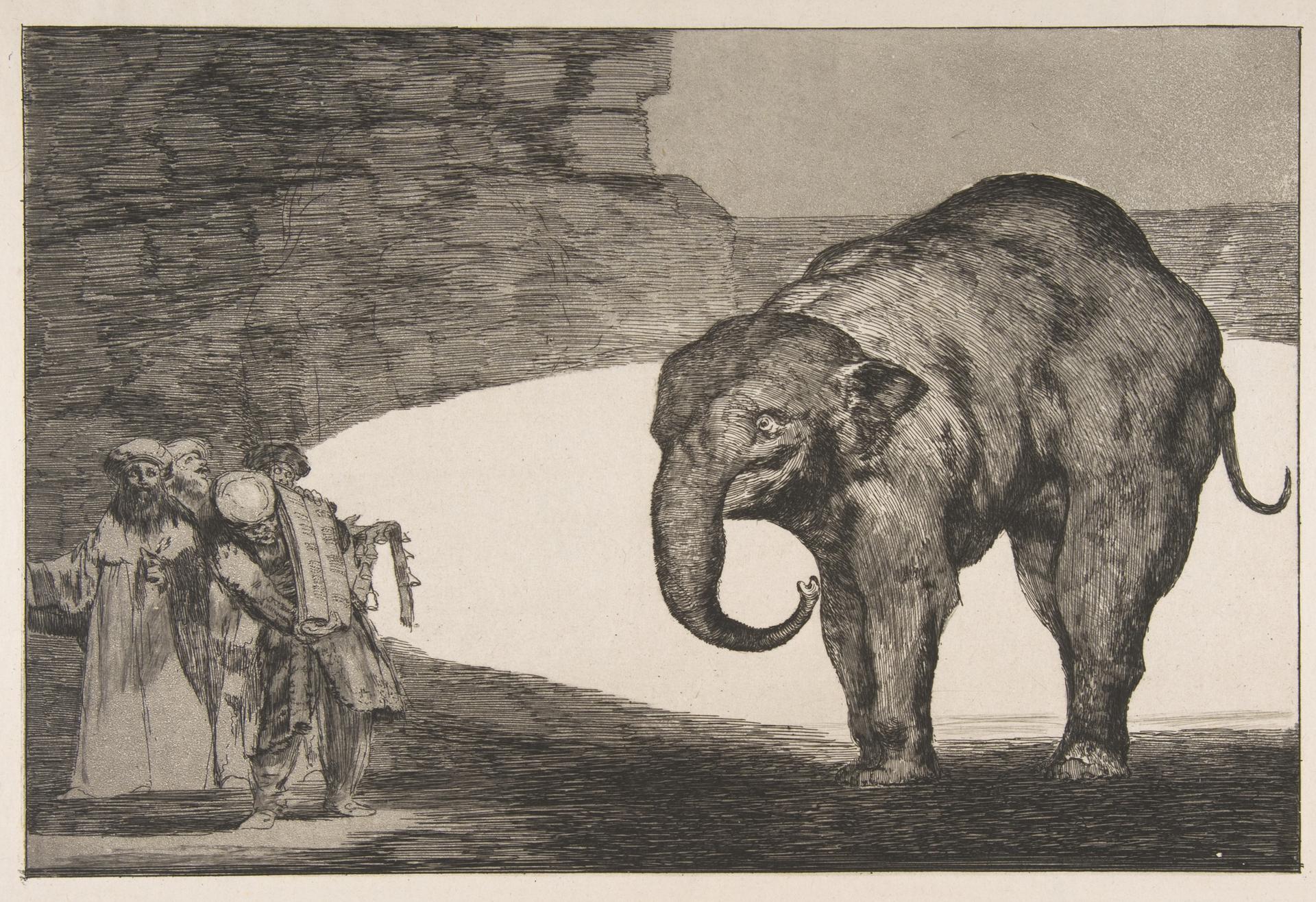
Made around 1815–19, Francisco de Goya's 'Animal Folly' belongs to the series 'Disparates', also called 'Follies' or 'Irrationalities'. A group of people stands observing a large elephant. The etching, worked with aquatint and drypoint on Japan paper, comes from Goya's late period of printmaking.
Description
The layout feels lopsided: on the left, several figures in traditional, possibly oriental dress gather on a raised platform, while the elephant, with long tusks and prominent ears, fills most of the right side. A dark, textured wall or rock face closes off the space behind. Subdued light picks out shadows and the surfaces of figures and beast. Grey tones govern the whole palette; colour is absent.
Context
The 'Disparates' were made between 1815 and 1819 but did not appear in print until 1877, after Goya's death. He worked on them during a period of social and political turmoil in Spain, directly after the restoration of Bourbon rule. The plates in this series are known for their hard-to-read, often satirical imagery, which resists any single interpretation.
Impact
An unsettling, surreal mood emanates from the print and leaves the viewer at a loss. The exotic subject meets a gloomy, heavily textured graphic style, and from that grows the sense of the irrational that runs through the entire series.
Technique
The plate was printed as an etching, combined with aquatint and drypoint, on Japan paper. Aquatint produces soft grey gradations and gentle transitions, while drypoint sets fine, scratchy lines against them. The result is a broad tonal range that renders light and shadow in detail.
AI-generated description text
Source: Metropolitan Museum of Art · Public Domain (CC0 1.0)