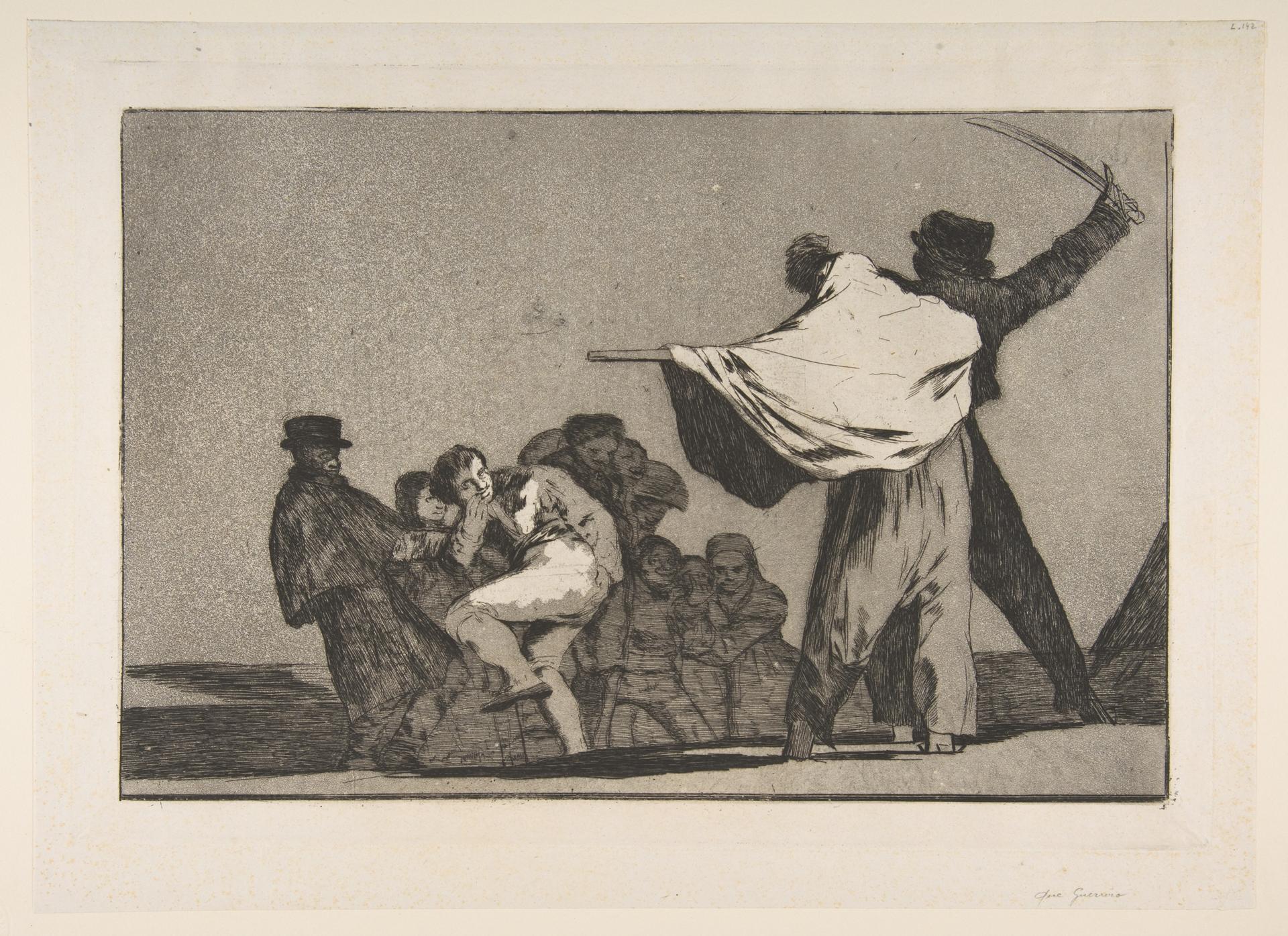
Well-Known Folly (ca. 1815–19 (published before 1877), Met-Objekt 1368)
Original title: 'Well-Known Folly' from the 'Disparates' (Follies / Irrationalities, Plate A)
kurzbeschreibung
Francisco de Goya made "Wohlbekannte Torheit" as an etching with aquatint between 1815 and 1819. The sheet belongs to the series "Disparates" (Follies) and was published before 1877. It shows a group of figures in a puzzling, possibly threatening situation.
Description
In the foreground a man in agitated posture holds up a long object—it could serve as a tool or a weapon. To one side, a figure sits on a chair, held by a third person, while others in the background watch what is happening. The layout is clearly asymmetrical and emphasizes the main actor's restlessness. The etching's gray tones bring out the outlines and the texture of the clothing; the light appears flat, without strong shadows.
Context
The "Disparates" date from Goya's late period, when he was increasingly detaching himself from social norms. The prints were published only after his death—a sign of their private and rule-breaking character. In them Goya repeatedly took up human foolishness and social ills without resolving them clearly.
Impact
The scene spreads an unsettling tension because the figures' actions cannot be clearly deciphered. The uneven distribution of the figures and the dynamic pose of the main actor heighten the impression of unease and threat that keeps the viewer engaged for a long time.
Technique
Etching with burnished aquatint allows fine tonal gradations and deep, rich areas. Line etching and aquatint together make possible both sharp contours and soft, painterly shadows. The sheet measures 24.5 × 35 cm and is printed on a larger sheet of 27.5 × 38 cm.
AI-generated description text
Source: Metropolitan Museum of Art · Public Domain (CC0 1.0)