Little Bulls' Folly
Original title: 'Little Bulls' Folly' from the 'Disparates' (Follies / Irrationalities, Plate D)
kurzbeschreibung
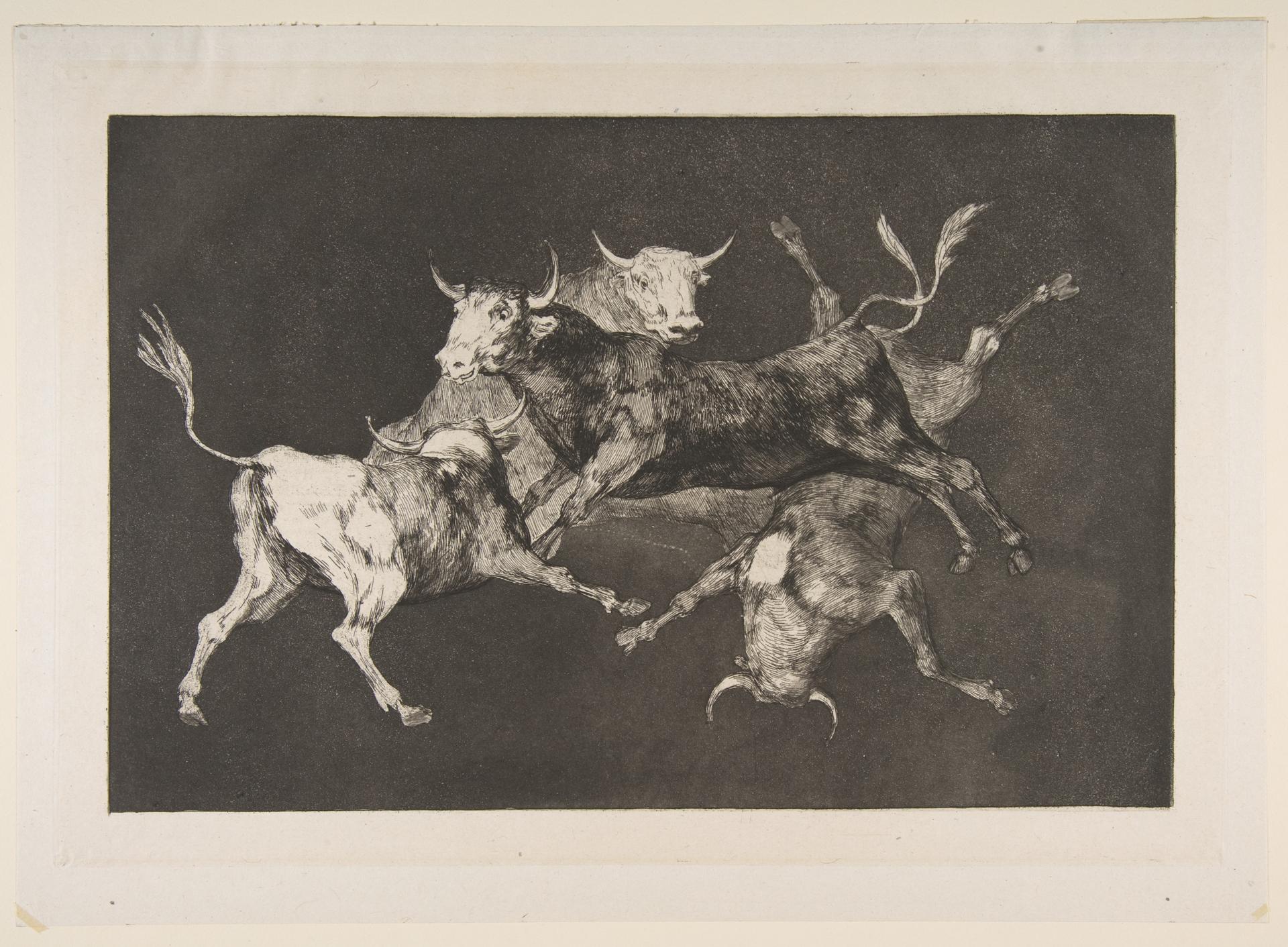
Unlike many related sheets from the 'Disparates,' this etching by Francisco de Goya from around 1815–19 does not rely on individual figures but on a group of four cattle in agitated movement. The motif is executed as a combination of drypoint, aquatint, and etching, printed on Japan paper.
Description
Four cattle, each in a different phase of motion, butt and chase one another. The layout is asymmetrical, which further emphasizes the restless action. Gray tones dominate the sheet; fine lines and hatching bring out the contours. Shadows are almost entirely absent, and the light appears even, so that the bodies and their movements come fully to the fore.
Context
The 'Disparates' series was created between 1815 and 1819, when Spain was politically unstable after the return of the Bourbons. The prints were not published until after Goya's death, with the first edition appearing before 1877. Among his works, the series is considered one of the most enigmatic and at the same time most critical, as it addresses social and political grievances.
Impact
The swirling activity of the cattle draws the viewer into an uncontrolled movement while leaving them feeling alienated. The monochrome design and nuanced tonal gradations give the sheet a dark, almost threatening mood, characteristic of Goya's late graphic work.
Technique
Drypoint, aquatint, and etching on Japan paper come together here. These techniques allow both precise lines and soft tonal transitions that accurately model the animals' movements. The plate measures 24.5 × 35 cm, the paper sheet 27.5 × 38 cm.
AI-generated description text
Source: Metropolitan Museum of Art · Public Domain (CC0 1.0)