Blind Guitarist
Original title: Blind Guitarist
kurzbeschreibung
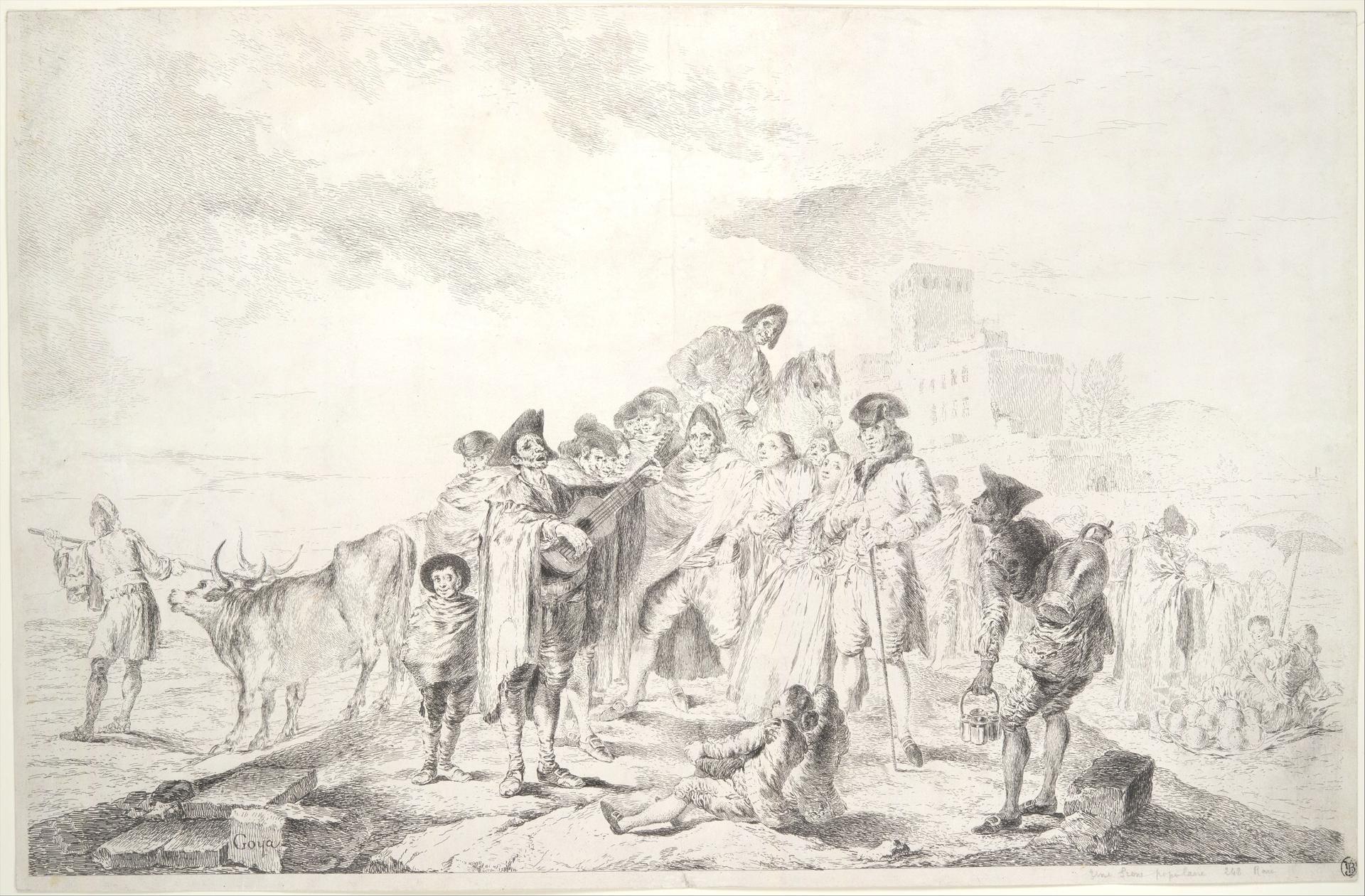
Around 1778, Francisco de Goya y Lucientes made the etching "Blind Guitarist." The image presents a blind musician with his guitar in a rural setting, surrounded by listeners and passersby.
Description
In the foreground sits a blind guitarist, with several people in various clothing standing around him. Some listen, while others go about their own business. On the left, a man with a staff; on the right, one with a bucket; in the middle, another with a staff. Buildings, trees, and a person with an umbrella can be made out in the distance. The black-and-white print renders figures and surroundings in detail.
Context
This etching dates from Goya's early period, when he engaged closely with Spanish popular life. It belongs to a series of prints that capture everyday scenes and social types of the time. The blind musician points to the tradition of itinerant singers and beggars in eighteenth-century Spain.
Impact
Precise lines and realistic figures define the sheet. The arrangement draws the eye to the musician and creates a calm, contemplative mood. The black-and-white technique underscores the seriousness of the subject and the social reality of those depicted.
Technique
This etching is an intaglio process: the drawing is scratched into a metal plate and bitten with acid. Goya achieved fine lines and shading, allowing a detailed rendering of the scene. The sheet measures 35.1 × 54 cm.
AI-generated description text
Source: Metropolitan Museum of Art · Public Domain (CC0 1.0)