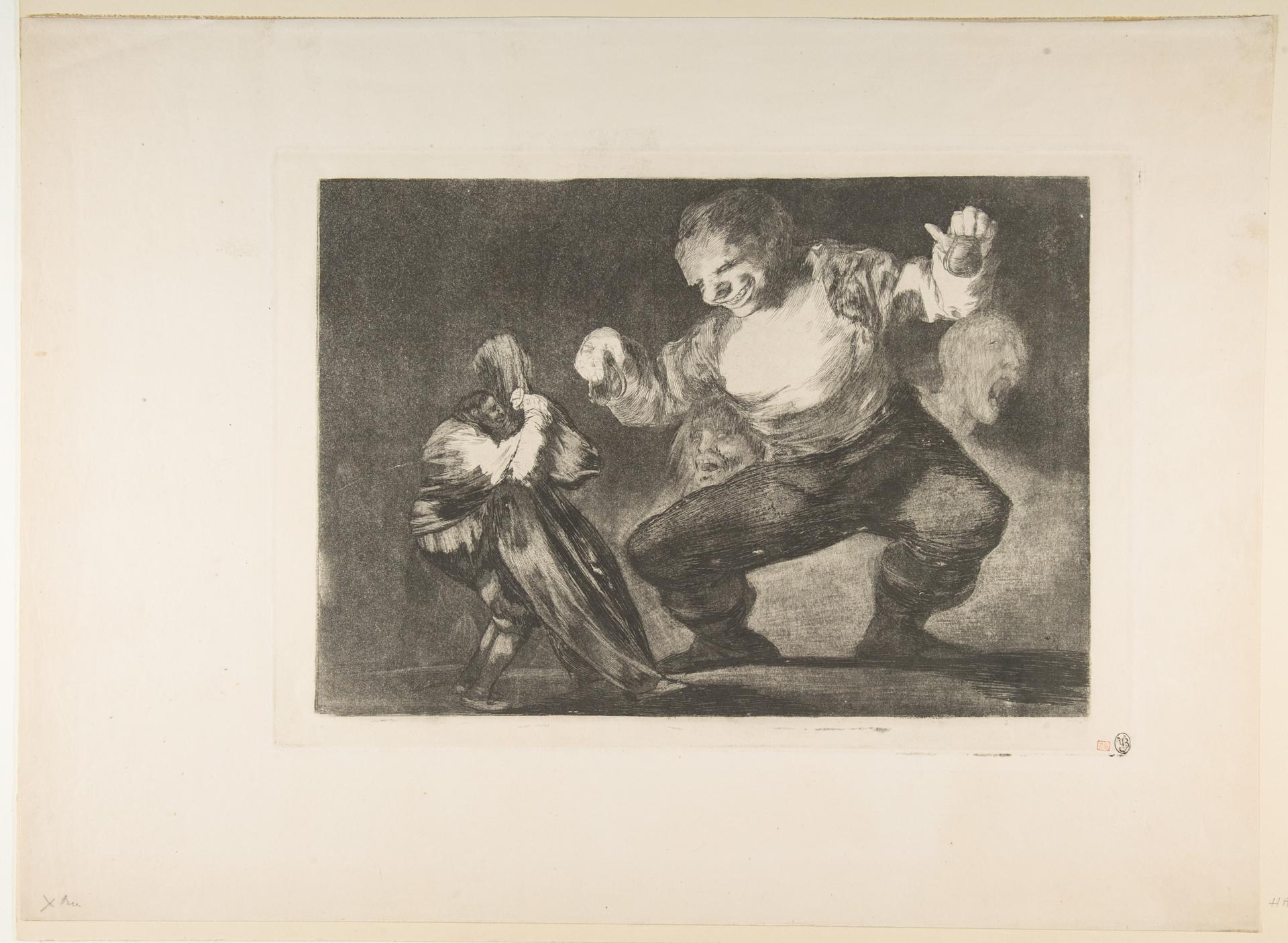
Dancing Giant (ca. 1815–19 (published between 1854–63))
Original title: 'Dancing Giant' from the 'Disparates' (Follies / Irrationalities)
kurzbeschreibung
Two figures appear in expressive dance poses, grotesquely exaggerated. Francisco de Goya made this print around 1815–19 as part of his 'Disparates' series, which was not published until between 1854 and 1863. It is executed as an etching, with aquatint and drypoint added.
Description
The larger figure in front wears an exaggerated, comic expression; the folds of drapery and gesturing arms intensify this impression. It seems to be dancing or rejoicing. Behind it, a smaller figure moves similarly but is less dominant in the overall image. Dark, almost black tones prevail; light falling from above accentuates contours and lines of movement. The layout is asymmetrical—the large figure in front, the smaller one behind—which heightens the dynamism.
Context
The 'Disparates' were created between 1815 and 1819 but only came to public light after Goya's death. Within his oeuvre, this group of works is among the most enigmatic and often circles around social absurdities and human folly. The prints fell into a phase of political restoration in Spain, after the liberal constitution of 1812 had been repealed. The series' dark, satirical imagery is often read as a commentary on the conditions of those years.
Impact
The almost monochrome darkness and the grotesquely distorted figures evoke a mood that oscillates between menace and comedy. The sweeping poses and unusual arrangement give the sheet an expressive, almost carnivalesque energy. Such tension unsettles the viewer and prompts reflection.
Technique
Etching, burnished aquatint and drypoint come together here, producing a fine gradation of tones and a dense texture. The deep, velvety blacks stem from the aquatint, while the drypoint contributes precise, expressive lines. The plate measures 24.5 × 35 cm; it was presumably reworked in several stages to achieve the intended dramatic lighting effect.
AI-generated description text
Source: Metropolitan Museum of Art · Public Domain (CC0 1.0)