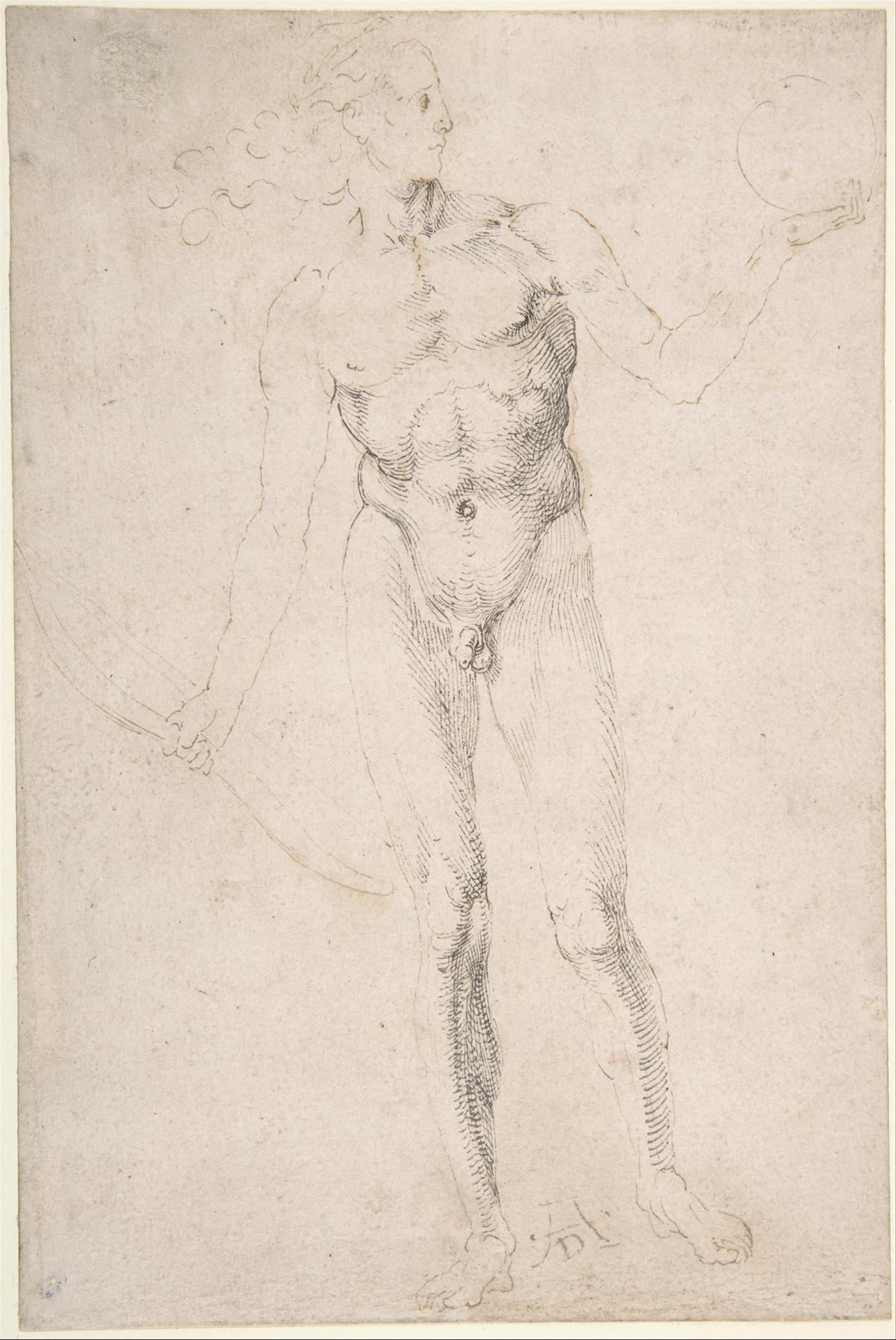
Standing Male Nude Holding a Bow ("Poynter Apollo")
Original title: Standing Male Nude Holding a Bow ("Poynter Apollo")
kurzbeschreibung
Albrecht Dürer drew this standing nude man with a bow between 1501 and 1503. The man appears in profile, has long, wavy hair, and holds a bow in his right hand, while his left hand presents a disc or shield. The sheet is executed with pen in brown and black ink on paper.
Description
The upright figure fills almost the entire sheet, leaving the background empty so that the paper's texture remains visible. Seen from the side and turned slightly to the right, the man's long, wavy hair falls over his shoulders. His right hand holds a bow curved downward, and his outstretched left hand displays a round object resembling a shield. The legs are set somewhat apart, giving the pose stability.
Context
During his second stay in Italy (1501–1503), Dürer made this study at a time when he was deeply engaged with ancient models and the proportions of the human body. The nickname “Poynter-Apollo” comes from the collection of the British artist Edward Poynter, where the sheet once belonged. Such drawings served Dürer as preparatory studies for larger paintings and prints, for example for the Apollo in the “Martyrdom of the Ten Thousand Christians”.
Impact
Clear, calm lines and precise anatomical observation define the sheet. Because the surroundings remain empty, attention focuses entirely on the figure, which gains a monumental, almost antique presence through its upright posture and the symmetrical arrangement of bow and shield.
Technique
Executed in pen with brown and black ink, the drawing relies on fine, controlled lines, and the mixture of inks yields subtle tonal values that model the musculature without hatching or wash. The upright figure occupies most of the sheet, while the empty background leaves the paper's natural texture visible.
AI-generated description text
Source: Metropolitan Museum of Art · Public Domain (CC0 1.0)