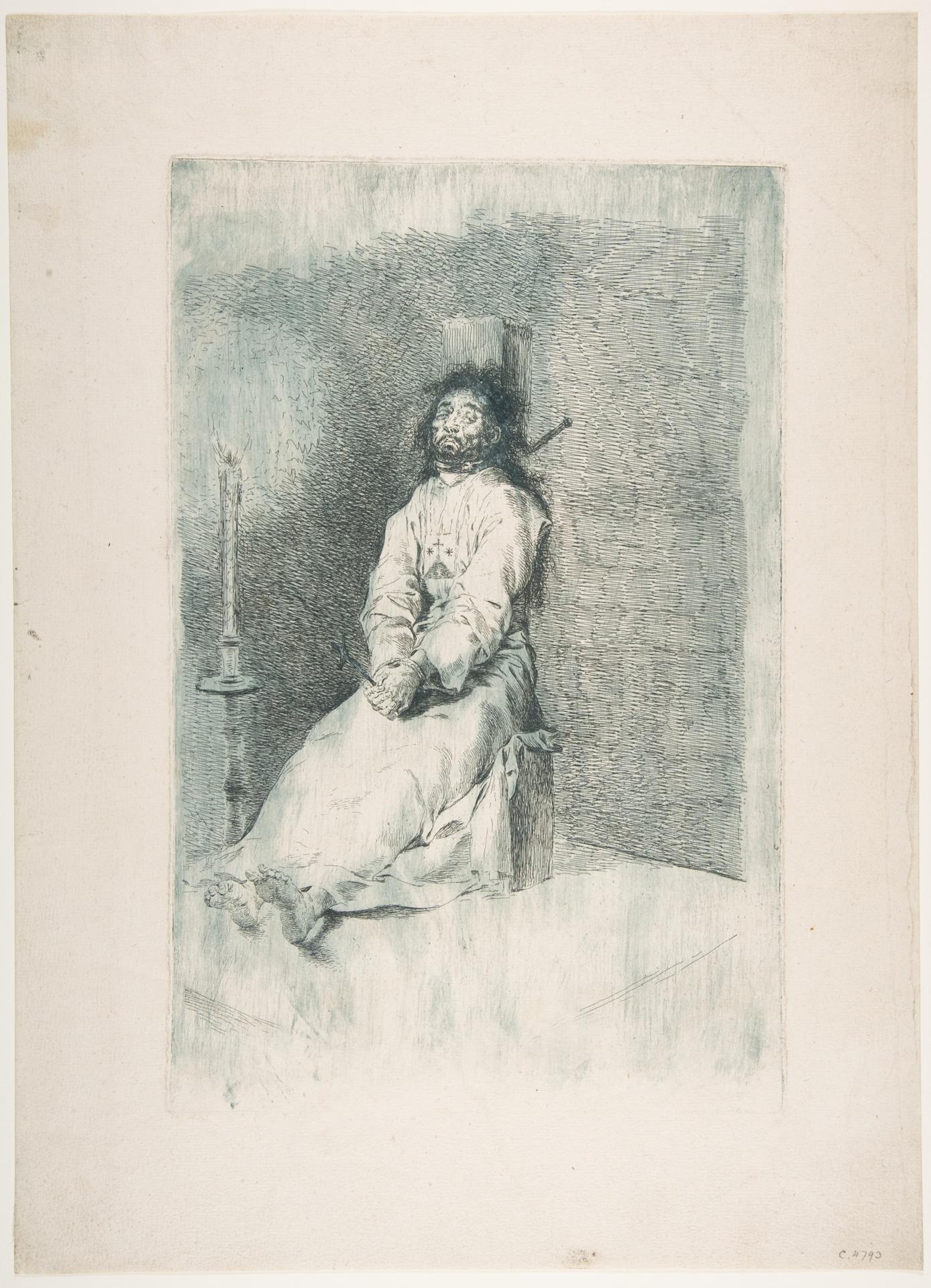
Garroted Man
Original title: Garroted Man
kurzbeschreibung
Francisco de Goya y Lucientes made this etching around 1775–78. It is a working proof printed in blue, showing a seated, bound figure with a mask or skull on its head.
Description
The figure sits at the front, wrapped in a long robe, arms bound in front of the body. A mask or skull covers its head. To its left, a candlestick with a flame gives off light. Strong hatching runs through the dark background, creating an oppressive mood. The layout feels lopsided: the figure on the right, the candlestick on the left.
Context
This etching belongs to Goya's early years, before his appointment as royal court painter in 1786. It is part of a group of prints dealing with violence and execution — a subject he would take up again later. The existence of a proof in blue shows Goya testing different printing inks to vary the effect of his etchings.
Impact
The blue tone and harsh contrasts of light and dark give the sheet a gloomy, almost surreal air. The isolated figure with the mask seems stripped of its humanity and stirs unease. Fine lines and hatching bring out the texture of the robe and the harshness of the event.
Technique
An etching, with the plate worked in fine lines and hatching. It was printed in blue ink — unusual for a proof — which heightens the play of light and shadow. Goya's precise technique shapes both contours and dark areas.
AI-generated description text
Source: Metropolitan Museum of Art · Public Domain (CC0 1.0)