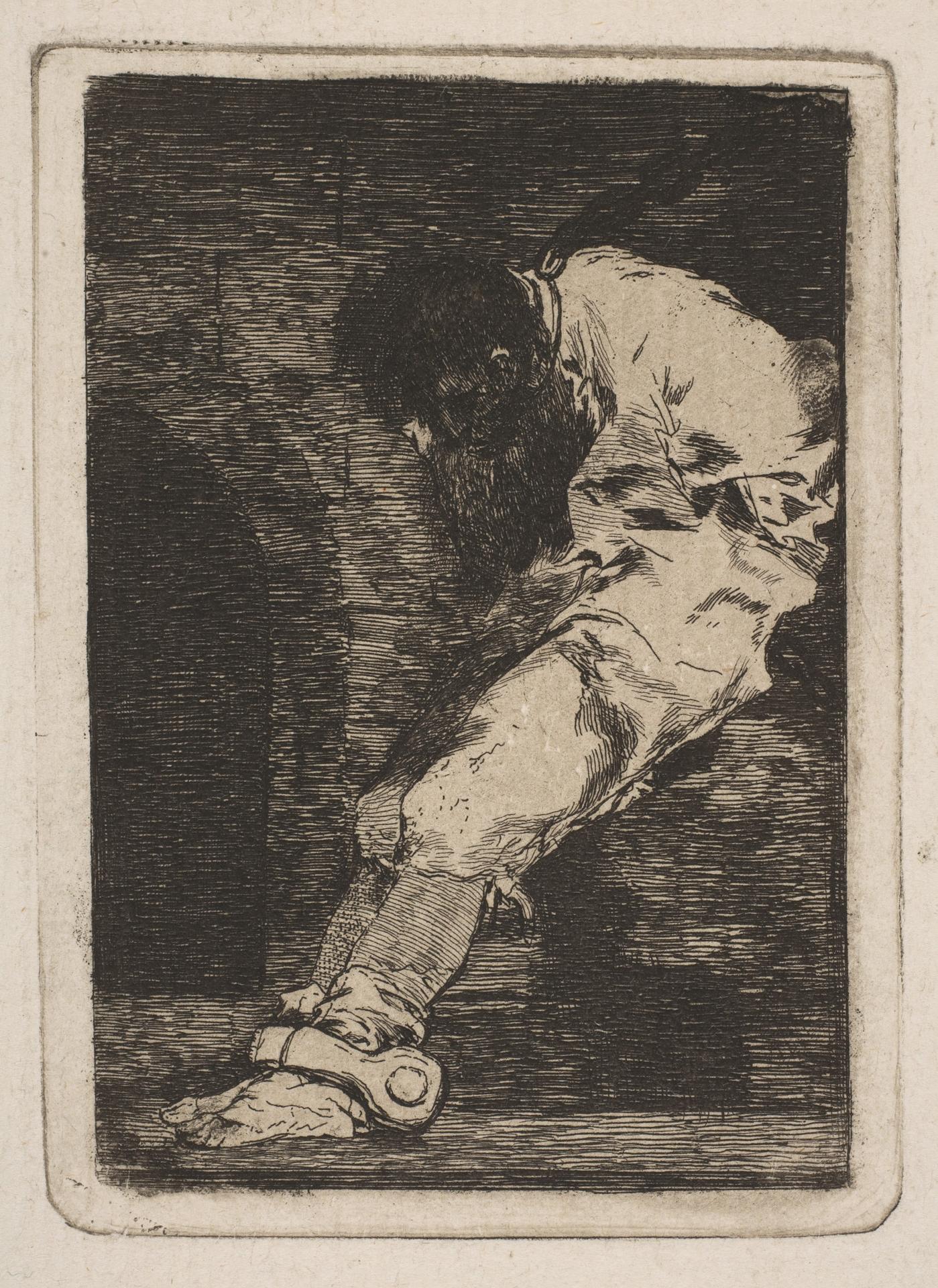
If he is guilty, let him die quickly (Si es delinquente qe. muera presto)
Original title: 'If he is guilty, let him die quickly' (Si es delinquente qe. muera presto)
kurzbeschreibung
Francisco de Goya made this etching around 1815, though it was not published until 1859. It shows a bound man crouching in darkness. The print belongs to a series devoted to the atrocities and violence of war.
Description
A man in chains remains hunched over. His head droops forward, his face expressing despair. The shackles are clearly visible, binding both hands and feet. The background stays dark and undefined, keeping the prisoner at the center. Fine lines and hatching define the contours and surfaces of the man and the chains.
Context
Goya produced this etching during a period marked by the aftermath of the Napoleonic Wars in Spain. It is part of a series dealing with the horrors of war and oppression. Only after Goya's death, in 1859, was the work published—a fact that suggests possible censorship or restraint during his lifetime.
Impact
Gloomy and oppressive, the print immediately draws the viewer in. The prisoner's despair and the dark background evoke a sense of hopelessness and human suffering.
Technique
As an etching, the work uses fine lines and hatching to shape light and shadow. This technique allows precise rendering of details such as the chains and the man's facial expression, while the dark areas are built up through dense layers of strokes.
AI-generated description text
Source: Metropolitan Museum of Art · Public Domain (CC0 1.0)