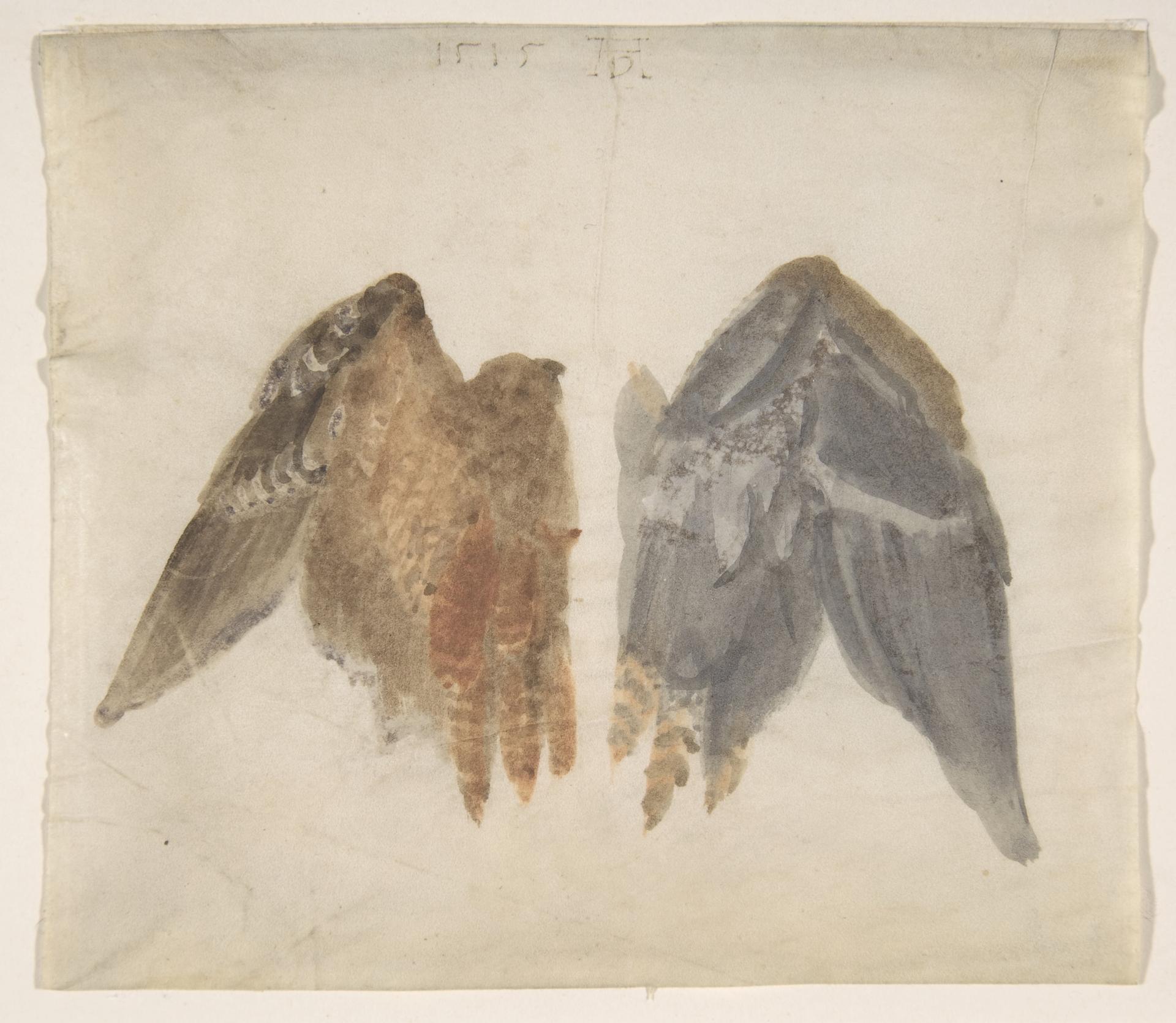
Bittern's Wings: study showing both sides
Original title: Bittern's Wings: study showing both sides
kurzbeschreibung
Albrecht Dürer's 'Bittern's Wings: study showing both sides' (1515) is a watercolor on vellum depicting two views of a bittern's wings. The study shows the underside of the left wing and the upper side of the right wing, with the date inscribed at the top.
Description
The composition presents two wings laid out horizontally, each held by a small hand at the base. The left wing is rendered in warm browns with a reddish accent at the wrist, showing the feather structure from below. The right wing, in cool grays, displays the upper surface of the bird. The date '1515' is written in cursive at the top edge of the sheet.
Context
Dürer created this study in 1515, during a period when he produced detailed natural history studies, including the famous rhinoceros woodcut. Such wing studies were likely made for reference in larger compositions, possibly for altarpieces or prints. The bittern, a marsh bird, was a subject of interest in Renaissance naturalia collections.
Impact
The juxtaposition of the two wings—one warm-toned, the other cool—creates a subtle visual rhythm that emphasizes the anatomical differences between the upper and lower surfaces. Dürer's precise rendering gives the feathers a lifelike texture, inviting close inspection. The scientific clarity is balanced by an aesthetic sensitivity to color and form.
Technique
Dürer employed watercolor on vellum, a technique that allowed for fine detail and translucent layering. The use of vellum provided a smooth, durable surface ideal for delicate brushwork. The artist likely worked from a freshly killed specimen, capturing the exact color and structure of the feathers.
AI-generated description text
Source: Metropolitan Museum of Art · Public domain (CC0)