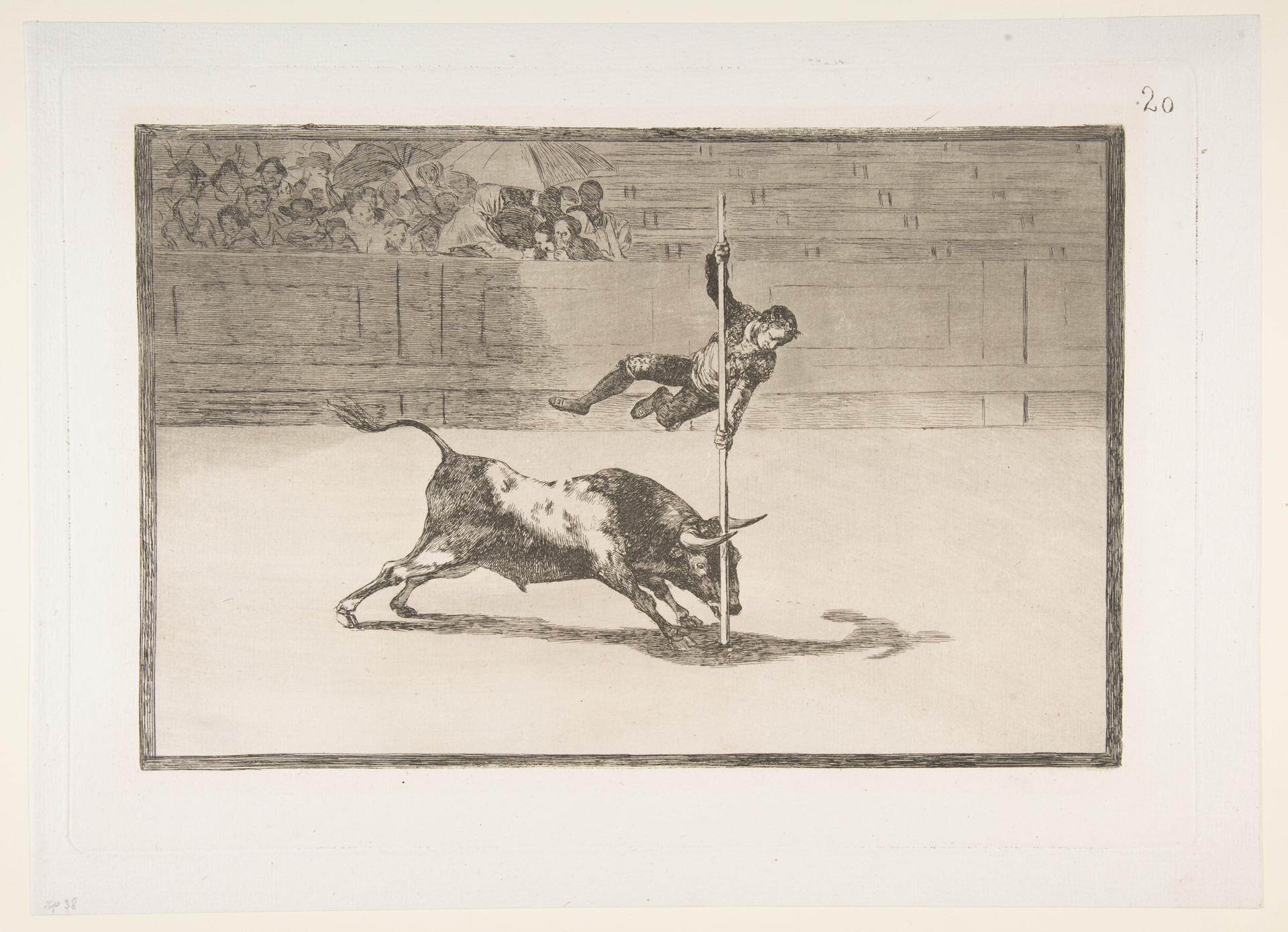
The agility and audacity of Juanito Apiñani in [the ring] at Madrid, plate 20 from "La Tauromaquia"
Original title: The agility and audacity of Juanito Apiñani in [the ring] at Madrid, plate 20 from "La Tauromaquia"
kurzbeschreibung
Juanito Apiñani, an early 19th-century bullfighter, balances on a bull hook in the arena of Madrid as the bull rushes beneath him. Goya captured this daring moment in 1816 in an etching with aquatint, part of his series 'La Tauromaquia'. The print shows the acrobatic feat before the eyes of the audience.
Description
A bull charges forward with its head lowered, a bull hook stuck in its back. On it, a man has settled into a reckless pose that combines balance and daring. Behind the fighting area rises a wooden stand where spectators stand tightly packed, some holding parasols. The layout is asymmetrical and draws the eye to the interplay of strength between man and animal. Gray tones dominate the monochrome print, with shadows almost entirely absent, suggesting even lighting.
Context
The etching was made in 1816 and belongs to the 33-print series 'La Tauromaquia', which Goya created between 1815 and 1816. In it, he traces the development of Spanish bullfighting from its beginnings to his own time. Juanito Apiñani was a well-known torero of the early 19th century whose acrobatic tricks were famous. The series was published in Madrid in 1816 after the first edition of 1815 found no buyers.
Impact
The man's contorted posture and the bull's urge to move create a gripping tension. Even lighting and the densely packed crowd make the event appear as a public spectacle. Viewers of the print witness a dangerous moment that evokes both admiration and unease.
Technique
For this print, Goya used etching with aquatint, a technique that allows soft tonal gradations. The lines are drawn precisely, while the aquatint provides soft gray values in the areas. The plate size of about 24.5 × 35.3 cm corresponds to the usual format of printed graphics of that time.
AI-generated description text
Source: Metropolitan Museum of Art · Public Domain (CC0 1.0)