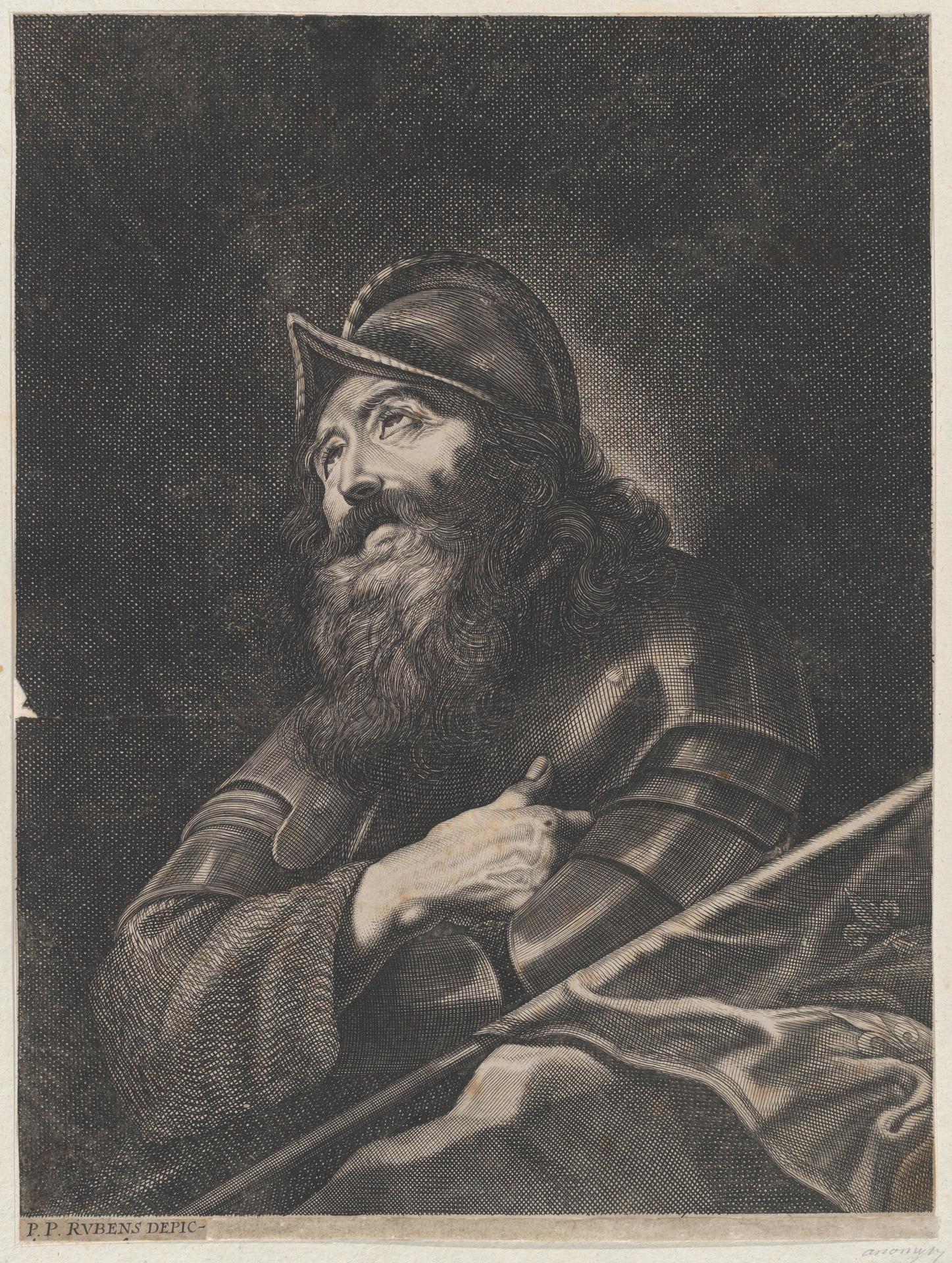
Saint William of Aquitaine (?)
Original title: Saint William of Aquitaine (?)
kurzbeschreibung
A bearded man in armor, wearing a helmet and holding a shield, appears in this anonymous 18th-century engraving or etching. The inscription “P.P. RUBENS DEPICT” suggests the design originates with Peter Paul Rubens. The sheet is identified as Saint William of Aquitaine and has been trimmed to 36.4 × 27.2 cm.
Description
The viewer’s eye is first drawn to the man’s pale face, turned upward and to the side in a near-profile. Long, thick beard and hair frame it, emerging from beneath a helmet. An arm guard and a shield resting at his side are visible. The dark, high-contrast background makes the figure stand out, while delicate lines and hatching emphasize the contours and textures of armor and clothing.
Context
The inscription “P.P. RUBENS DEPICT” points to a design by Peter Paul Rubens, active in the 17th century. This sheet, however, dates from the 18th century and is the work of an unknown engraver reproducing Rubens’s composition. William of Aquitaine was a medieval duke later canonized; his portrayal as a knight with helmet and shield follows the iconography of the warrior saint.
Impact
The dark background and bright face give the scene a dramatic yet contemplative mood. The upward gaze lends the figure a spiritual presence, grounded by the detailed rendering of the armor. The etching produces a fine, graphic texture that marks the sheet as a high-quality reproduction.
Technique
Fine lines and hatching, created by etching into a metal plate, identify the work as an etching. The print on paper has been trimmed to 36.4 × 27.2 cm, suggesting later framing or binding. This technique allows precise details and a wide contrast range that emulates the lighting of Rubens’s original.
AI-generated description text
Source: Metropolitan Museum of Art · Public Domain (CC0 1.0)