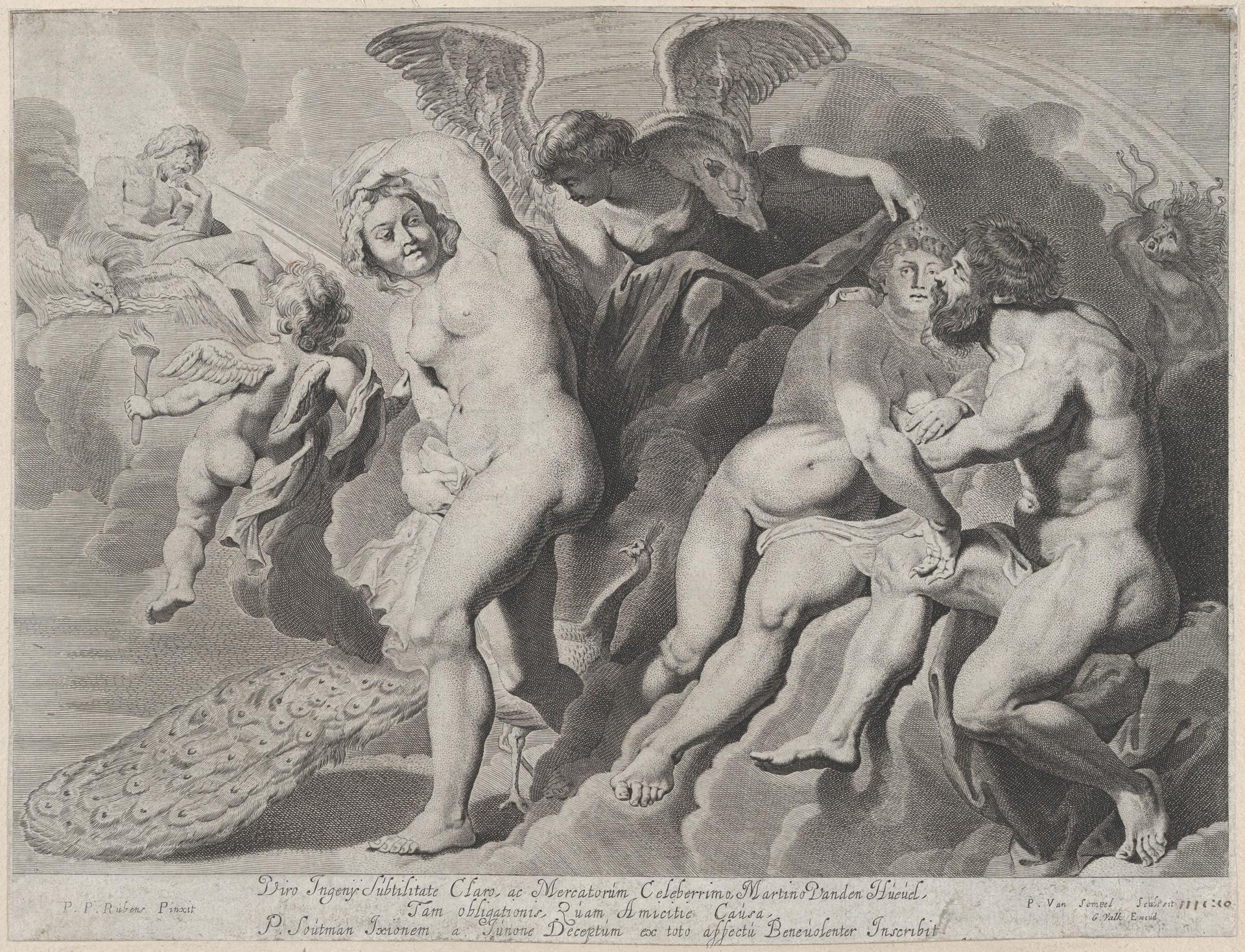
Ixion Deceived by Hera
Original title: Ixion deceived by Hera
kurzbeschreibung
Pieter Van Sompel produced this engraving between 1620 and 1624. It presents the mythical episode in which Hera deceives Ixion by placing a cloud before him in her own likeness. The sheet survives as the fourth and final state according to Hollstein.
Description
A winged female figure wearing a headscarf, generally understood as Hera, occupies the middle of the image and wraps a man—presumably Ixion—in a cloth. Beside her stand two figures resembling angels or cherubim; one of them holds a candle. Further back, another female figure appears seated on an eagle. Clouds and a luminous ground define the celestial setting, while strong contrasts of light and dark make the figures stand out. The graded gray tones are characteristic of etching from this period.
Context
Van Sompel belongs to the Dutch engravers of the early seventeenth century and became known primarily for his reproductive prints. His sheet appeared at a time when mythological subjects were in high demand in Netherlandish printmaking. The source is the ancient legend transmitted through Ovid's Metamorphoses; it captures a moment of deception that Baroque art often took up. That four states of the plate exist points to repeated reworking and sustained interest in the motif.
Impact
The high-contrast lighting directs attention to Hera and lends the event dramatic tension. Floating figures and the heavenly backdrop create a stage-like presence. The wealth of detail draws the viewer into the mythical action.
Technique
This engraving relies on the process of incising lines into a metal plate and then printing from it. Fine hatching and nuanced gray values produce a sculptural effect and atmospheric depth. The fourth state demonstrates that the plate was worked on several times—a sign of careful artistic labor.
AI-generated description text
Source: Metropolitan Museum of Art · Public Domain (CC0 1.0)