Portrait of Gisbert de la Marche, Bishop of Liège
Original title: Portrait of Gisbert de la Marche, Bishop of Liège
kurzbeschreibung
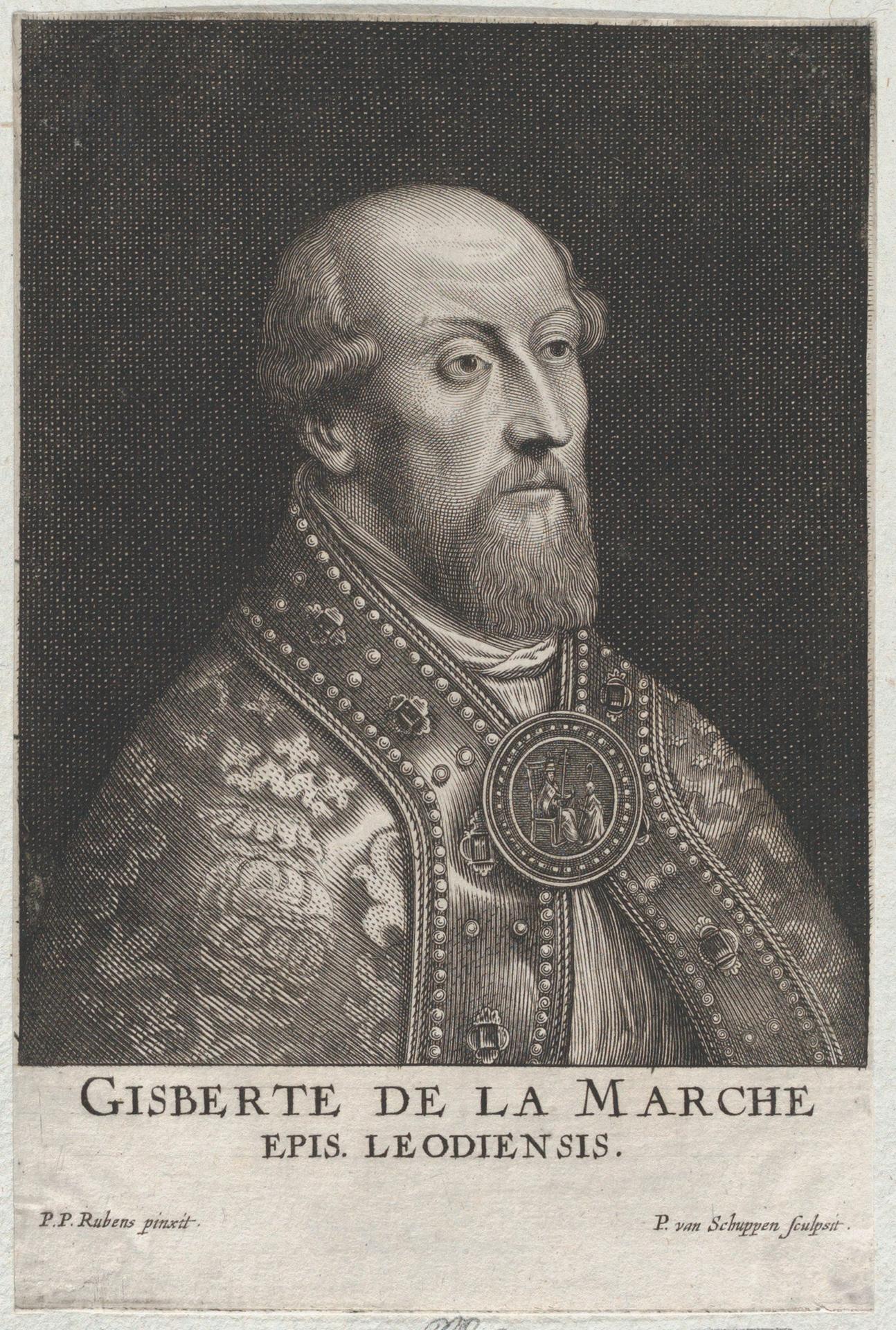
Pierre van Schuppen produced this engraving after a painting by Peter Paul Rubens. It represents Gisbert de la Marche, Bishop of Liège, and was made around 1645–55. The bishop is shown full length.
Description
The bishop stands at full length, his head turned slightly to the left. His vestments are elaborate, with fine embroidery and buttons; a large medallion with a figured scene stands out on them. The face looks serious and thoughtful, framed by short hair and a carefully trimmed beard. A plain dark background emphasises the figure. At the bottom of the sheet are the name and title of the sitter: 'Gisberte de la Marche, Epis. Leodiensis'.
Context
The model was a painting by Rubens, one of the leading Flemish Baroque painters, whose portraits were much sought after. The Antwerp engraver van Schuppen transferred it into an etching so that a wider circle could see the likeness. Reproductive prints of this kind served in the 17th century above all to disseminate works of art.
Impact
The bishop's posture and gravity give the sheet a dignified, commanding presence. The precise rendering of clothing and medallion makes the sitter's wealth and rank visible. The dark background draws the eye entirely to the person and gives the portrait a ceremonial character.
Technique
The etching remains in shades of grey, as is usual for this process. A metal plate is bitten with acid so that the lines are created. Van Schuppen worked with delicate lines and hatching to capture the texture of the vestments and the facial features accurately.
AI-generated description text
Source: Metropolitan Museum of Art · Public Domain (CC0 1.0)