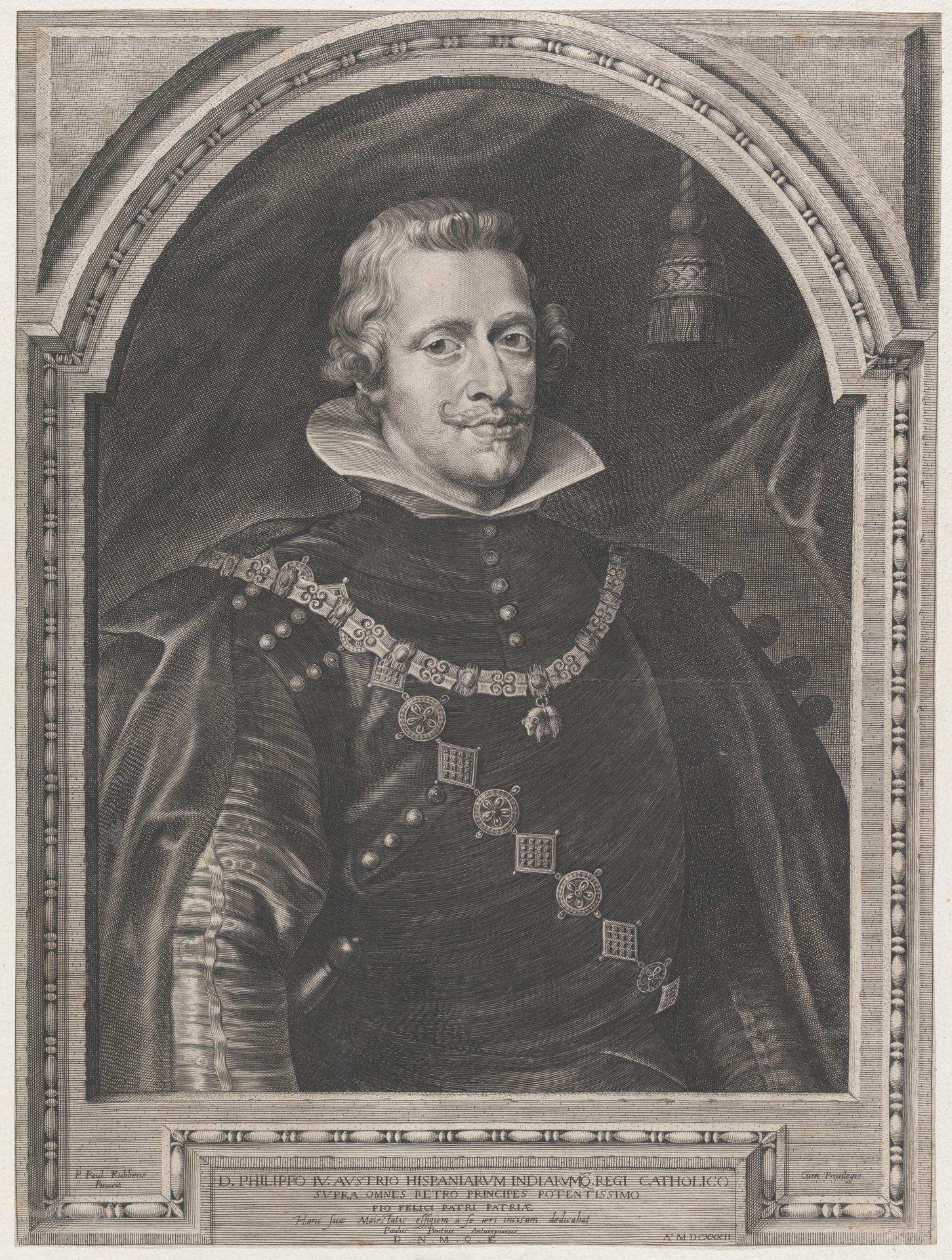
Portrait of Philip IV (1630, Met-Objekt 1331)
Original title: Portrait of Philip IV
kurzbeschreibung
In 1630, Paulus Pontius engraved a half-length profile of King Philip IV of Spain. This impression comes from the third and final state of the plate, a fine example of Baroque reproductive printmaking.
Description
A garment encrusted with medallions and orders envelops the monarch, whose long wavy hair and prominent moustache stand out. The dark background pushes the centrally placed figure forward. The layout feels strict and ceremonial; even light traces the contours of face and clothing.
Context
Pontius, a Fleming, often collaborated with Peter Paul Rubens. The model was a painting by Rubens or from his workshop depicting Philip IV of Spain. The engraving was meant to circulate the royal likeness among the European high nobility and belonged to a series of ruler portraits.
Impact
Sumptuous clothing and the formal pose convey royal power. From the even lighting and symmetrical arrangement arises a dignified, quiet presence characteristic of Baroque princely portraits.
Technique
In copper engraving, lines are cut into the metal plate; ink is then pulled onto paper, producing the typical grey tones. That this is the third of three print states attests to careful reworking of the plate.
AI-generated description text
Source: Metropolitan Museum of Art · Public Domain (CC0 1.0)