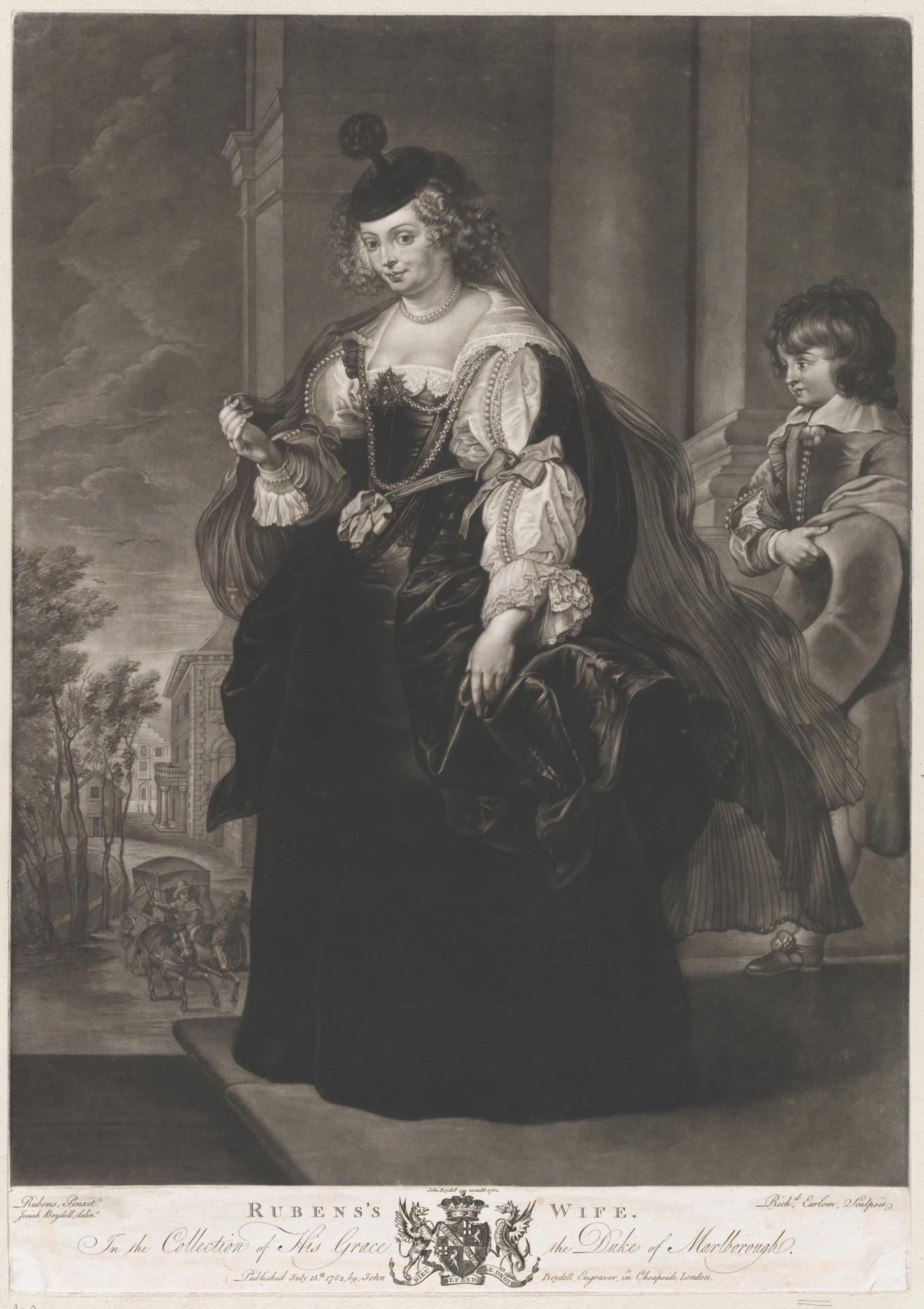
Portrait of Helena Fourment, with a young page behind her
Original title: Portrait of Helena Fourment, with a young page behind her
kurzbeschreibung
In 1782, Richard Earlom produced a mezzotint portrait of Helena Fourment, the second wife of Peter Paul Rubens, with a young servant in the background. The print reproduces a painting by Rubens and is here in the second state (Dutuit).
Description
Helena Fourment stands in the foreground, wearing a magnificent dress with rich embroidery and pearl necklaces; her hair is piled high and adorned with jewels. Facing her is the servant, who holds a cloth or similar fabric. Behind the figures, a landscape opens up with trees, a building, and a road where horses and carriages can be seen. The layout appears symmetrical, and the light falling from the front highlights the contours and texture of the garment.
Context
Helena Fourment married Peter Paul Rubens in 1630 and was his second wife. Rubens painted several portraits of her, which were later reproduced as prints by artists such as Richard Earlom. Earlom, an eighteenth-century British printmaker, was known for his mezzotint reproductions of famous paintings. The 1782 sheet reflects the period's interest in disseminating Baroque masterpieces.
Impact
The soft tonal gradations of the mezzotint create a gentle, almost painterly effect that brings out the preciousness of the dress and the delicacy of the facial features. Because the woman is rendered in great detail while the background remains subdued, the portrait gains a dignified, elegant presence.
Technique
This print was made using mezzotint, an intaglio technique in which the plate is first roughened and then smoothed in places to create tonal values. Earlom used the method to capture the fine details of the dress and the soft transitions of shadow. The print is trimmed to a sheet of 50.4 × 35.5 cm.
AI-generated description text
Source: Metropolitan Museum of Art · Public Domain (CC0 1.0)