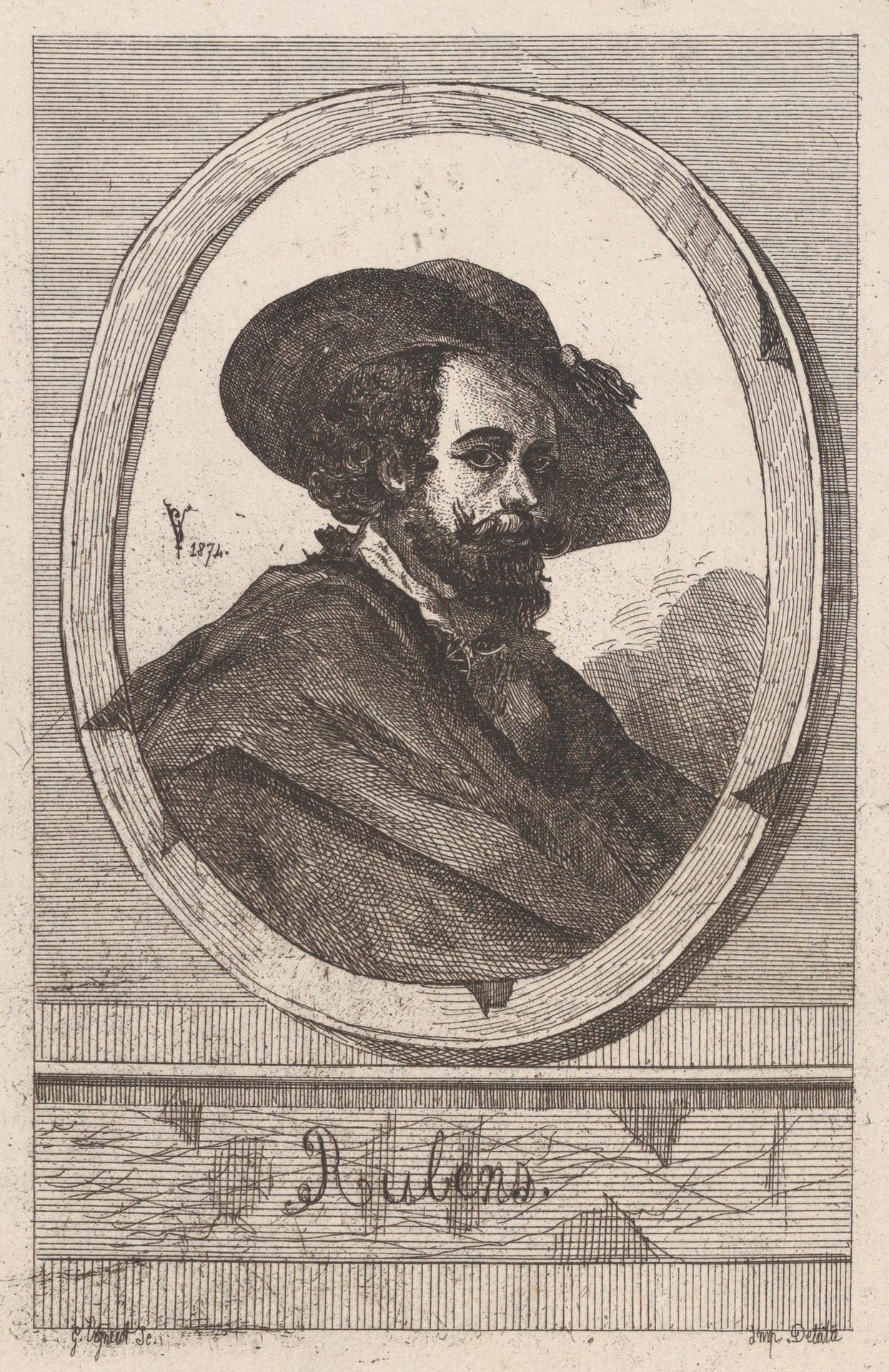
Self-portrait of Peter Paul Rubens
Original title: Self-portrait of Peter Paul Rubens
kurzbeschreibung
Made in 1874, this anonymous etching offers a self-portrait of Peter Paul Rubens. The Flemish Baroque painter appears as a half-length figure inside an oval frame, with the name "Rubens" inscribed below. Executed in a single tone, the sheet relies on clearly visible hatching throughout.
Description
Rubens is shown to the waist, his face turned toward the left, his gaze directed into the distance. He wears a wide-brimmed hat and a jacket; his hair is combed back and tied into a ponytail. Fine horizontal lines form the oval frame. At the bottom the name "Rubens" appears in decorative lettering. The etching is monochrome, built up from varied lines and hatching, with light spread evenly and no strong shadows.
Context
The etching dates from 1874, roughly 234 years after the death of Peter Paul Rubens (1577–1640). Because it has come down to us anonymously, it was likely made as a reproductive print after a painting or drawing. Such printed portraits were common in the nineteenth century, bringing famous artistic figures closer to a broad public. The hat and ponytail follow established formulas for Rubens portraits that go back to contemporary models.
Impact
Calm, even lighting and delicate hatching give the etching a dignified, somewhat reserved air. The oval frame underlines the portrait's representative purpose, while the averted gaze creates a thoughtful, almost melancholy mood. Overall the sheet feels clear and controlled, without dramatic effects.
Technique
This is an etching: the drawing was scratched into an acid-resistant ground on a copper plate and then bitten with acid. The process allows fine lines and hatching, used here to model the face and clothing in three dimensions. The sheet is signed and dated, which suggests an independent artistic execution.
AI-generated description text
Source: Metropolitan Museum of Art · Public Domain (CC0 1.0)