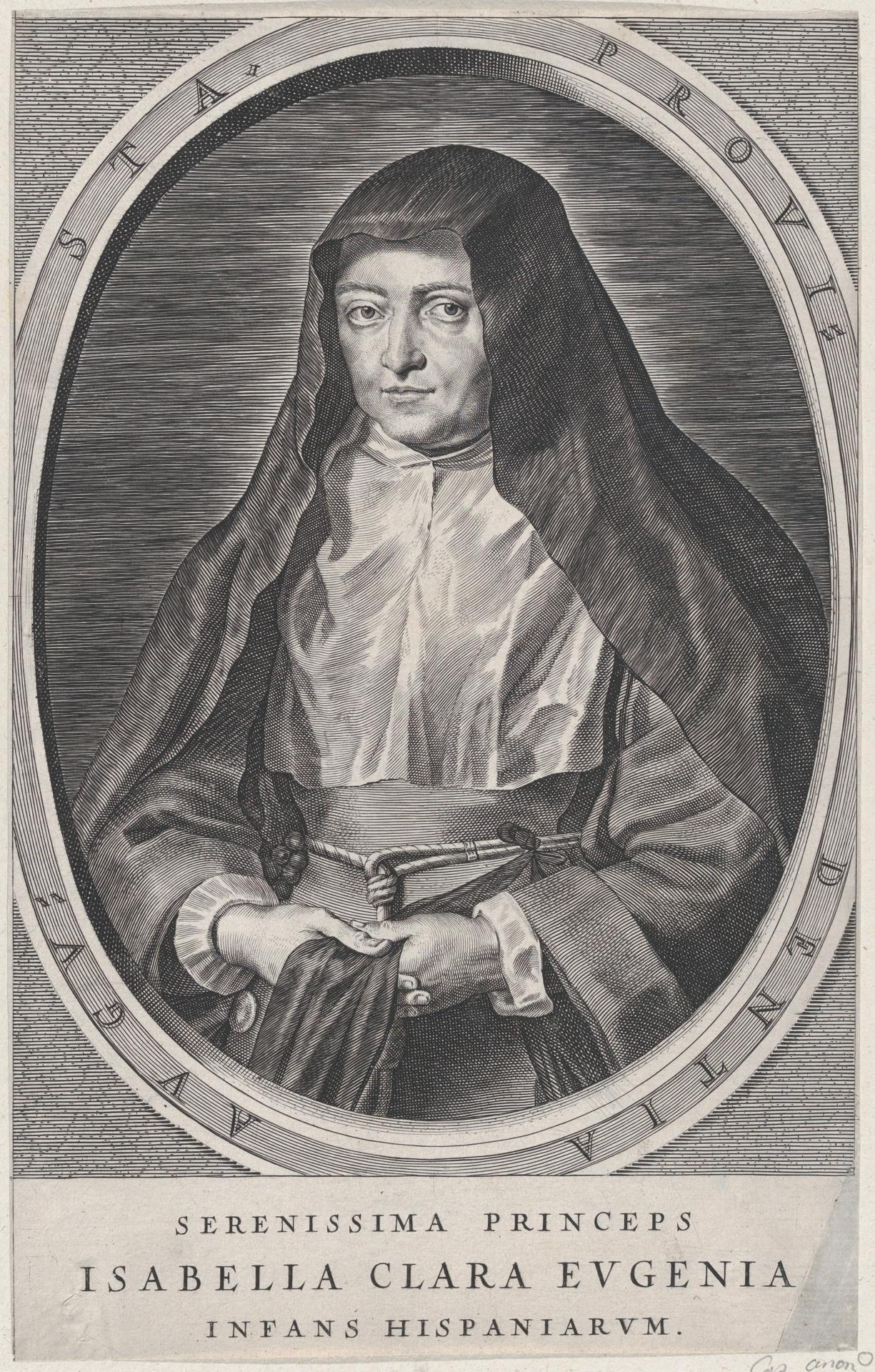
Portrait of Archduchess Isabella Clara Eugenia, Spanish Regent of the Low Countries, as a Nun (ca. 1625–1700)
Original title: Portrait of Archduchess Isabella Clara Eugenia, Spanish Regent of the Low Countries, as a Nun
kurzbeschreibung
An anonymous engraving from between 1625 and 1700 shows Archduchess Isabella Clara Eugenia (1566–1633) wearing the habit of a Poor Clare. The Spanish regent of the Netherlands entered the order after her husband's death in 1621, which explains the subject. This upright sheet serves as a formal devotional image, linking her piety with her political standing.
Description
She appears as a half-length figure against a dark ground, with a circular border framing the view. She wears a dark, long-sleeved robe with a white collar and a sash wound around her neck and waist. Her hands are folded in front of her body, holding a book. Inside the circle are the letters 'S.R.A. PROV' and 'D.F.N.I.A.', and below them a Latin poem with her name and the title 'Infans Hispaniarum'. The linework is precise and detailed, as is characteristic of etching.
Context
Isabella Clara Eugenia, daughter of Philip II of Spain, ruled the Spanish Netherlands from 1598 to 1621 jointly with her husband Archduke Albert. After his death she entered the Order of Poor Clares in 1621 but retained the role of governor until her death in 1633. This portrait was probably made after she took the veil, when her image as a devout ruler was widely circulated. The inscription 'Infans Hispaniarum' refers to her royal birth and rank.
Impact
Rule and piety are intertwined here: the plain nun's habit is elevated by her dignified posture and the book as a sign of learning. The dark background and clear contour make the figure appear monumental and prayerful. The sheet functions as a devotional portrait that also underscores the sitter's political authority.
Technique
The work is an engraving or etching, recognizable from its fine, precise linework. The technique allows detailed rendering of fabrics and facial features. The sheet has been trimmed, so the original format is no longer fully intact.
AI-generated description text
Source: Metropolitan Museum of Art · Public Domain (CC0 1.0)