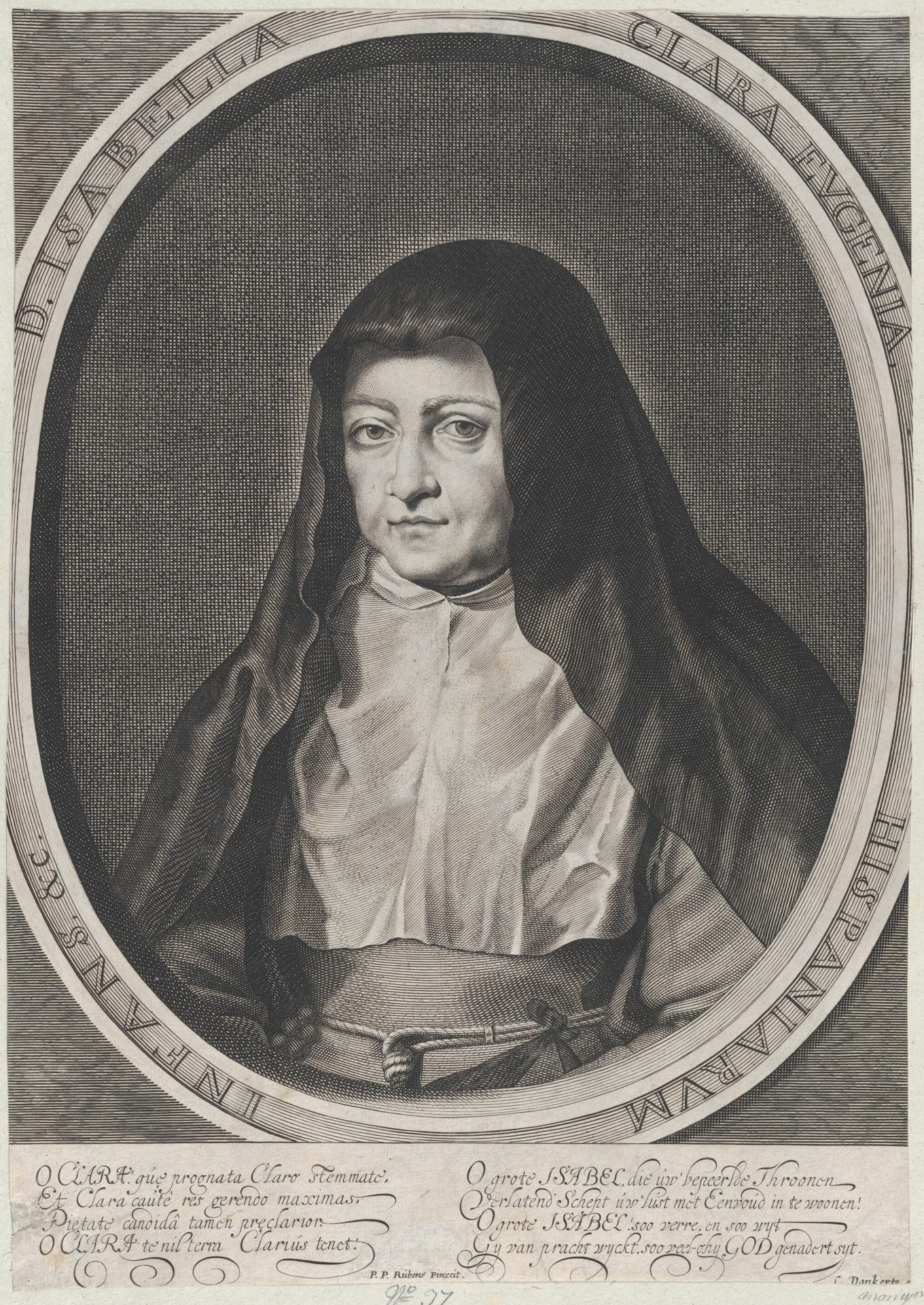
Portrait of Archduchess Isabella Clara Eugenia, Spanish Regent of the Low Countries, as a Nun (ca. 1628–56)
Original title: Portrait of Archduchess Isabella Clara Eugenia, Spanish Regent of the Low Countries, as a Nun
kurzbeschreibung
An anonymous engraved portrait, made between about 1628 and 1656, shows Archduchess Isabella Clara Eugenia (1566–1633). After the death of her husband Albert VII in 1621, she took over as Spanish regent of the Netherlands. Here she appears in the habit of a Poor Clare, which she adopted after losing her husband. The print is considered a telling example of princely image-making in the seventeenth century.
Description
A woman in a nun’s habit, her dark head covering falling to her shoulders over a white blouse. Her posture is calm and withdrawn, her gaze turned slightly to the left. Behind her the ground stays dark and plain, so that the figure stands out clearly. The design is centred and strictly symmetrical. An oval border at the edge carries the inscription “D. ISABELLA CLARA EUGENIA” and “INFANS HISPANIAM”; below it are Latin and Dutch verses.
Context
Isabella Clara Eugenia, daughter of King Philip II of Spain, ruled the Spanish Netherlands after the death of her husband Archduke Albert VII of Austria. Following Albert’s death in 1621 she entered the Franciscan order but remained politically active as regent. The portrait dates from after 1621, when her religious habit became a common motif that emphasised both her piety and her political role. The engraving was likely printed as part of a series or as a single sheet for a court audience.
Impact
Regal dignity and monastic humility meet in a way that shifts between political authority and religious devotion. The sitter’s quiet, almost still bearing and the clear linework give the sheet a solemn, representative aura. The plain background draws attention to the face and the religious dress, underlining the regent’s personal piety.
Technique
As an engraving, the image was cut into a metal plate and then printed. Fine hatching and precise contours produce a nuanced rendering of fabrics and facial features. The mostly black-and-white palette is typical of intaglio printing and emphasises the graphic quality of the sheet.
AI-generated description text
Source: Metropolitan Museum of Art · Public Domain (CC0 1.0)