Portrait of a Young Woman (ca. 1745–76)
Original title: Portrait of a young woman
kurzbeschreibung
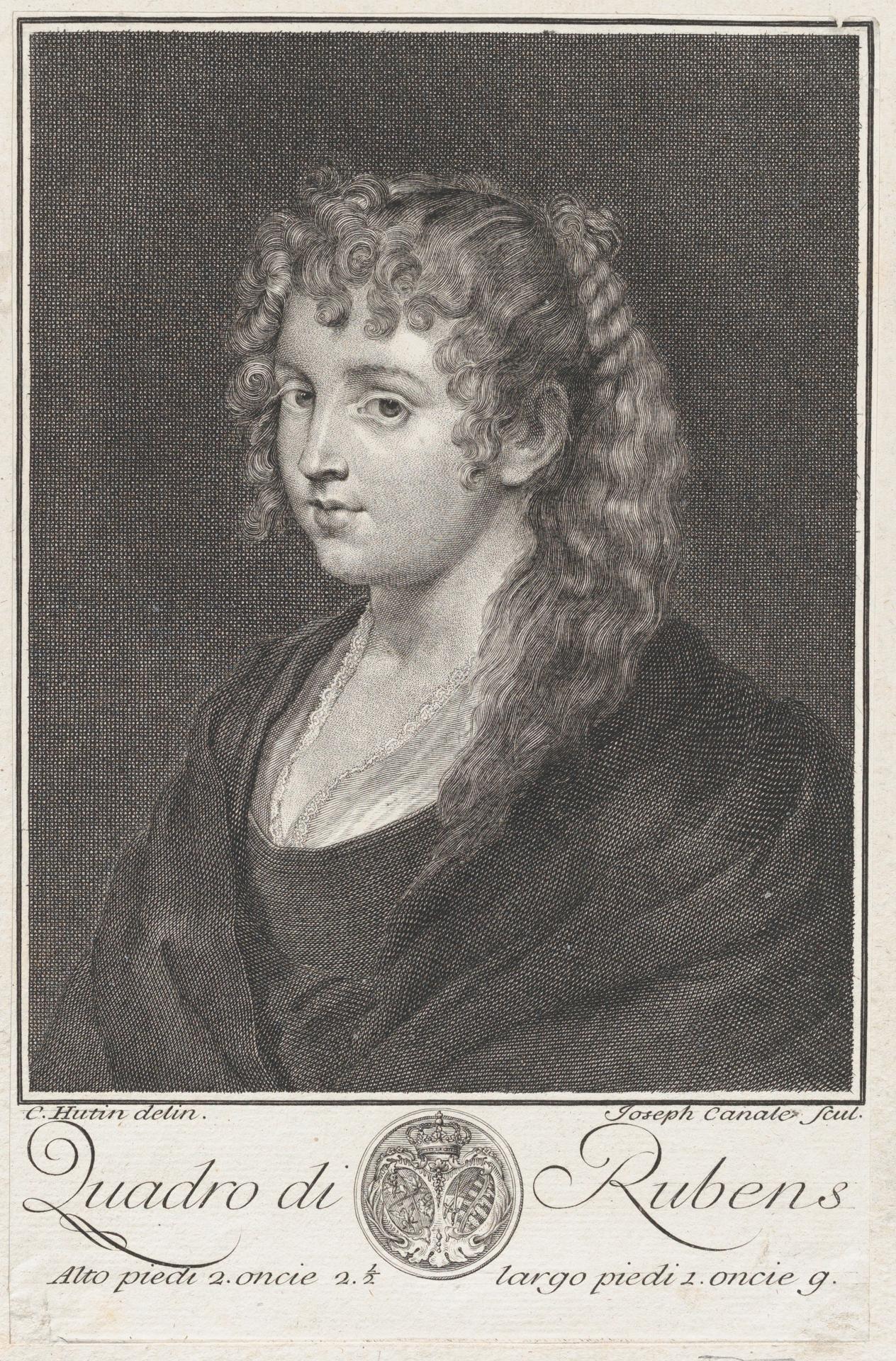
Giuseppe Canale, an 18th-century Italian engraver, produced this portrait of a young woman between 1745 and 1776. The print shows a young woman with curly hair, wearing a dark top over a white blouse, against a plain background. At the bottom edge are a seal with an eagle, the inscription 'Quadro di Rubens', and measurements in piedi and oncie.
Description
A young woman with curly hair tied in a braid appears in this engraving. She wears a dark top with an open neckline, beneath which a white blouse is visible. The plain, dark background emphasizes the figure. At the lower edge of the sheet are a seal with an eagle, the text 'Quadro di Rubens', and dimensions in piedi and oncie. The arrangement focuses on the woman, with hair and clothing textures carefully worked out.
Context
Giuseppe Canale, an 18th-century Italian engraver, was known for his reproductions after paintings. The inscription 'Quadro di Rubens' indicates that this portrait derives from a painting by Peter Paul Rubens, although the attribution remains uncertain. The measurements in piedi and oncie (Italian feet and inches) suggest the engraving served as documentation of an artwork. The dating around 1745–76 falls in the period of the late Baroque and Rococo, when reproductive printmaking was widespread.
Impact
Through its fine linework and clear contrasts, the print radiates a calm, dignified presence of the sitter. The dark surroundings draw the eye to the face and clothing, creating an intimate atmosphere. The detailed rendering of textures gives the sheet an almost painterly quality.
Technique
This work uses the technique of engraving, in which the motif is incised into a copper plate and then printed on paper. Fine lines and hatching create gradations of light and shadow, as visible in the image analysis. The sheet has been trimmed, suggesting later use or framing.
AI-generated description text
Source: Metropolitan Museum of Art · Public Domain (CC0 1.0)