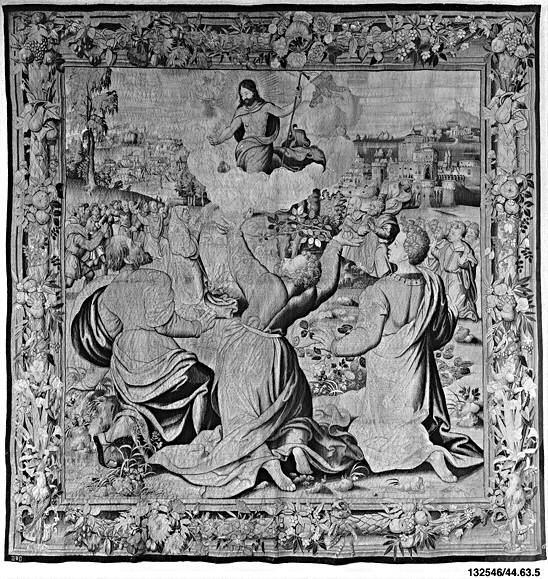
The Ascension
Original title: The Ascension
kurzbeschreibung
The tapestry The Ascension (Die Himmelfahrt) is by Michiel Coxie (I) and dates to 1540–45. Woven from wool, silk, silver-gilt and silver thread, it depicts Christ's rise into heaven. The piece belongs to a series and is kept at the Metropolitan Museum of Art.
Description
Christ hovers upward on a cloud, dressed in a blue robe and holding a lance. Below him, three apostles kneel in prayer, clothed in traditional garments. A city with fortress walls and towers, likely Jerusalem, forms the background. A richly decorated border of flowers and fruits frames the action. The palette feels monochromatic, and the layout is symmetrical.
Context
Michiel Coxie (I) worked as a Flemish painter and tapestry designer in sixteenth-century Brussels. At the time of the Ascension, tapestries ranked among Europe's most prestigious artworks. Precious materials such as silver thread point to a patron from the high nobility or clergy.
Impact
A calm, solemn mood reaches the viewer, carried by the symmetrical arrangement and restrained colours. The Ascension conveys spiritual loftiness and draws the eye into the biblical scene.
Technique
The tapestry was woven in a technique with 18–19 warps per inch (7–8 per cm). Wool, silk and silver-gilt threads create a fine texture and subdued sheen. Details such as the city in the background and the ornamental border attest to the high craftsmanship of Flemish tapestry weaving.
AI-generated description text
Source: Metropolitan Museum of Art · Public Domain (CC0 1.0)