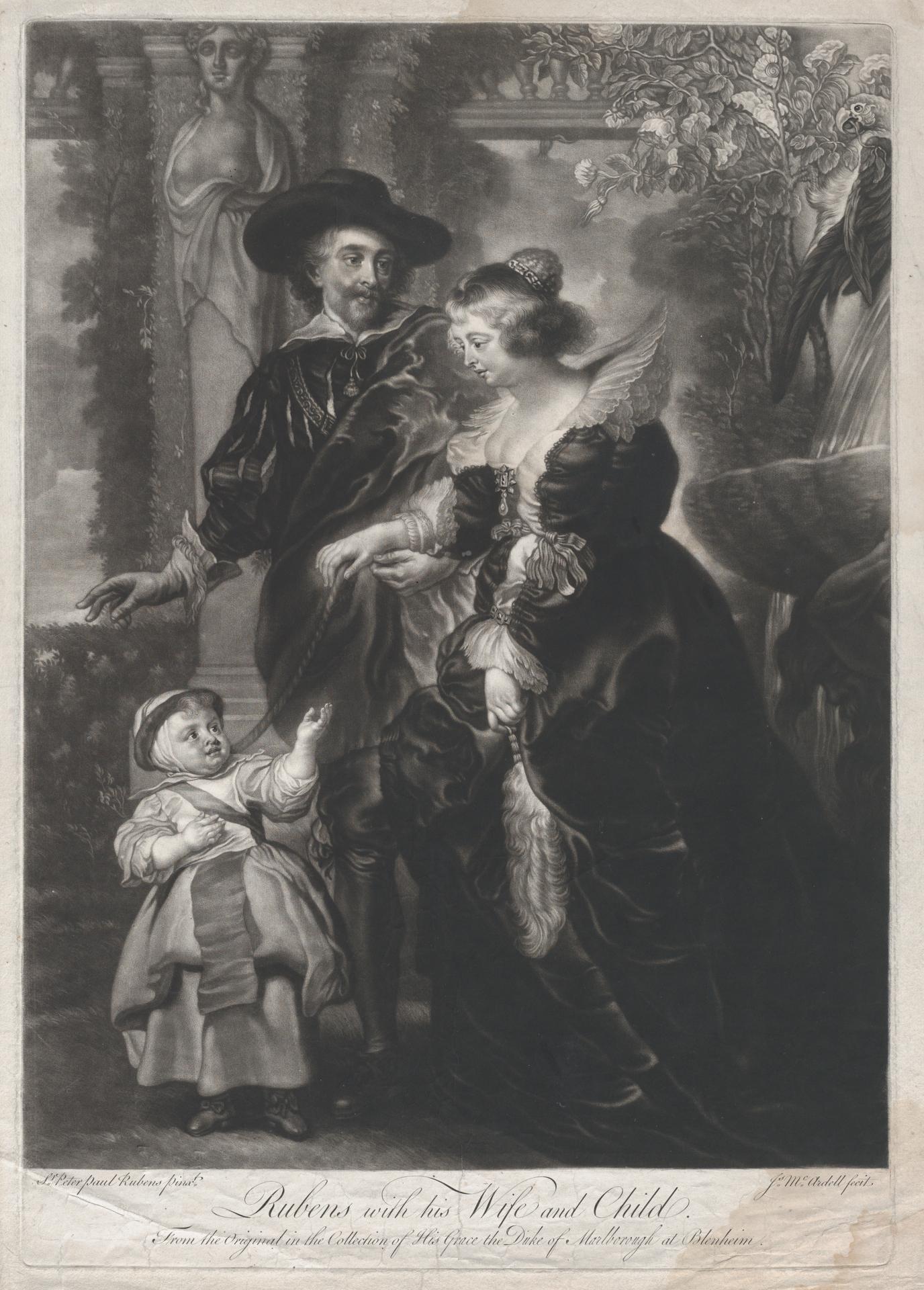
Rubens with his Wife and Child (1740–65, Met-Objekt 1298)
Original title: Rubens with his Wife and Child
kurzbeschreibung
James McArdell produced this mezzotint between 1740 and 1765. It portrays Peter Paul Rubens with his wife and their child. The print is the second of two states and translates a painting into the mezzotint medium.
Description
Rubens occupies the middle ground, dressed in dark fabric and a wide-brimmed hat. Beside him stands his wife in a richly ornamented robe with a striking headdress. Before the parents appears a small girl, her gaze lifted upward. A column bearing a female statue, along with flowers and plants on the right, fills the rear area. The arrangement feels symmetrical, while light falling from above picks out the contours. Grey mezzotint tones shape the figures and the architecture behind them.
Context
This reproductive print after a painting by Peter Paul Rubens was made in the eighteenth century. McArdell, an Irish engraver, worked in London and became known for his high-quality mezzotints. The rendering of the Flemish painter with his family belongs to a series of artist portraits that were widely admired at the time.
Impact
At first, the gentle shift between light and dark draws the eye, letting it glide across the figures. The delicate tonal gradations of the mezzotint give the sheet a painterly softness reminiscent of Rubens's oil sketches. Calm light and the balanced placement of the people create a dignified, representative presence.
Technique
For this work McArdell used mezzotint, an intaglio method. The plate is first roughened, then smoothed in the desired areas to achieve varying tonal values. The second state shows reworking compared with the first impression. It was printed on paper, and the plate measures approximately 51.1 × 35.8 cm.
AI-generated description text
Source: Metropolitan Museum of Art · Public Domain (CC0 1.0)