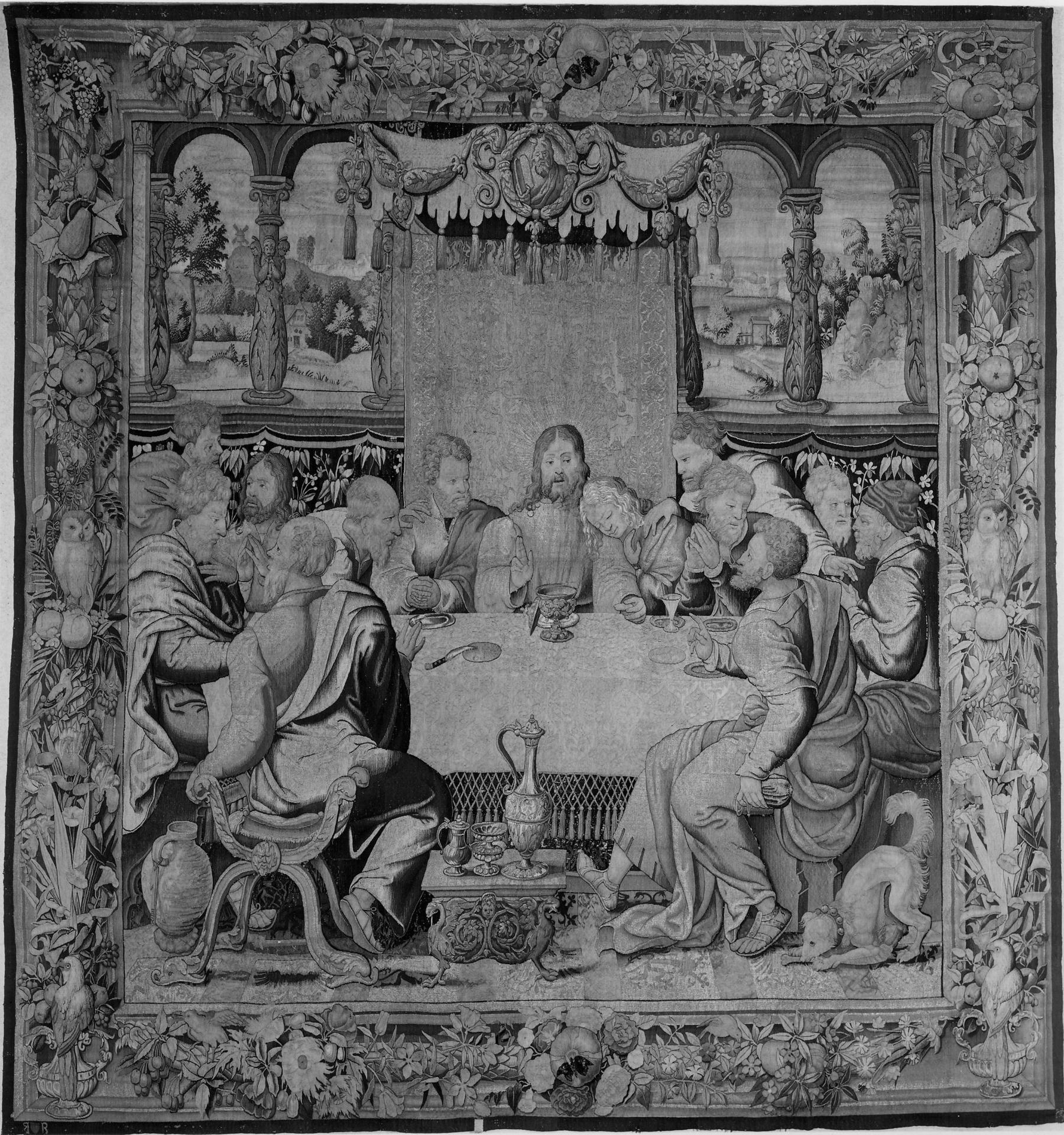
The Last Supper (1540–45)
Original title: The Last Supper
kurzbeschreibung
Woven around 1540–45, the tapestry "Das letzte Abendmahl" was made after a design by Michiel Coxie (I). It depicts the biblical scene of Christ's final meal with his twelve disciples, executed in wool, silk, silver-gilt and silver thread. Measuring approximately 312 × 292 cm, it ranks among the monumental tapestries of its era.
Description
A symmetrical layout governs the tapestry: Christ sits enthroned at the center behind a long table, with the twelve apostles grouped on either side. Some of them pray, others converse or hold chalices and bowls. Behind the table opens a landscape with trees and a tower. Grey tones dominate the palette, determined by the materials used. The light falls evenly and calmly, as is typical of historical tapestries.
Context
Michiel Coxie (I) was a Flemish painter and designer active in the first half of the 16th century. Tapestries of this kind were prized in aristocratic circles and in ecclesiastical settings, combining representational splendour with religious devotion. The piece was probably produced in a Brussels workshop famous for its high quality. Coxie's style was strongly influenced by the Italian Renaissance, which is reflected in the symmetrical, figure-rich arrangement.
Impact
Solemn and dignified, the tapestry confronts the viewer. The symmetrical arrangement and the calm, even lighting contribute to this effect. Predominantly grey tones lend the work a noble restraint that directs attention to the figures and their gestures.
Technique
The tapestry was made using the technique of tapestry weaving. Wool, silk, silver-gilt and silver thread were used. The weave density is 18–19 warp threads per inch (7–8 per centimetre), allowing for fine detail. The metallic threads provide a subtle sheen and enhance the material value.
AI-generated description text
Source: Metropolitan Museum of Art · Public Domain (CC0 1.0)