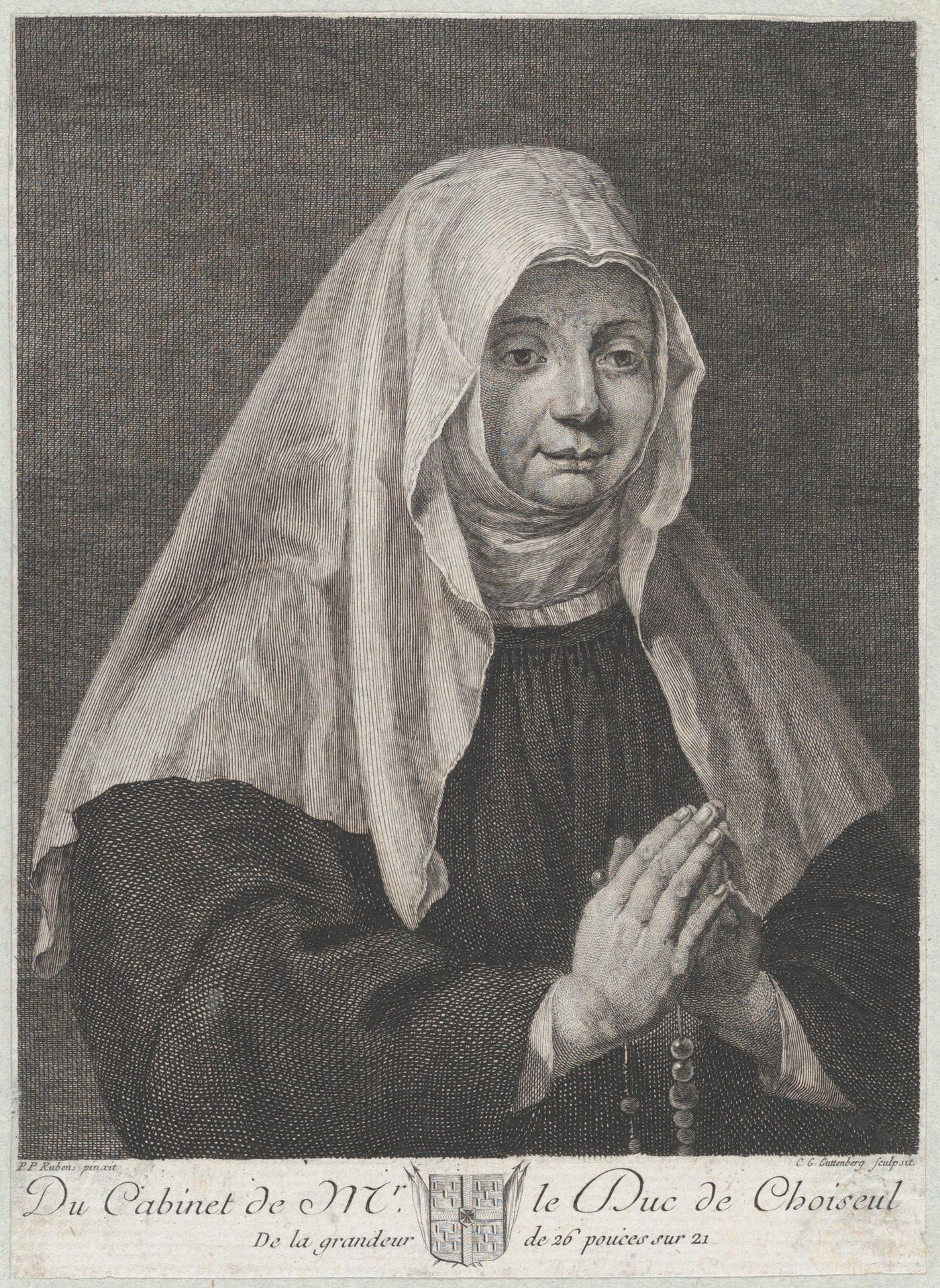
Portrait of a praying nun (ca. 1771, Met-Objekt 1287)
Original title: Portrait of a praying nun
kurzbeschreibung
Carl Guttenberg's engraving Porträt einer betenden Nonne, made around 1771, sets itself apart from similar devotional images by the deliberate plainness of its background, which throws the nun's clasped hands and rosary into sharper relief. The print once belonged to the collection of the Duke of Choiseul.
Description
A white headcloth falls over the praying nun's shoulders, and beneath it she wears a black habit. Her hands are folded in prayer and hold a rosary. The dark, unadorned background makes the figure stand out. In the lower part of the image are a coat of arms and the inscription 'Du Cabinet de M. le Duc de Choiseul'. The execution is rich in detail: the textures of the garments are precisely rendered, and the light falls evenly, avoiding harsh shadows.
Context
Created around 1771, the print was part of the collection of the Duke of Choiseul, an influential French statesman and patron of the arts in the eighteenth century. Carl Guttenberg, a German engraver, worked in Paris and was valued for his accurate reproductions. It is likely a reproductive print after a painting, of the kind frequently made at the time.
Impact
The nun's calm posture and the absence of background details create a concentrated, devotional mood. The precise linework gives the portrait something delicate and immediate, without dissolving the distance inherent to the medium.
Technique
The etching is an intaglio process in which the drawing is worked into a plate and etched with acid. Varying densities and spacings of lines produce the monochrome gray tones that model light and shadow. The print was pulled on paper; it displays the detail typical of eighteenth-century reproductive printmaking.
AI-generated description text
Source: Metropolitan Museum of Art · Public Domain (CC0 1.0)