Head of a Satyr
Original title: Head of a satyr
kurzbeschreibung
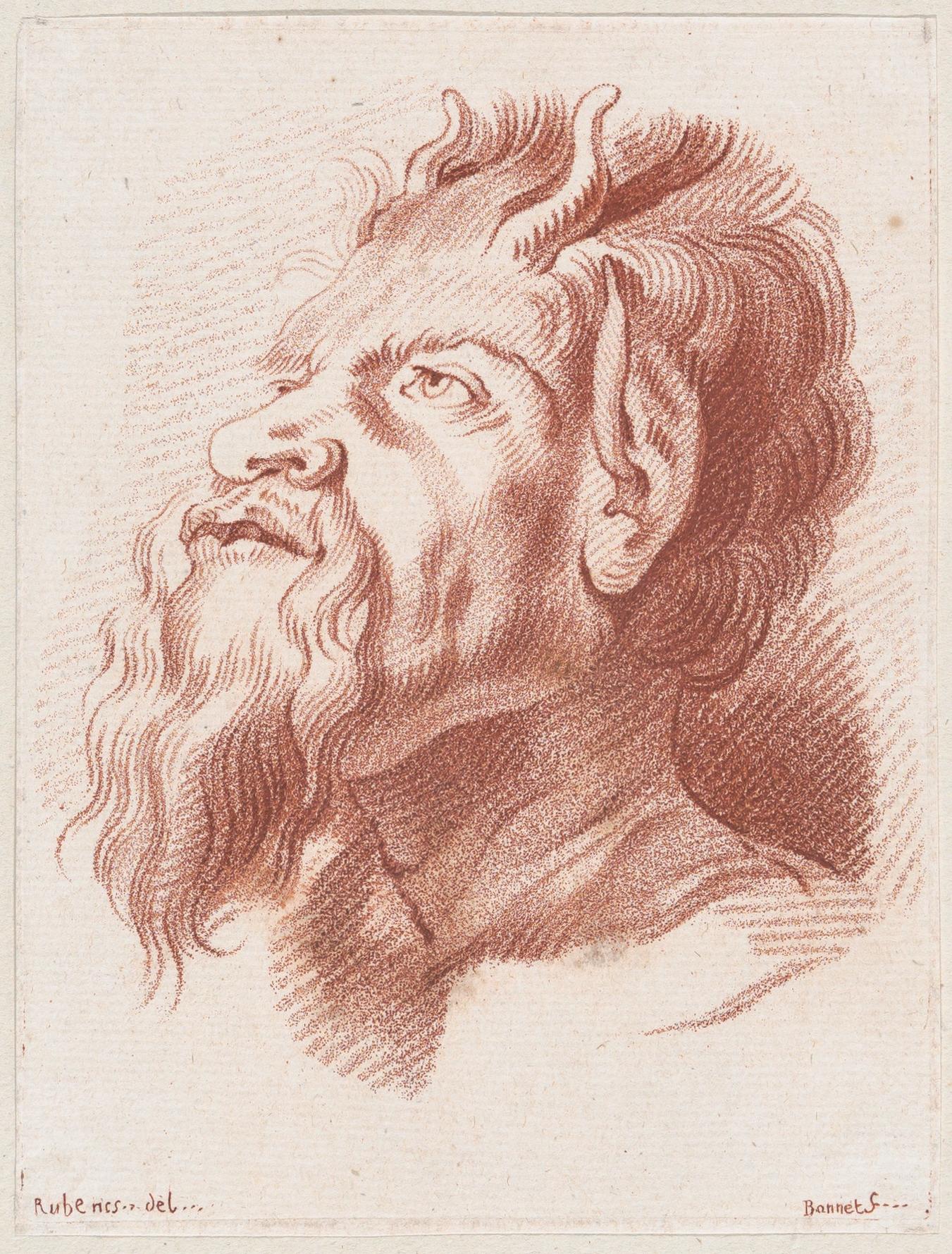
Louis Marin Bonnet created this 'Head of a Satyr', dated between 1755 and 1793, a print showing the face of a satyr in profile. The work is executed as a crayon-manner engraving in red ink and measures 14.6 × 11.1 cm.
Description
The satyr appears in profile, with head and shoulder filling the frame. His face is marked by a long, wavy beard and mustache, along with thick curly hair. The large, expressive eyes and slightly open mouth suggest a lively or pensive mood. Fine strokes model the hair and beard, emphasizing their texture; a soft shadow lies over the background. At bottom left is the inscription 'Rubens del.', at bottom right 'Bannet...'.
Context
The Frenchman Louis Marin Bonnet was an 18th-century printmaker who stood out for innovations in the crayon manner—a technique that imitates chalk drawings. This sheet belongs to the Rococo period, when mythological subjects and pastel techniques were in demand in French art. The inscription 'Rubens del.' names a model after Peter Paul Rubens, pointing to the contemporary practice of reproductive printmaking.
Impact
The red ink and crayon-like execution give the sheet a warm, drawing-like quality that recalls an original chalk study. The expressive gaze and the carefully worked hair make the satyr appear vivid and almost sculptural.
Technique
The crayon-manner engraving was printed in red ink. Fine stippling and hatching imitate the effect of red chalk, reproducing the texture and stroke of a hand drawing.
AI-generated description text
Source: Metropolitan Museum of Art · Public Domain (CC0 1.0)