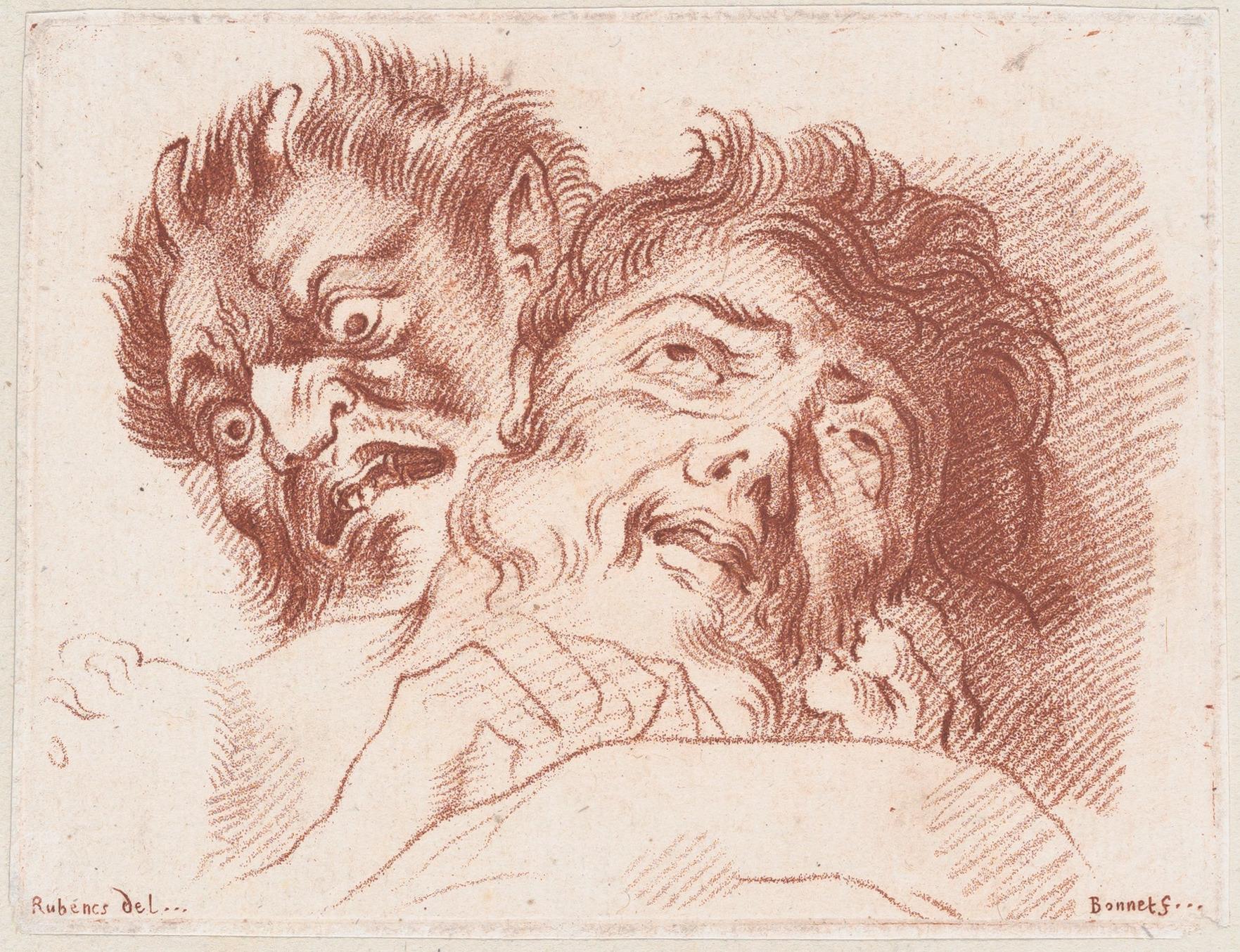
Head of a man and a satyr
Original title: Head of a man and a satyr
kurzbeschreibung
Two heads face the viewer directly in this print by Louis Marin Bonnet, made between about 1755 and 1793. On the right is a man with a worried look around his eyes; on the left, a satyr with conspicuous ears. The work is executed as a crayon-manner engraving in red ink.
Description
The two heads lie close together, tilted slightly to the left. The satyr has a strong forehead, a broad nose, and an open mouth; the man beside him appears dejected. Hair and beard are carefully worked, while the background remains plain. At the bottom are the notes “Rubens del...” and “Bonnet f...”.
Context
Bonnet, an eighteenth-century French engraver, mastered the crayon manner, which could imitate red-chalk drawings deceptively well. The inscription suggests that a drawing by Peter Paul Rubens served as the model. Such reproductions were used in the eighteenth century to make old-master drawings available to a wider public.
Impact
The red printing tone gives a warm, sketch-like mood. The confrontation of satyr and man creates a tension that makes the viewer's gaze travel back and forth between the two faces, taking on almost narrative qualities.
Technique
The crayon-manner engraving uses a multitude of dots and short strokes to create the impression of a red-chalk drawing. It was printed with red ink on paper, which strengthens the illusion of an original drawing. The precise linework testifies to the high skill of the process.
AI-generated description text
Source: Metropolitan Museum of Art · Public Domain (CC0 1.0)