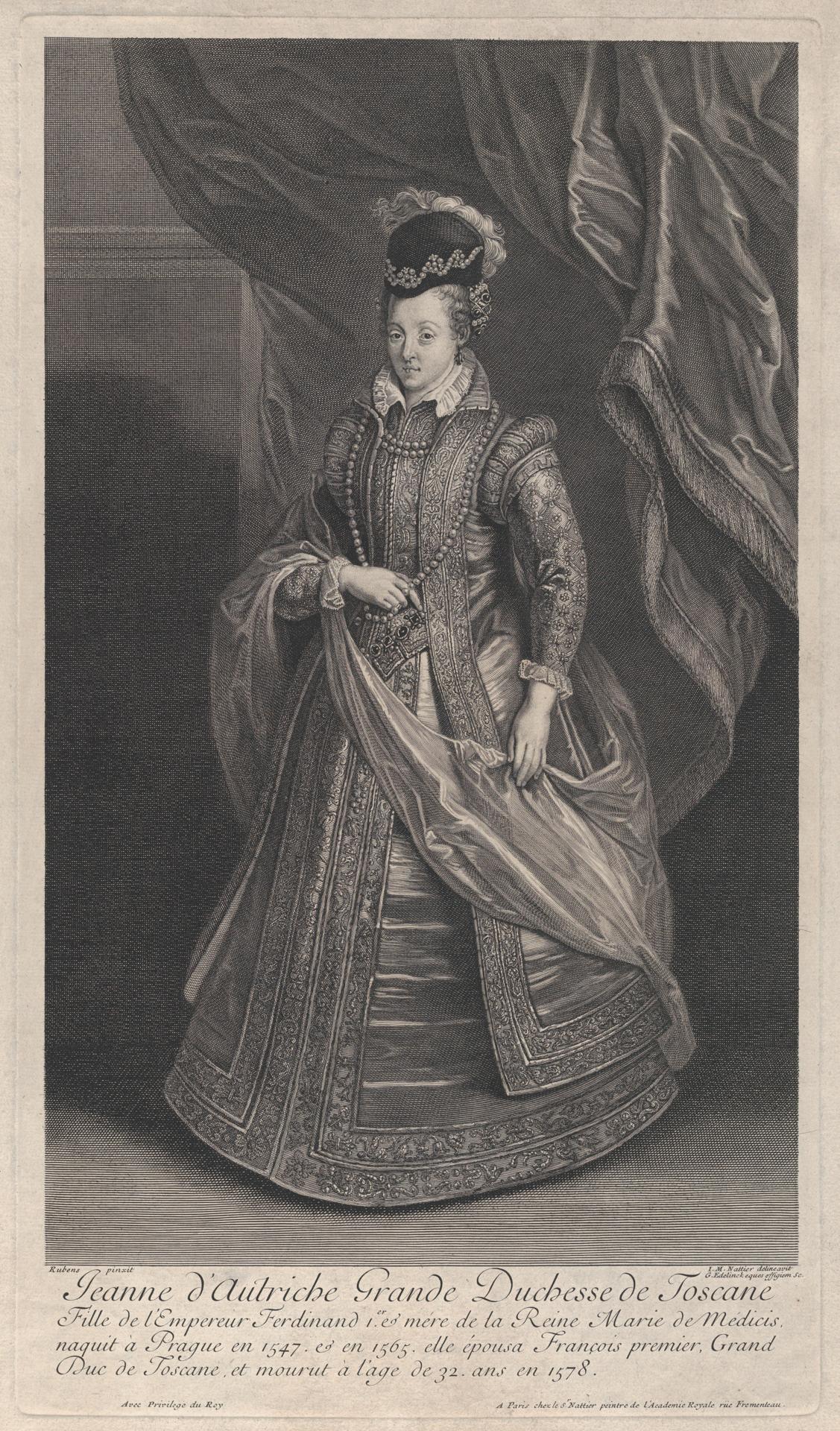
Portrait of Joanna of Austria, Grand Duchess of Tuscany
Original title: Portrait of Joanna of Austria, Grand Duchess of Tuscany
kurzbeschreibung
Unlike many princely portraits of its time, this print sets aside allegorical accessories and focuses entirely on the person: Johanna of Austria, Grand Duchess of Tuscany, in a formal pose. Gérard Edelinck made the likeness around 1707 as an etching and engraving. She appears in precious attire with dense embroidery and pearl jewelry.
Description
Johanna of Austria occupies the center, yet the space is dominated by a heavy curtain falling on both sides and darkening almost the entire background. Her dress is covered with elaborate embroidery, several pearl necklaces rest around her neck and chest, and more pearls adorn her high-piled hair. Frontal light strikes her face, bringing out both her features and the details of the fabric. The arrangement is strictly symmetrical, with the figure as the focal point. At the bottom of the sheet, an explanatory text describes her person and family.
Context
Johanna of Austria (1547–1578) held the title of Archduchess of Austria and became Grand Duchess of Tuscany through marriage. This sheet is a reproductive print after a painting probably by Alessandro Allori, executed around 1707 by Gérard Edelinck. Born in Flanders and active in Paris, Edelinck was known as a specialist in accurate portrait engravings. The print belonged to a series of princely portraits documenting European aristocracy.
Impact
The symmetrical arrangement and frontal light give the portrait a ceremonial, official character. Fabrics and jewelry are rendered in such detail that the image gains a tangible material presence, and the sitter's high rank is immediately apparent.
Technique
Etching and engraving are combined here, allowing both precise linework and nuanced shading. This method makes it possible to reproduce embroidery and pearls with great accuracy while keeping contours sharp and clear.
AI-generated description text
Source: Metropolitan Museum of Art · Public Domain (CC0 1.0)