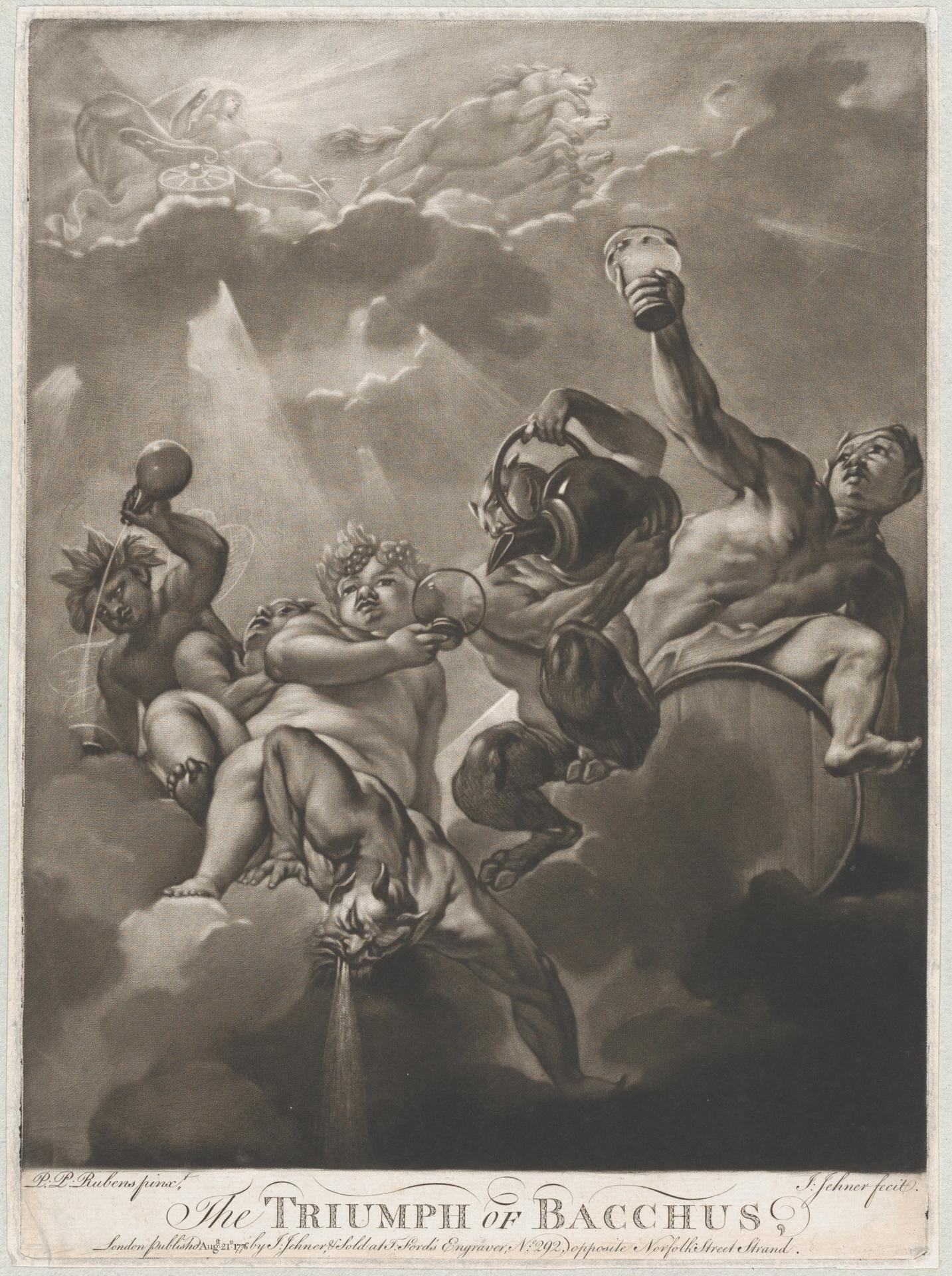
The Triumph of Bacchus (1776)
Original title: The Triumph of Bacchus
kurzbeschreibung
Isaac Jehner's 1776 mezzotint, titled 'The Triumph of Bacchus,' places the ancient wine god in a victorious pose. Around him, exuberant putti and a horse-drawn chariot guided by an angel. This engraving measures approximately 33.2 × 24.2 centimeters.
Description
Bacchus dominates the center of the sheet: powerfully built, wrapped in simple drapery, his face confident and triumphant. His right hand holds a goblet from which wine spills. Nearby, several putti drink; one in the foreground also raises a cup and looks up at him, while another has settled on his shoulder. Clouds and a horse-drawn chariot steered by an angel fill the background. The arrangement feels lively and urgent, with figures pointing in various directions. Light from above highlights Bacchus's muscular form and the group's animation.
Context
This mezzotint by Isaac Jehner was made in 1776, when mythological subjects remained popular throughout the 17th and 18th centuries. In England, where Jehner worked, mezzotint was a common printmaking technique—used for reproductions of paintings as well as independent works. The baroque character of the motif echoes older models in which Bacchus stands for joie de vivre and fertility.
Impact
A festive, infectious mood immediately draws the viewer into the revelry. The dynamic layout and carefully placed light create a dramatic, almost theatrical tension that emphasizes Bacchus's divine power.
Technique
Mezzotint is an intaglio process: the plate is roughened and then selectively smoothed to produce tonal gradations. This allows soft transitions between light and shadow, especially suited to skin tones and fabrics. Jehner used the technique to suggest depth and sculptural physicality.
AI-generated description text
Source: Metropolitan Museum of Art · Public Domain (CC0 1.0)