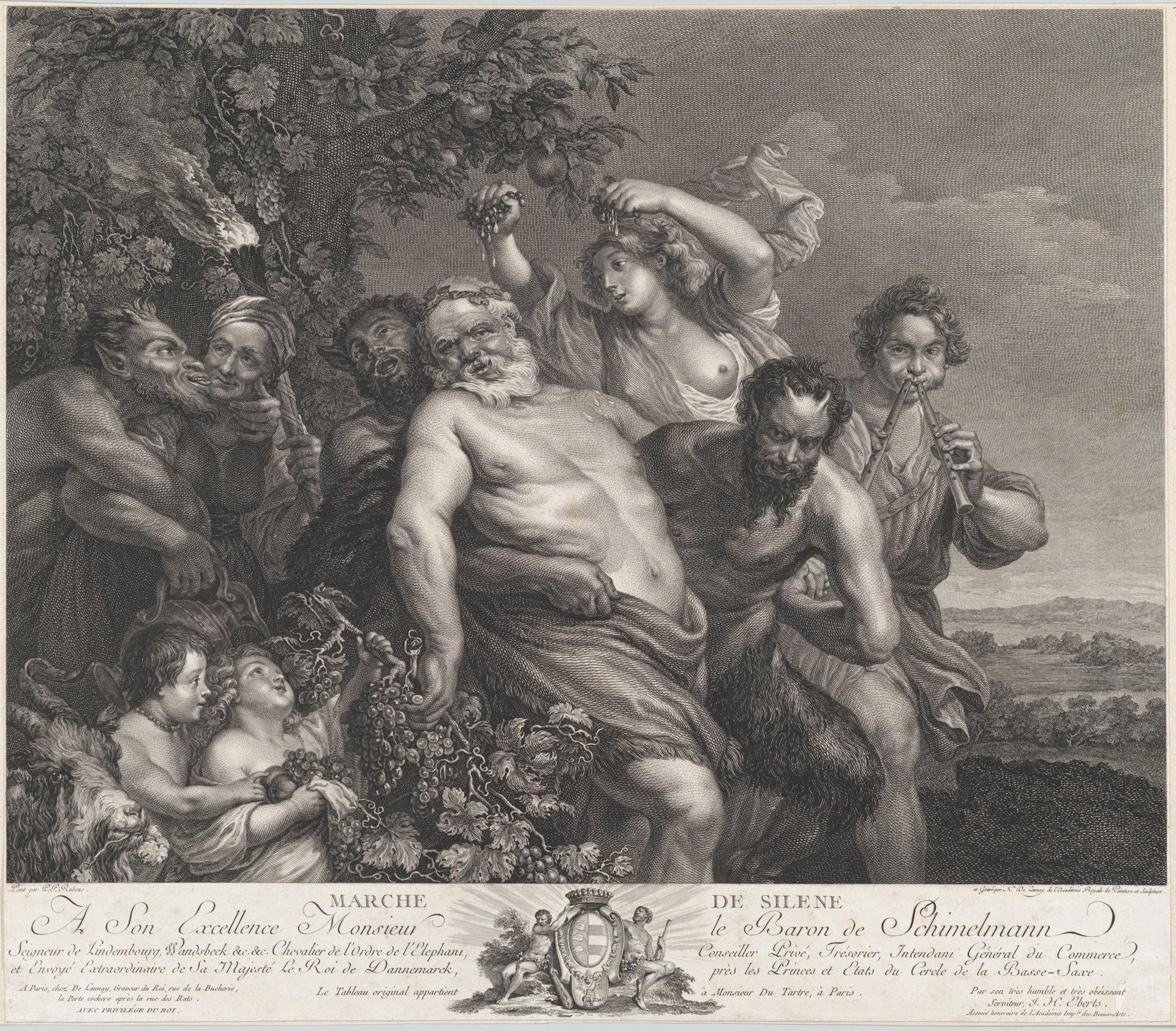
The Triumph of Silenus
Original title: The Triumph of Silenus
kurzbeschreibung
Unlike related mythological prints, this engraving by Nicolas de Launay, made between 1775 and 1778, puts the god Silenus at the heart of a boisterous circle of men and women. Music and nature run through the scene, which joins mythological storytelling with a busy, many-figured arrangement.
Description
A man wrapped in cloth, readable as Silenus, gives the image its visual anchor; several people crowd around him. One woman offers a piece of fruit, others play flutes, and the bodies are in motion, full of life. Trees and vines divide the landscape, while a suggested horizon closes it off at the back. The grey tones typical of an etching, with sharp and richly detailed lines, model skin areas and folds of clothing. Along the bottom edge sits a block of text with a coat of arms and a title, pointing to an aristocratic patron.
Context
Nicolas de Launay, an eighteenth-century French engraver, was known above all for reproductions after paintings. His print falls in the age of Neoclassicism, when mythological subjects were in demand. The coat of arms at the lower edge suggests a noble commissioner, for whom the sheet was made as a reproductive print.
Impact
The layout builds a dynamic, energetic tension, and the figures give off a high-spirited mood. The delicate linework lends the view a detailed yet elegant appearance.
Technique
This engraving is made by cutting lines into a copper plate and then printing it. The precise, sharp lines produce fine gradations and bring out details such as skin and fabric. Varying densities and directions of line create the grey tones.
AI-generated description text
Source: Metropolitan Museum of Art · Public Domain (CC0 1.0)