Bacchus and drunken Silenus
Original title: Bacchus and drunken Silenus
kurzbeschreibung
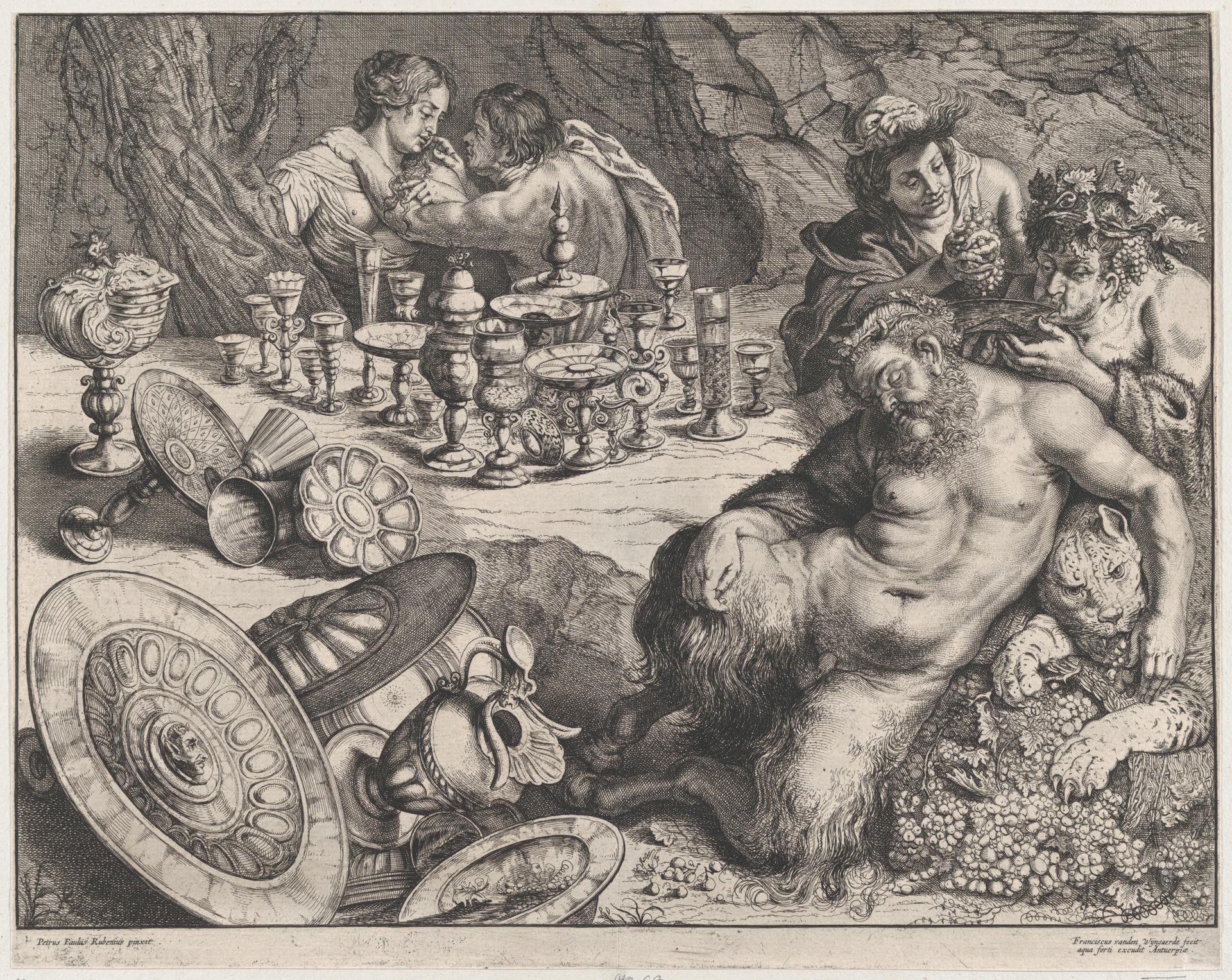
The Flemish engraver Frans van den Wyngaerde created the etching Bacchus and the Drunken Silenus between 1640 and 1660. This print presents the sleeping wine god Bacchus alongside his companion Silenus in a mythological scene. Executed in etching and engraving, it measures 34.1 × 42.8 cm.
Description
In the foreground, Bacchus lies asleep on the ground, bearded and with long, curly hair; a panther rests at his side. Plates, jugs, glasses, and other drinking vessels are scattered around the figures, pointing to a feast. Further back, additional figures sit in a landscape with trees and rocks, appearing drunk or relaxed. The layout is asymmetrical and feels natural and unposed, while the rendering is monochrome in black and white with delicate shading and contrasts.
Context
Frans van den Wyngaerde was a 17th-century Flemish artist who worked mainly as an engraver. This print was made during the Baroque era, known for dramatic scenes and mythological subjects. The motif draws on ancient mythology: Bacchus is the god of wine, Silenus his drunken companion. Such themes were highly popular in 17th-century Dutch art because they could serve allegorical and moralizing purposes.
Impact
Bacchus's calm, sleeping pose and the scattered drinking vessels give the print a relaxed yet melancholic mood. The etching's fine lines and contrasts create an intimate, almost silent atmosphere that draws the viewer into the scene. The natural setting and unforced arrangement reinforce the impression of a moment of rest after a lively celebration.
Technique
Etching and engraving are combined here, allowing for fine lines and precise details. This method enables nuanced rendering of light and shadow, as seen in the soft transitions of the shading. The black-and-white contrasts emphasize the sculptural effect of the figures and the landscape.
AI-generated description text
Source: Metropolitan Museum of Art · Public Domain (CC0 1.0)